


TL;DR:
Compliance debt is the cost and risk of a product falling short of its applicable requirements, in how it is built and what it can prove.
- Compliance debt can cost more than technical debt in two cases: an outside party sets the review date, or the review covers a period that has already passed.
- The cost of closing an architectural gap grows as more features and dependencies rely on the existing design.
- Records that were never made may be impossible to recreate reliably, even after you fix the technical gap.
- The practical response is to identify the applicable requirements and record the necessary evidence early, then prioritize remediation by risk and dependency.
Compliance debt is the accumulated cost and risk of a product falling short of the requirements that apply to it, in how it is built and in what it can prove. Those requirements can be legal or contractual, or set by an assurance framework such as SOC 2.
The debt grows when later development builds on the gaps, and it comes due when a review exposes them. Meanwhile, the balance stays quiet. Nobody files a report about a logging decision deferred in a sprint planning meeting. The statement arrives all at once, in the form of a questionnaire from a company that wants to buy your product.
Where compliance debt comes from
Technical debt usually starts with a shortcut. Compliance debt has more ways in:
- A deliberate deferral. A team ships without audit logging on admin actions to reach a launch date, and plans to add it later.
- A change of customer. The product was built for buyers who never asked for evidence. The first one who does finds the architecture has no answer.
- A change of data. A feature starts handling data with stricter rules than the system was designed for, such as health or financial records.
- A tool added without contractual cover. A vendor starts receiving personal data before anyone checks for an agreement.
- A change in the rules. The product stays the same, and the requirements move, so a system that passed last year can carry a gap now.
Only the first looks like technical debt. The other four can pass a code review untouched, which is why they surface in a buyer’s questionnaire and sprint planning never sees them.
Legacy systems carry the same balance in a more visible form, which our study of Assessing Healthcare Regulatory Compliance and Risk in Legacy Software Systems works through in detail.
Where the technical debt analogy holds
“Shipping first time code is like going into debt,” Ward Cunningham wrote in his 1992 OOPSLA experience report. His argument was that an early implementation speeds development, and that interest accrues for as long as the mismatch between the code and what the team has since learned stays in the code.
Two features of that arrangement carry over to compliance:
- A deliberate trade. Debt can be a decision, taken by people who know what they are deferring, in exchange for speed they need now. A team can defer a control deliberately when it knows which requirements apply and has compensating controls for the risk. A delivery date alone does not justify that call.
- Interest. The cost of the deferral grows with time, because subsequent work assumes the shortcut.
So far the metaphor behaves. A team can carry compliance debt deliberately and plan a repayment. Here the term works as an analytical frame that extends the metaphor, and none of the regulations mentioned in this article define it.
Where it breaks: the repayment date can belong to someone else
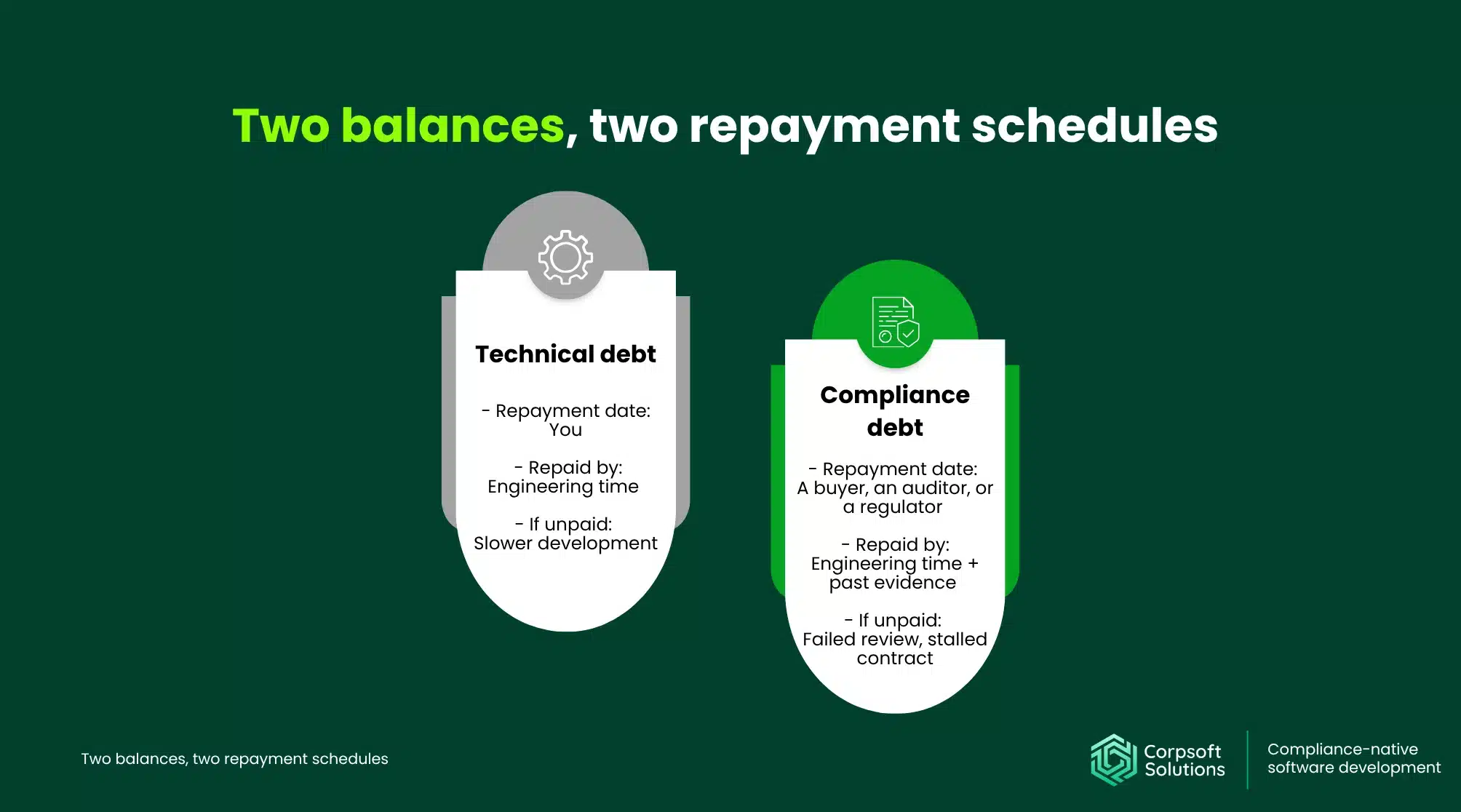
A technical debt can be repaid on the team’s calendar. The team weighs the refactor against the roadmap and can defer it if something more urgent appears. The creditor is usually the team itself, which makes the creditor unusually accommodating.
Compliance debt can have an outside creditor, and the repayment date comes with it:
- a buyer’s procurement process, which sends a security questionnaire;
- an auditor, who scopes the period under review;
- a contract, which commits the team to specific controls by a date;
- a regulator, whose requirement carries its own deadline.
None of them consult your roadmap.
Technical debt gives the team a signal: builds slow down, and small changes stop being small. A missing control often reports nothing. Removing a control removes work, so the product can ship faster and still pass its own tests. The first symptom can be a reviewer’s question.
| Technical debt | Compliance debt | |
| What is deferred | A technical fix or improvement | Closing gaps in controls, architecture or evidence |
| What raises the cost | New dependencies and code built on the shortcut | The same, plus a longer period to evidence and a growing set of requirements |
| Who sets the deadline | The team, unless an outside event intervenes | The team, a contract, a buyer, an auditor or a regulator |
| Can it be fixed later | Yes, at a price that varies | Technical gaps can be closed; records that were never made cannot be created afterwards |
Directional comparison, not a rule.
“Compounds faster” has a specific scope. It applies when an outside party sets the review date, or when the review covers a period that has already passed. Growing code raises the price in both cases. Where neither applies, compliance debt behaves like ordinary technical debt.
The gap that makes compliance debt compound
Corpsoft Solutions’ Audit to Fix Gap is the interval between identifying a compliance gap and implementing the change that closes it; the full framework is described in IT Regulatory Compliance Services: What Actually Transfers When You Outsource.
The cost of that interval depends on what gets built while it stays open: features and data structures that depend on the unresolved design.
What the interval costs
Suppose a gap report lands in March and names an access control that needs rebuilding. The engineering team has a roadmap through June.
By the time the item reaches a sprint, three months of features have been built against the current access model, and the rebuild now touches all of them. The finding did not change. The surface it applies to did.
What a longer interval reaches
Suppose the interval runs to a year and the intervening releases depend on the affected access model. Remediation then reaches every feature built on it, down to its data and its tests. Our guide to SOC 2 Type II Compliance: What Auditors Actually Expect Your System to Do shows what auditors ask a system to demonstrate.
Corpsoft Solutions’ 7-Day Risk Assessment is a technical audit of the architecture and the procedures around it. It ends with a remediation plan that shows which findings are already open.
The part that cannot be repaid retroactively
The engineering half of the balance can be repaid at any point. The price depends on what has grown around it.
What cannot be recreated
Evidence has a different constraint.
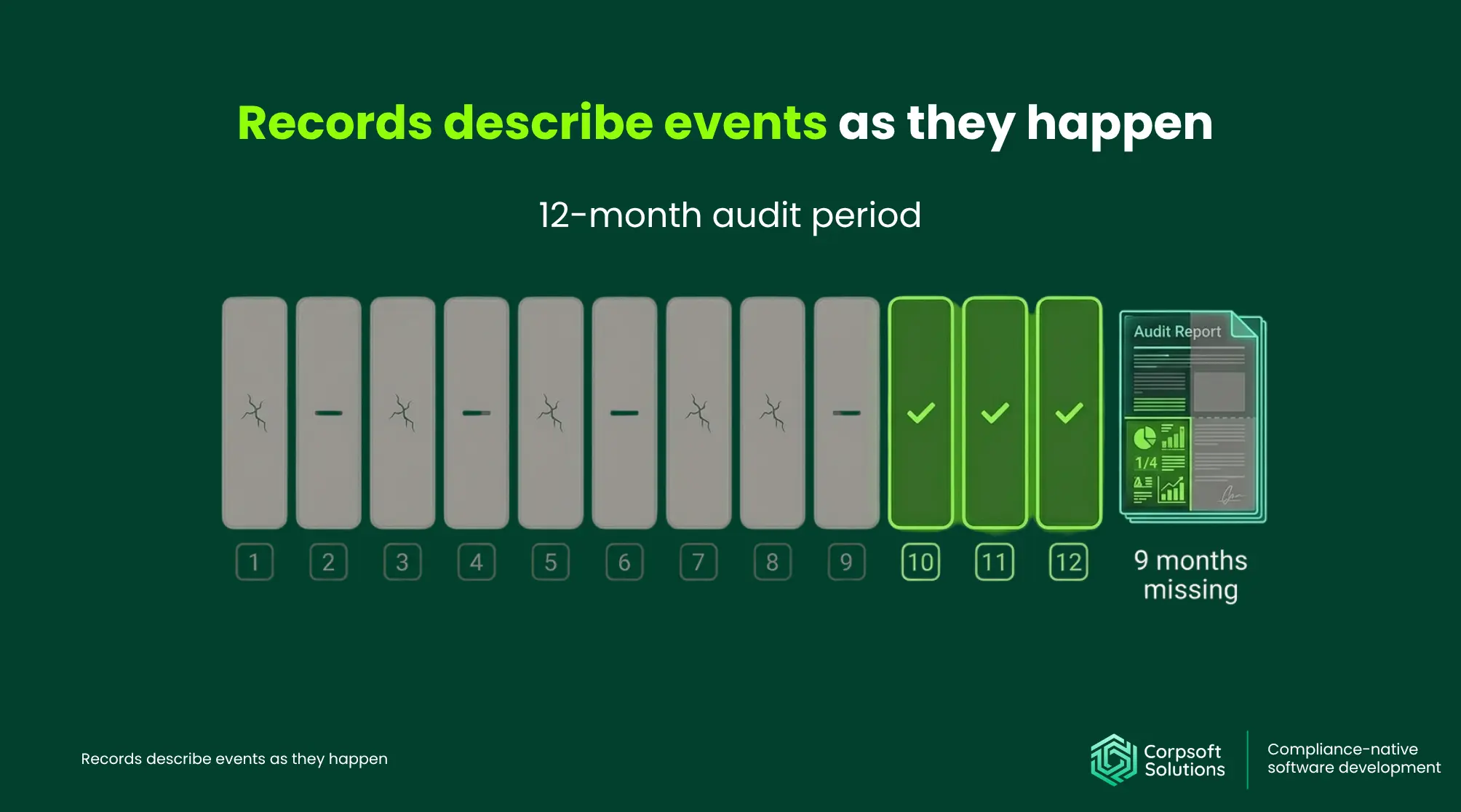
Suppose an auditor examines twelve months and asks for the access logs. A team that enabled logging in month ten produces two months of records and an explanation. The explanation is accurate and insufficient, because for the missing ten months nobody can say who opened what.
Where corroboration helps
Other systems sometimes corroborate part of the story, such as version control for changes or integration logs for transfers. A reconstruction must not be presented as the original record, and it may still fail the review.
What the evidence layer contains
For some systems, the law is explicit: Article 12 of the EU AI Act requires high-risk AI systems to technically allow for the automatic recording of events (logs) over the lifetime of the system. It applies to those systems only.
The same constraint runs across the evidence layer:
- Access records describe events as they happened. Without a log or another reliable source, the gap is permanent.
- Change history ties a modification to its approval, which version control and workflow records preserve when the process was followed.
- Where consent is the legal basis, consent records need the fact of consent and proof of what the user was shown.
- Subprocessor disclosures come as documents listing subprocessors and notifying changes, and as logs of what data flowed where.
What a usable record looks like
As a practical starting point, a record meant to hold up in a review answers three questions:
- Attributable. It names the actor, whether a person or a service account.
- Timestamped. It carries the time the event happened, and an export time proves nothing about it.
- Tamper-evident. A change to the record leaves its own trace.
The exact bar depends on the system and the criteria of the review. Logs that meet all three give a reviewer something to test. Debugging output alone gives a reviewer a conversation.
Code can be repaid. A record that was never made cannot be made later, which is why the calendar matters more here than for technical debt. The same reasoning applies to vendors inside your boundary, a subject covered in Third-Party Software Security Assessment: What to Check and Why Most Teams Skip It.
What waiting on compliance debt actually costs
Deferral is a legitimate strategy with a defined lifespan. Three events can end it, and each arrives with its own bill:
- An enterprise deal reaches security review. The buyer asks for evidence or remediation commitments, and the contract waits until the answers arrive.
- An investor starts due diligence. Unresolved security and compliance questions can call for extra documentation or technical work, and the round waits with them.
- A regulated customer prepares to onboard. Their contract and their own obligations can expose gaps in how the vendor handles data and what evidence it holds, and the engineering team comes off the roadmap to close them.
The cost of compliance before any of these events is a scoped engineering project on a schedule the team controls. Afterwards, the same work runs under a deadline set elsewhere, next to a sales process waiting for it.
The cost of non-compliance in this setting can appear before any formal penalty: in a delayed onboarding or in a buyer’s decision not to proceed.
The buyer’s side of the same decision
Our guide to building a Healthcare Learning Management System: How to Create and Scale LMS Software for Your Healthcare Organization covers one sector in detail: the questions a buyer there puts to a vendor before signing.
When compliance debt stops being repayable
Most of the balance can still be repaid late, at a higher price. Some of it cannot be repaid at all, and a missing record is only one example. Three situations run from permanent loss to expensive repair:
- Consent that was never captured. Where processing relies on consent, the organization has to be able to show that valid consent was obtained. If that evidence was never captured, later engineering can ask users again. The original decision cannot be recovered.
- Data that went to a vendor without the required arrangements. If a vendor receives personal data without the contractual arrangements, authorization or transparency measures the rules require, the organization may need to correct the arrangement or replace the vendor. Which steps apply depends on the roles involved and the obligations that govern them.
- A design the data depends on. A data model built around shared records or indefinite retention can be migrated. The migration is a project with its own risk, and its size follows the volume of data and the number of integrations.
What the system recorded and shared while the gap was open sets the line between expensive and unrepayable.
The early-stage argument
The case for acting early is strongest when a requirement touches decisions that the whole product shares:
What design time buys
| Decision | At design time | After the product has grown |
| Tenant isolation | A tenancy model in the schema and the auth layer | Every query and background job that assumed shared tables has to be found and changed |
| Access boundaries | Roles defined once and enforced in one place | Permission checks scattered across the codebase are located and reconciled one by one |
| Data retention | Retention fields and deletion jobs from the first table | Backups and analytics copies each hold their own copy of the data |
| Audit logging | An event schema and an append-only store before the first release | Every service has to start emitting events, and the history before that point does not exist |
| Data residency | Region-aware storage chosen at the start | The data and every third-party tool that touched it have to move or be replaced |
Built in from the start, those decisions are part of the normal architecture. Introduced later, they reach everything built on the old assumptions.
The tools a team brings in carry the same timing problem, which our Popular SaaS Tools That Create Third-Party Compliance Risk: A Developer’s Guide sets out in detail.
When custom development is justified
Corpsoft Solutions’ Compliance-Native Architecture engineers compliance into the design from day one, so the controls and their evidence exist in production from the first release. The practical argument for custom compliance software development is timing: the product is still small enough for the change to be cheap.
Custom compliance software becomes compliant only when the right controls are built into it. Whether it is justified depends on:
- which requirements apply;
- what infrastructure already exists;
- how much control the team needs over data flows and evidence.
What belongs in the build plan
Where the answers to those three questions point to the architecture itself, compliance software development belongs in the build plan, because artifacts then accumulate in the form a reviewer expects.
A sensible order starts with the controls that produce records, when the review will cover a past period. Documentation and policy work can follow a normal roadmap.

How to quantify compliance debt, one gap at a time
To quantify compliance debt, ask the same questions of every known gap:
- Which requirement applies, and who enforces it?
- What is the risk if the gap stays open?
- Which components depend on the affected design?
- Which historical records does the review expect, and from when?
- Which external date is already known?
- What is the next concrete step?
Suppose a product has several open gaps. The rows are illustrative and do not describe a client.
| Gap | Requirement and who checks it | What depends on it | Next step |
| Admin actions are not logged | A SOC 2 criterion within the audit scope, checked by an auditor | Admin console and user management | Define the event schema and start recording now |
| Customer data is kept indefinitely | Contract retention terms, checked by the buyer | Primary database, backups and analytics exports | Add retention fields and a deletion job, then inventory the copies |
| An analytics vendor receives user identifiers | A data processing agreement, checked by the buyer | Frontend tracking and the event pipeline | Confirm the agreement exists or stop sending the identifiers |
The table is a debt statement, and the answers behind it give a repayment schedule that follows the product’s own obligations, since no universal timetable exists.
Related questions worth exploring
Does this apply to AI features specifically? Regulated AI work accrues the same balance on a shorter fuse, since the review can arrive with the first enterprise pilot. AI Regulatory Compliance: Where Most Pilots Get Stuck — and How to Prevent Failure traces where those pilots stall.
How do we tell compliance debt from ordinary product backlog? A useful test is who would notice the item is missing: users notice a missing feature, a reviewer notices a missing control.
Sources and verification
Two external claims appear in this article, each linked at the point it is made. Cost figures and industry percentages are absent, since no verifiable source was available.
- Origin of the debt metaphor for software: Ward Cunningham, OOPSLA 1992 experience report, c2.com/doc/oopsla92.html
- Logging requirement for high-risk AI systems: Article 12, Regulation (EU) 2024/1689, AI Act Service Desk, European Commission
Share this post: