


TL;DR:
Third-party software security assessment is a familiar idea and a rare practice — most technical leads know they should run one, but far fewer have made it happen consistently, without someone having to remember.
Teams skip the assessment for three specific reasons, not vague ones: no time, no owner, and false comfort from a vendor’s SOC 2 badge.
- A checklist of questions about one vendor isn’t the same as a process — the questions change by vendor, but a real process runs the same way every time, regardless of which vendor triggered it.
- Four elements separate a process from a checklist: what triggers it, who owns it, how often it repeats, and what counts as evidence it happened.
- Not every vendor needs the same depth of review. The right question is how much access a vendor has, regardless of how well-known it is.
- The first cost of skipping the process is usually a due-diligence question nobody can answer on the spot, long before a regulator is involved.
- Corpsoft Solutions calls the architecture behind this Compliance-Native Architecture: the system triggers the assessment on its own, so no one has to remember to run it.
Why technical leads skip vendor security assessment
A third-party vendor rarely becomes a security problem the day you approve it. It becomes one later — when nobody can remember why it was approved, what it could reach, or whether any of that is still true.
That’s the uncomfortable part of a third-party software security assessment: knowing what to ask a vendor is the easy half. Making sure anyone asks at all is the half that fails.
A technical lead usually knows a vendor should be assessed before it reaches production. What’s usually missing is anything that makes the assessment happen without someone choosing to do it that day. The result is a familiar pattern: the checklist exists, the policy exists, and the new vendor still gets connected on a Friday afternoon because the product team needs it live by Monday.
Three things get in the way, and none of them is a lack of awareness.
- Time. A vendor evaluation competes for attention with a shipping deadline, and the deadline almost always wins, because nothing forces the evaluation to happen before the integration goes live.
- Ownership. Security assessment sits in the gap between roles, and a task that belongs to everyone gets done by no one.
- False comfort. The vendor has SOC 2, so the question gets treated as answered.
SOC 2 is useful evidence. It isn’t a compliance amulet. The badge answers one question — is this vendor’s own environment controlled? A second question sits behind it: what happens to our data now that we’ve connected to them? A report scoped to the vendor’s system doesn’t automatically cover that.
Each of these is fixable on its own. Fixed together, they stop being separate problems and become one missing piece: a process that runs independent of who remembers what this quarter.
What a real security assessment actually checks
A security assessment, done properly, answers one question with evidence: what can this vendor reach, and what happens if it’s compromised or changes how it processes your data.
Our guide Popular SaaS Tools That Create Third-Party Compliance Risk walks through that question for specific tools — SendGrid, Shopify, Segment, and others already common in most stacks — with a six-question checklist for evaluating any one of them before you integrate it. Those are the right questions to ask about a single vendor. This article is about what’s underneath them: what makes those questions get asked in the first place, for every vendor, without someone remembering to bring the list out.
A software compliance audit asks for evidence that controls and processes exist. A vendor security assessment is meant to inform the decision before the integration goes live, while there’s still time to choose a different vendor or negotiate a different contract term.
A vendor due diligence checklist is the artifact this produces for one vendor at one point in time. It’s necessary. It’s also the easy part — the part that breaks first is upstream of any checklist: whether anyone knew to fill one out.
The methodology: Trigger, Owner, Cadence, Evidence
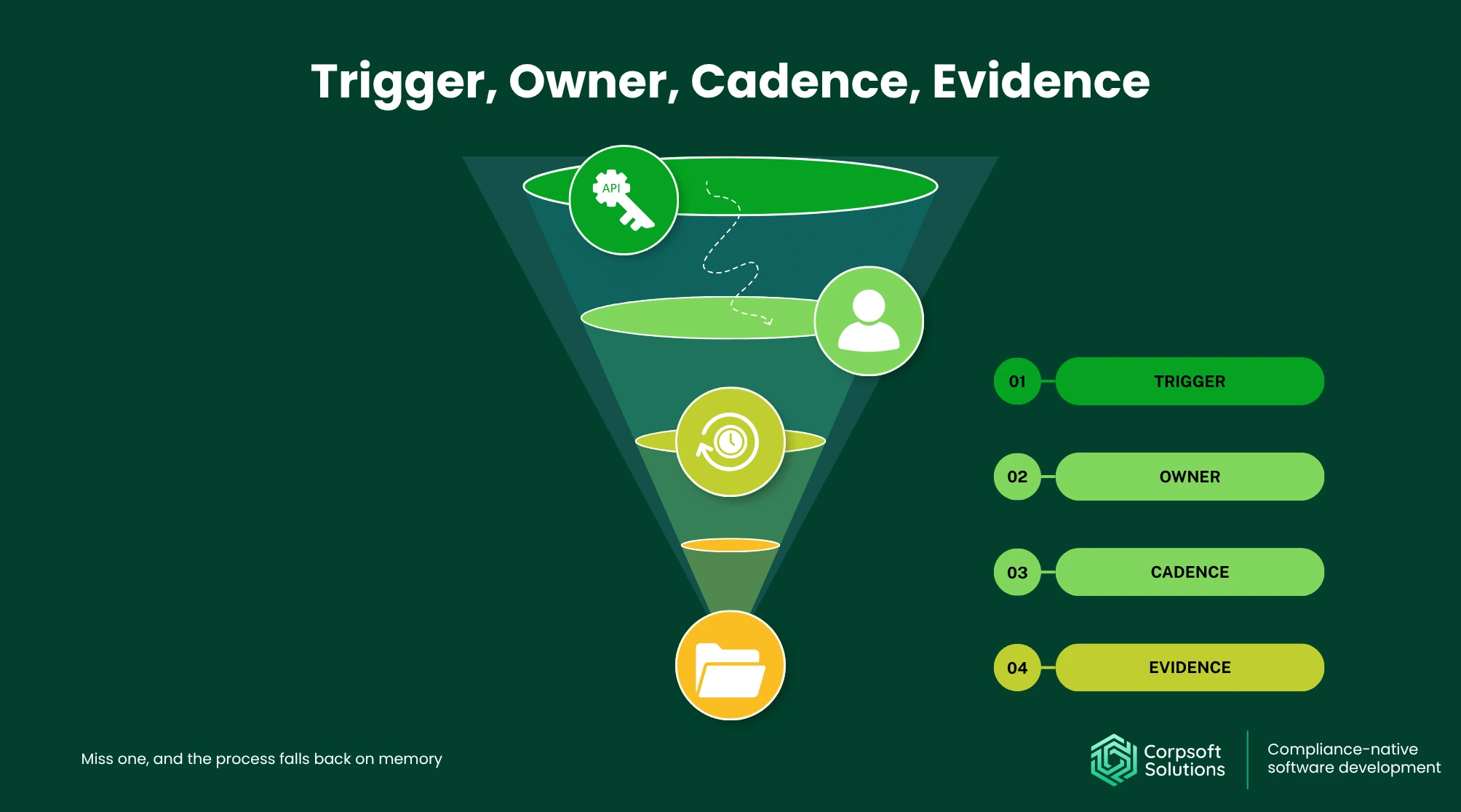
A repeatable assessment process rests on four elements, defined once and then applied consistently to every vendor, according to that vendor’s risk tier. An informal version of one or two of these usually already exists somewhere. Having all four written down, in a place a new hire could find them, is rarer.
A useful shift is to stop treating vendor assessment as a questionnaire and start treating it as a control loop.
| Element | What It Decides | What Breaks Without It |
| Trigger | The specific moment a vendor enters the assessment process | Vendors get added to the stack quietly, and the assessment only happens if someone happens to remember |
| Owner | Who is accountable for running the assessment and recording the decision | The task has no single accountable person, so it competes with everyone’s other priorities and usually loses |
| Cadence | How often an already-approved vendor gets checked again | A vendor approved two years ago stays treated as approved, even after it changed its subprocessors, its pricing tier, or its own security posture |
| Evidence | What gets recorded to prove the assessment happened, and what decision came out of it | The only proof is someone’s memory of a conversation, which doesn’t survive a due-diligence request or a departed employee |
Miss any one of the four, and the process falls back on memory. Memory is a poor control mechanism.
Trigger
The trigger is the specific event that starts an assessment, and for most teams, no such event exists — a vendor gets added the same way a library gets added, through a pull request nobody flags as different.
Corpsoft Solutions calls the alternative Compliance-Native Architecture: the trigger lives in the system itself, not in a person’s judgment call. A new dependency in the manifest, a new API key requested, a new OAuth scope granted — any of these can be wired to block a merge until someone records an assessment decision. The trigger stops being a matter of remembering and becomes a property of how the pipeline works.
Owner
An owner is one named person or role accountable for a specific vendor’s assessment: “the engineer who added the integration, reviewed by a named second person” qualifies, and a policy line pointing at the security team does not.
This matters more than it sounds like it should. Security work has an unusual failure mode: nothing breaks immediately. The integration works, the deployment succeeds, and nobody notices that the assessment never happened. Ambiguous ownership fails quietly, by default, without anyone deciding it should. If everyone owns the assessment, nobody does. “Security team” is a department. An accountable owner is a name.
Cadence
Cadence is how often an approved vendor gets reassessed, on a risk-based interval set in advance instead of decided in the moment: an annual review as a practical baseline, with shorter or event-driven reassessment for higher-risk vendors.
A vendor’s risk profile isn’t fixed at the moment of approval. Subprocessors change. A change in pricing or product tier can also change the data flows or contractual terms that apply to your integration. A vendor can be acquired, which may change its ownership, governance, infrastructure, or security practices. None of this shows up unless something is scheduled to look for it.
Evidence
Evidence is the record that an assessment happened, who made the decision, and what the decision was — kept somewhere a due-diligence request can actually find it, months or years later.
This is where a checklist and a process diverge most clearly. A checklist produces answers about a vendor. A process produces a paper trail about itself:
- The date the assessment happened
- Who made the decision
- What the decision was
- The specific version of the vendor’s terms it was based on
The second kind of record is what a buyer’s security team or a regulator actually wants to see, because it proves the assessment ran, not just that someone once knew the answers.
This risk-based approach lines up with NIST’s supply-chain guidance: SP 800-161 Rev. 1 treats supplier risk management as a continuous activity carried across the whole supplier relationship, which is what a cadence and an evidence trail produce together.
Does every vendor need the same depth of review?
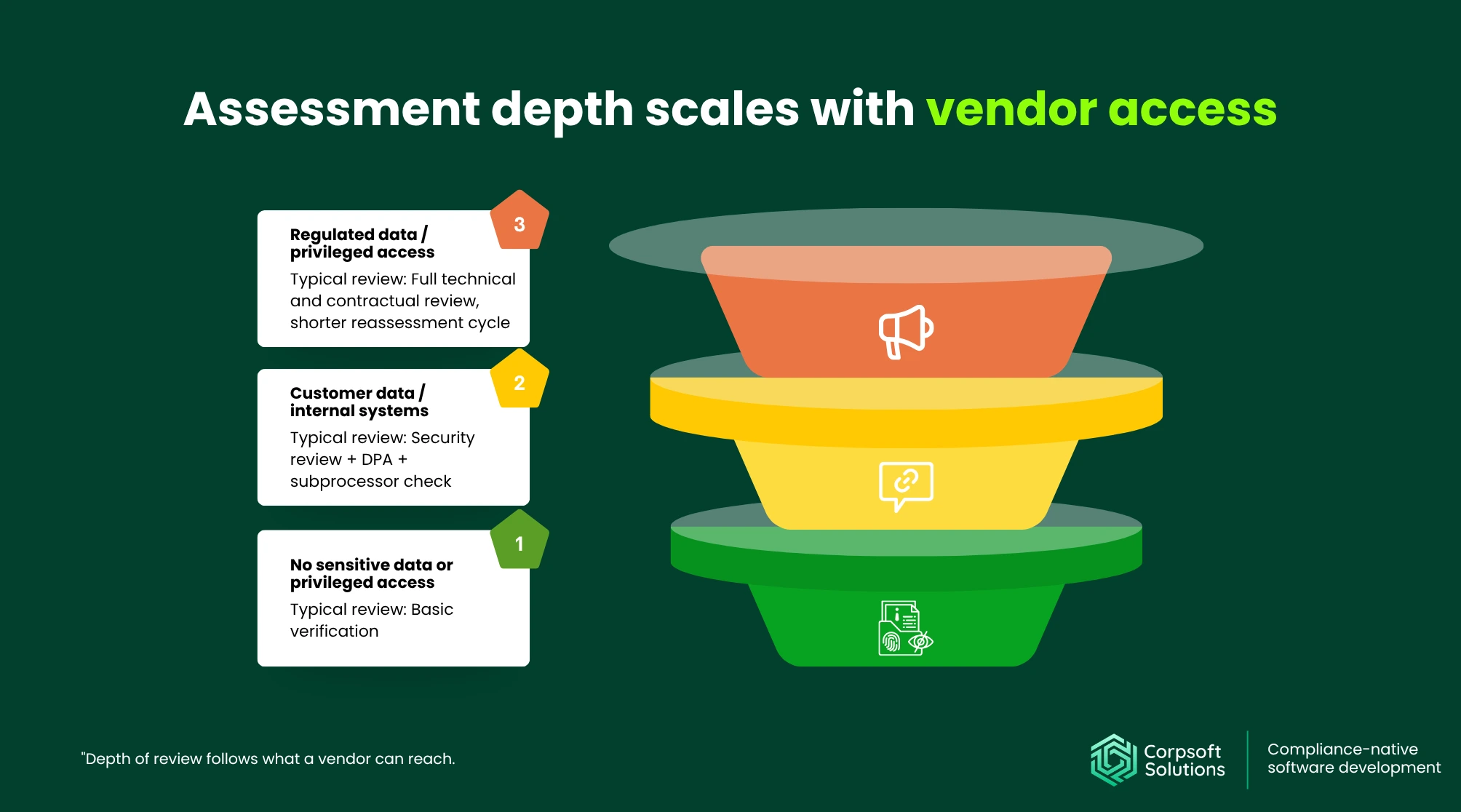
The right depth of review scales with what a vendor can reach: how much data, which systems, and under whose control once the integration goes live — regardless of how well-known the vendor’s name is.
This is vendor risk tiering: sorting vendors by what they can access, then matching the depth of assessment to that tier. A vendor with no path to customer data gets a lighter review than one that touches regulated records directly.
A vendor at the high end of that scale typically needs:
- A DPA, a BAA, or other contractual data-protection terms, depending on the data involved and which requirements apply
- A documented list of its subprocessors
- Confirmation of where data is actually processed and stored
Popular SaaS Tools That Create Third-Party Compliance Risk covers exactly this kind of product-level detail for specific named tools. A vendor at the low end — one that never touches customer data — needs a lighter check: confirmation of that boundary, and nothing more elaborate.
| Vendor access or exposure | Typical review |
| No sensitive data or privileged access | Basic verification |
| Customer data / internal systems | Security review + DPA + subprocessor check |
| Regulated data / privileged access | Full technical and contractual review, shorter reassessment cycle |
Tiering also determines cadence. A high-tier vendor gets reassessed more often than a low-tier one, because the cost of missing a change is higher.
What skipping the process actually costs
The immediate cost of skipping this process often doesn’t show up as a fine. What arrives first is a due-diligence question nobody in the room can answer, at the exact moment answering well would have mattered most.
A buyer’s security team asks which vendors touch their data before signing an enterprise contract. A regulator may ask how third-party risks were assessed and managed, especially after an incident. Both want the same kind of proof: that a process ran, at a specific time, for a specific vendor.
Reconstructing a paper trail after the fact is slower, less reliable, and harder to defend than having the record created when the decision was made.
The commercial cost is rarely dramatic enough to make the news. That’s exactly why it survives — one more question, one more week of review, one more reason for procurement to wait.
Is your vendor assessment a real process, or a memory?
A security process is real only if it survives the person who built it leaving the company. If it disappears the day that engineer leaves, it was never a process — it was institutional memory with a login.
Four questions test whether the process actually exists, independent of any single vendor:
- Is there a specific event that starts an assessment, or does a vendor only get reviewed if someone happens to notice it?
- Is there one named person accountable for each vendor’s assessment, or does the task belong to a team in theory and no one in practice?
- Is there a set interval for re-checking an approved vendor, or does approval quietly become permanent?
- Is there a written record of the decision and the date, or does the answer live in someone’s memory of a conversation?
A team that can’t answer all four with confidence has a process gap — and the gap is usually easier to fix once you can see exactly where it occurs.

If those four answers aren’t clear, the next useful step isn’t another vendor questionnaire. It’s finding out exactly where the process currently breaks.
Related questions worth exploring
Looking for the specific questions to ask about a vendor you’re integrating right now? Popular SaaS Tools That Create Third-Party Compliance Risk covers that ground tool by tool, including SendGrid, Shopify, Segment, and others already common in most stacks.
Wondering how this connects to a buyer’s own security review of you? SOC 2 Type II Compliance: What Auditors Actually Expect Your System to Do covers what an auditor checks on your side of the relationship — the mirror image of the vendor assessment covered here.
Building the data-handling side of this from scratch? GDPR-Compliant Software: Regulation Requirements and How to Ensure Them covers the regulation that usually drives the DPA question in the first place.
Share this post: