



TL;DR:
Third-party vendors are usually where vendor compliance risk hides, not your own codebase — and it depends on the specific data flow, not the vendor’s reputation.
- Compliance exposure can extend well beyond your own codebase to the vendors and external services your application integrates, often without a documented compliance check before integration.
- A missing BAA doesn’t automatically mean a vendor is “non-compliant” — it means you need to determine whether that vendor is even acting as a business associate for your use case.
- The same vendor can be low risk for one integration and high risk for another, depending on the data flowing through it.
- We checked SendGrid, Shopify, Segment, OpenAI API, and Twilio against their own official documentation as of this article’s research date.
- Handling third-party compliance risk yourself, hiring an auditor, hiring a consultant, and building it into your architecture from day one are four different approaches with different tradeoffs — not interchangeable options.
Why isn’t your tech stack usually the compliance risk?
Most engineering teams building for HIPAA, GDPR, or a SOC 2 audit spend their review time on their own code: access controls, encryption, logging. Those controls are necessary, but they are only part of the compliance boundary. What gets missed is everything the application talks to outside its own boundary — the email service that sends password resets, the analytics pipeline that captures user events, the AI API that processes support tickets.
Each of those is a separate legal relationship with its own compliance posture, and that posture doesn’t automatically align with yours. A vendor can be SOC 2 Type II certified and still be the wrong choice for a specific data flow, because certification tells you about the vendor’s internal controls — not about whether they’ll take on the specific regulatory obligations your use case requires.
What actually makes a third-party vendor a compliance risk?
Vendor risks aren’t all the same — whether a given vendor creates compliance risk for you comes down to four things, not one label:
- What data reaches the vendor. A support tool that only sees ticket subject lines is a different risk than one that sees full patient messages.
- Which regulations apply. HIPAA, GDPR, and CCPA don’t all trigger from the same data, and they don’t all require the same contractual mechanism.
- What the vendor contractually accepts. A privacy policy does not serve the same contractual role as a BAA or DPA (Data Processing Addendum). Where a BAA or DPA is required, verify that the appropriate agreement is actually in place.
- Whether you can control, restrict, or replace the data flow. A vendor you can configure to exclude sensitive fields carries different risk than one that ingests everything by default.
The same vendor can create different levels of risk. A vendor isn’t compliant or non-compliant as a fixed property — exposure depends on what data you actually send it, why you’re sending it, what contractual protections cover that specific flow, and how much control you retain over it. The same email API can be low-risk for marketing newsletters and high-risk the moment a password-reset email includes a patient’s name and diagnosis code.
When does a missing BAA create compliance exposure?
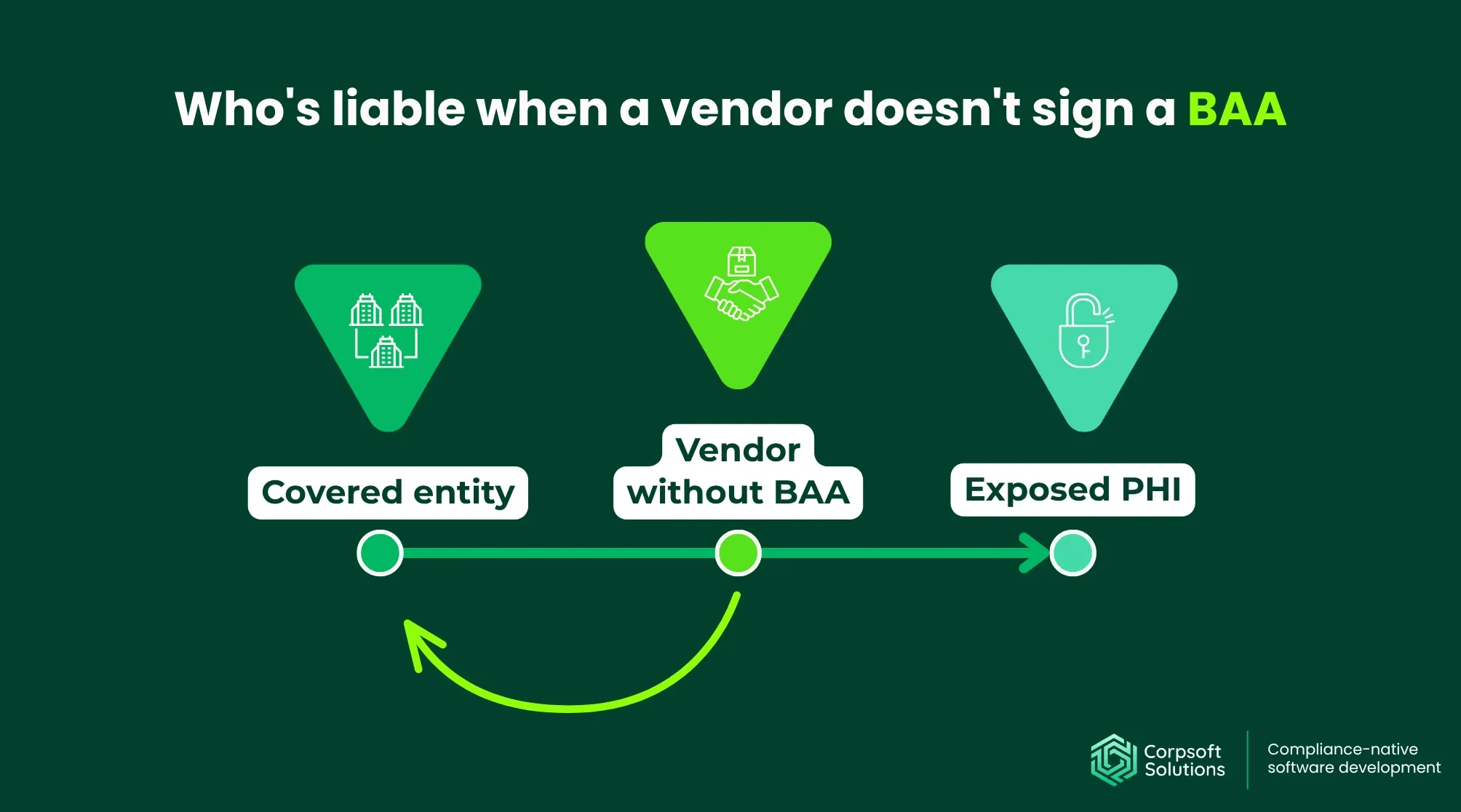
If a vendor handles Protected Health Information (PHI) on your behalf, the absence of a required Business Associate Agreement (BAA) can create a serious third-party HIPAA compliance gap. A vendor may be a business associate when it creates, receives, maintains, or transmits PHI on behalf of a covered entity or business associate. Whether that relationship exists depends on the services the vendor provides and how the data is handled. A vendor that does not handle PHI on behalf of a covered entity may not require a BAA for that integration. If the vendor does handle PHI on behalf of a covered entity or business associate, determine whether the relationship requires a BAA before the data flow goes live.
This is also where a common assumption breaks down: signing a vendor’s terms of service, or even a DPA, doesn’t mean the vendor has assumed liability for every regulatory outcome. A vendor agreement does not automatically eliminate the obligations that remain with your organization before integrating a third party — those responsibilities depend on the applicable regulation, the roles of the parties, and the specific data flow.
For teams building HIPAA-compliant products, this distinction matters at the architecture stage, not just the legal-review stage — a project we worked on recently, a HIPAA-compliant telehealth platform, had to make exactly this call for every vendor in its stack before any PHI touched them.
How we evaluated these vendors
Selection criteria: this is a third-party vendor compliance review, so we chose SendGrid, Shopify, Segment, OpenAI API, and Twilio because they represent recognizable categories in modern developer stacks: transactional email, commerce, customer data, AI APIs, and communications — not because any of them is unusually risky. This is a representative sample, not an exhaustive list of SaaS vendors.
Sources & methodology: vendor-specific findings are based on the vendor’s official documentation, including applicable DPA/BAA, privacy, security, and data-processing materials reviewed during the research period. OpenAI API’s BAA, HIPAA-eligibility, and DPA documentation were reviewed manually after automated verification was blocked by the source’s access controls.
Research last updated: August 2026. We evaluated the documentation available at the time of research; this is a point-in-time assessment, not a permanent certification of a vendor’s compliance posture.
How we classified risk: “Potential compliance risk” in the table below reflects four factors:
- what data the vendor can handle in a standard integration,
- whether a BAA or equivalent contractual coverage exists for that data,
- what the vendor’s own documentation says about GDPR/DPA coverage,
- and how much the risk depends on configuration choices you make.
Configuration-dependent means the risk level isn’t fixed — it changes materially based on which plan tier, which specific product, or which settings you use. Segment, Twilio, and OpenAI API all fall into this category: coverage exists for each, but only under specific conditions you have to actively confirm — plan tier for Segment, product eligibility for Twilio, and provisioned retention settings for OpenAI API.
This is a narrow, vendor-specific view — not a substitute for a full enterprise risk assessment. Risk levels are directional, not regulatory ratings — “High” indicates that a particular data flow creates materially greater compliance exposure under the conditions described, not that the vendor itself is non-compliant.
Vendor policies and product capabilities can change — verify current documentation before making decisions. Treat this table as a starting point for ongoing third-party compliance risk management, not a one-time check.
Disclaimer: This assessment focuses on vendor-level compliance exposure and does not constitute a legal determination that a vendor is compliant or non-compliant for every use case.
Which popular developer tools can create compliance risk?
| Vendor | Typical use | Potential sensitive data exposure | BAA availability/applicability | GDPR considerations | Potential compliance risk |
|---|---|---|---|---|---|
| SendGrid | Transactional and marketing email | Can include email content and recipient PII (Personally Identifiable Information) | Not available — Twilio does not sign a BAA for SendGrid | Covered by Twilio’s standard DPA | High if PHI enters email content; lower exposure for standard transactional/marketing use |
| Shopify | E-commerce storefront and checkout | Can include customer PII and payment data | Not offered; Shopify’s Acceptable Use Policy separately prohibits uploading PHI | Dedicated DPA; merchant is controller, Shopify is processor | High for PHI use cases; lower exposure for standard commerce data |
| Segment | Customer data pipeline / analytics | Can include event and trait data, potentially PHI | Available on Business Tier only, per-product eligibility, requires workspace HIPAA confirmation | Dedicated DPA/SCCs (Standard Contractual Clauses) | Configuration-dependent |
| OpenAI API | AI text/data processing | Can include prompt and response content | Available on request (case-by-case) for accounts provisioned with Modified Retention; covers a defined set of API endpoints, not the full platform by default | DPA available for API/business accounts (GDPR Article 28 processor terms, SCCs for international transfers); not offered for consumer ChatGPT accounts | Configuration-dependent |
| Twilio (core: SMS/Voice/Video) | Communications | Can include message and call content and recipient PII | Available for products on Twilio’s specific HIPAA-eligible list — confirm per product, not per account | Twilio DPA applies; verify terms for the specific service | Configuration-dependent |
Key takeaway: A vendor’s compliance posture is often determined at the product, plan, and configuration level — not at the company level. Verify the exact service and data flow you plan to use.
How do you evaluate a vendor before you integrate it?
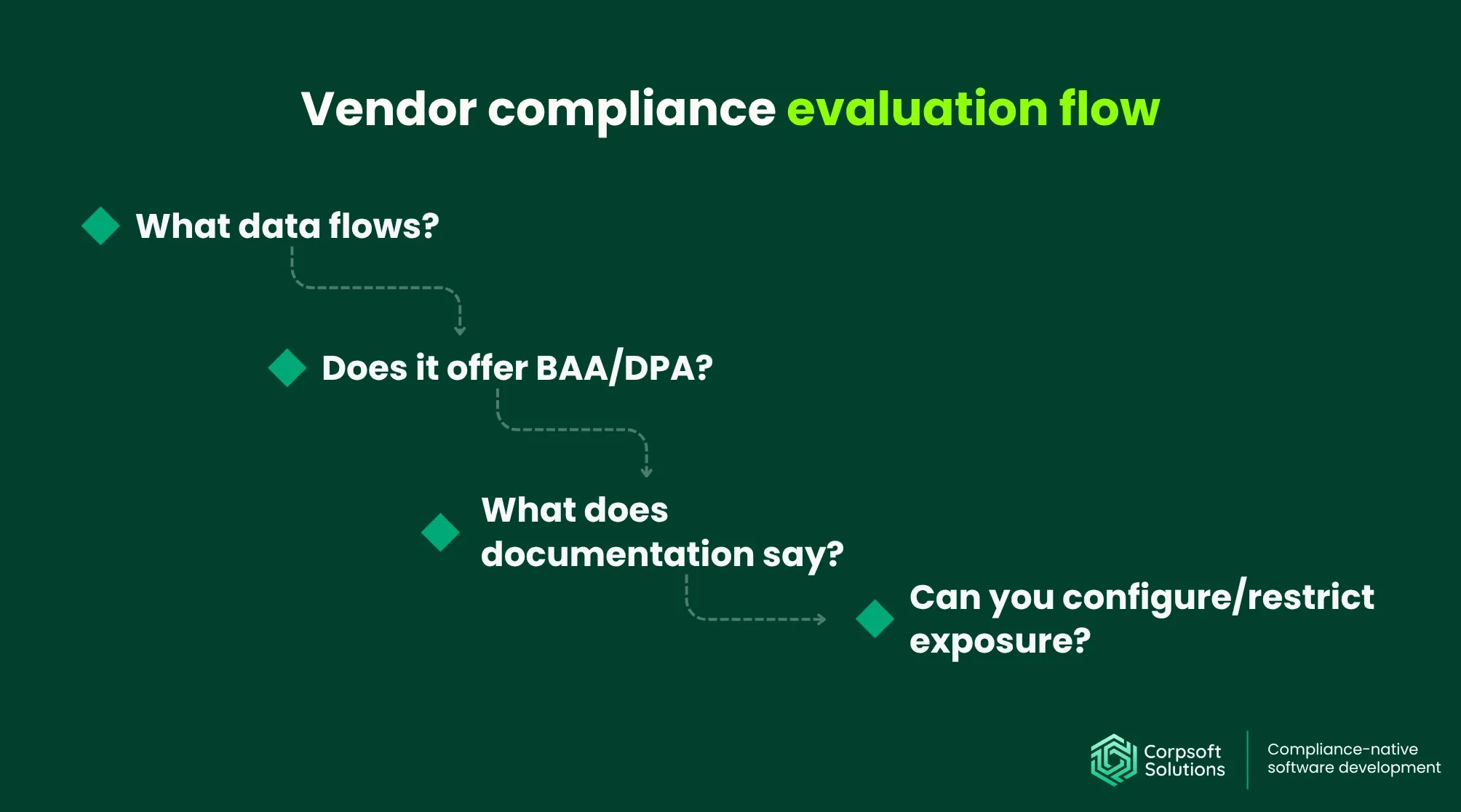
This is fundamentally a question of third-party risk compliance: whether the vendor’s practices match what your regulatory obligations actually require. Before adding a new vendor to a system that touches regulated data, this vendor due diligence checklist covers what matters most:
- What data will actually flow to this vendor — not what the integration is capable of sending, but what it will send in your specific implementation.
- Does the vendor offer a BAA, DPA, or equivalent for the product you’re using — check the specific product, not the vendor’s brand name. As the table above shows, a vendor can offer a BAA for one product and not another.
- What does the vendor’s own documentation say, not a third-party summary of it. Aggregator sites and blog posts about vendor compliance are frequently outdated or make product-specific claims stated as vendor-wide facts.
- Can you configure the integration to reduce what the vendor sees — field-level exclusions, data minimization, or routing sensitive data through a different path entirely?
- What happens to the data after processing? — retention period, deletion policy, logging, and any subprocessors the vendor uses.
- What happens if the vendor changes its terms or product? — plan changes, feature changes, new subprocessors, or changes to compliance eligibility can all shift a vendor from covered to uncovered without you changing anything on your side.
The questions stay mostly the same even when the vendor and the answers change.
Who should handle third-party compliance risk?
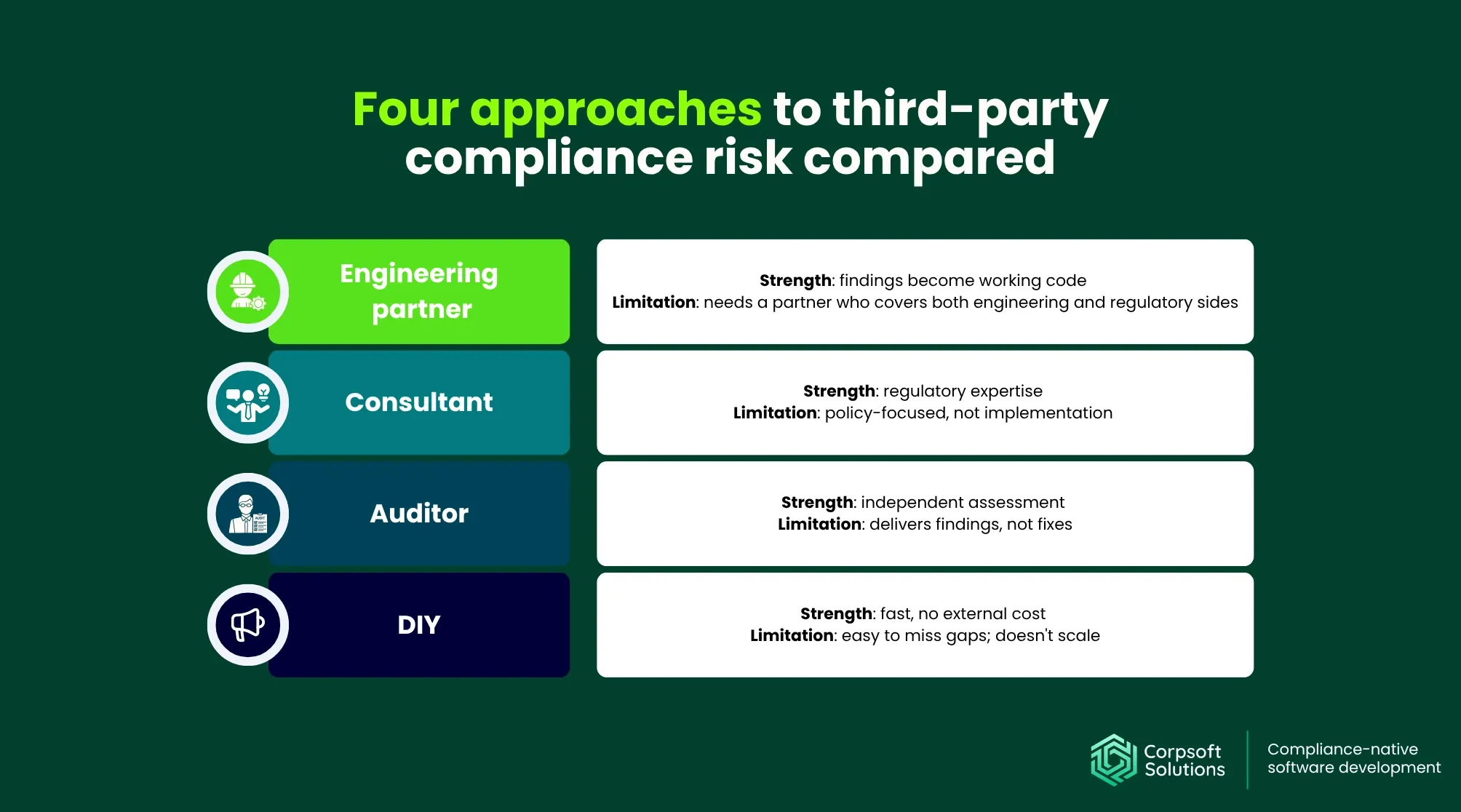
Vendor compliance management isn’t a single task — it can sit with different owners depending on how deep the work needs to go.
| Approach | Best when | Strength |
Limitation |
| DIY (in-house review) | Stack is small, team already understands the relevant regulations | Fast, no external cost, full context on your own data flows | Easy to miss product-specific BAA/DPA gaps; doesn’t scale as vendor count grows |
| Auditor | You need a point-in-time compliance status confirmation | Independent assessment, useful for external stakeholders | Typically focuses on assessment and evidence rather than ongoing software implementation |
| Consultant | You need a compliance framework and documentation | Brings regulatory expertise you may not have in-house | May focus more heavily on governance, policy, and documentation than implementation |
| Engineering partner | Compliance requirements need to be built into the architecture itself, not layered on after | Findings become working code and configuration, not just a report | Requires a partner who understands both engineering and the regulatory side |
This is where an engineering-led compliance approach differs: vendor risk can be addressed as part of architecture, integration, and implementation rather than treated only as a policy-review exercise. Corpsoft Solutions calls this approach Compliance-Native Architecture.
What should you do when you find a compliance risk in your vendor stack?
Finding a compliance risk isn’t the end of the process. The next step depends on scope: a single misconfigured field can often be fixed by restricting what data reaches the vendor; a vendor that structurally can’t support your requirements needs to be replaced or worked around at the architecture level.
Remove — cut the vendor from the flow entirely if it can’t support the requirement. Replace — swap in a vendor with adequate contractual coverage. Restrict — reduce what data reaches the vendor so the requirement no longer applies. Remediate — put the missing agreement or control in place before the integration goes live.
If your vendor stack is large enough that this kind of review needs to happen regularly, that’s usually the point to bring in outside help. Our guide to compliance consulting options covers the main third-party compliance companies and consulting firms worth evaluating, and how they compare to handling it in-house.

This kind of review works best as an ongoing third-party compliance management practice, not a one-time audit — vendor terms change, and a vendor compliance checklist from last year may already be outdated. Teams that treat this as a running third-party compliance program, revisited on a schedule, catch changes before they turn into gaps.
Share this post: