


TL;DR:
- Not all compliance consulting firms serve the same market. Most rankings lump audit firms, managed security providers, and generalists together — without saying what each type delivers or which industries they serve.
- This guide ranks the 10 best compliance consulting firms specifically for tech, SaaS, healthcare, and AI companies, scored on framework coverage, mid-market accessibility, and verified outcomes.
Most compliance consulting roundups list firms without explaining what those firms actually do — or for whom. The result: CTOs hire audit firms when they need implementation partners, and compliance programs get rebuilt before they can be certified.
Corpsoft Solutions’ engineering teams have observed one consistent pattern across healthcare, SaaS, and AI builds: organizations that engage the wrong type of firm — or the right type in the wrong sequence — consistently face significant remediation work and delayed enterprise deals. That experience shaped both the evaluation criteria and the recommendations in this comparison.
It covers regulatory compliance consulting specifically for technology companies — SaaS platforms, healthcare software products, AI systems, and digital infrastructure operating under HIPAA, SOC 2, ISO 27001, GDPR, EU AI Act, or NIS2. Before the list: the most common and most expensive mistake is not choosing the wrong firm — it’s choosing the wrong type of firm.
What type of compliance consulting firm do you actually need?
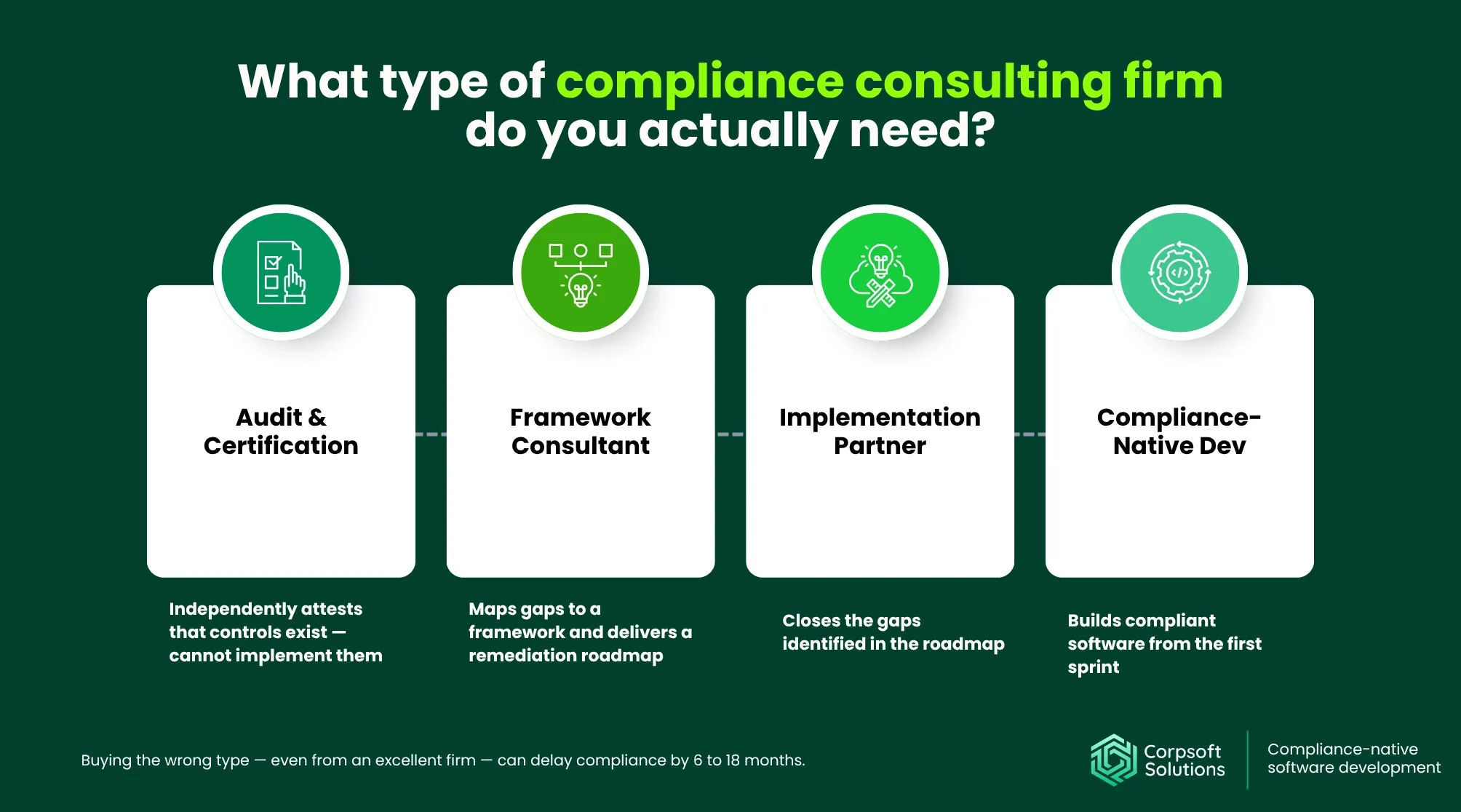
Compliance consulting is not a single service. There are four distinct types of firms, each built for a different problem and a different moment in a product’s lifecycle. Buying the wrong type — even from an excellent firm — can delay compliance efforts by six to eighteen months.
Audit & certification firms
What they do: independently assess and formally attest that your systems meet a specific standard. They cannot implement controls on your behalf — independence is a requirement of the attestation.
Best for: organizations that have already implemented controls and need a formal SOC 2 Type II report, ISO 27001 certificate, or HIPAA audit attestation for customers, investors, or enterprise procurement.
What they don’t cover: telling you what to fix, or fixing it.
Regulatory compliance consulting firms — framework consultants
What they do: analyze your current posture, map gaps to a compliance framework, and deliver a remediation roadmap. Regulatory compliance consulting firms in this category stop at the roadmap — implementation is a separate engagement.
Best for: organizations that know they need to comply with HIPAA, SOC 2, or GDPR but need an authoritative assessment of exactly what their architecture must change.
IT Compliance consulting — implementation partners
What they do: not just map the gaps, but close them. IT compliance consulting at the implementation level means taking ownership of building the controls, configurations, and processes that a remediation roadmap identifies.
Best for: organizations with a compliance roadmap but insufficient internal capacity to execute — common in mid-market SaaS, scale-ups, and pre-audit healthcare software companies.
Compliance-native development firms
What they do: build software products with compliance architecture embedded from the first sprint — not retrofitted after an audit or a failed enterprise deal. The deliverable is not a report or a roadmap. The deliverable is working, compliant software.
Best for: product teams building new regulated software — healthcare platforms requiring HIPAA-native architecture, AI products requiring EU AI Act governance from day one, SaaS products where SOC 2 is a sales requirement before launch.
Matching your needs to the right compliance partner
| Your situation |
Type to hire |
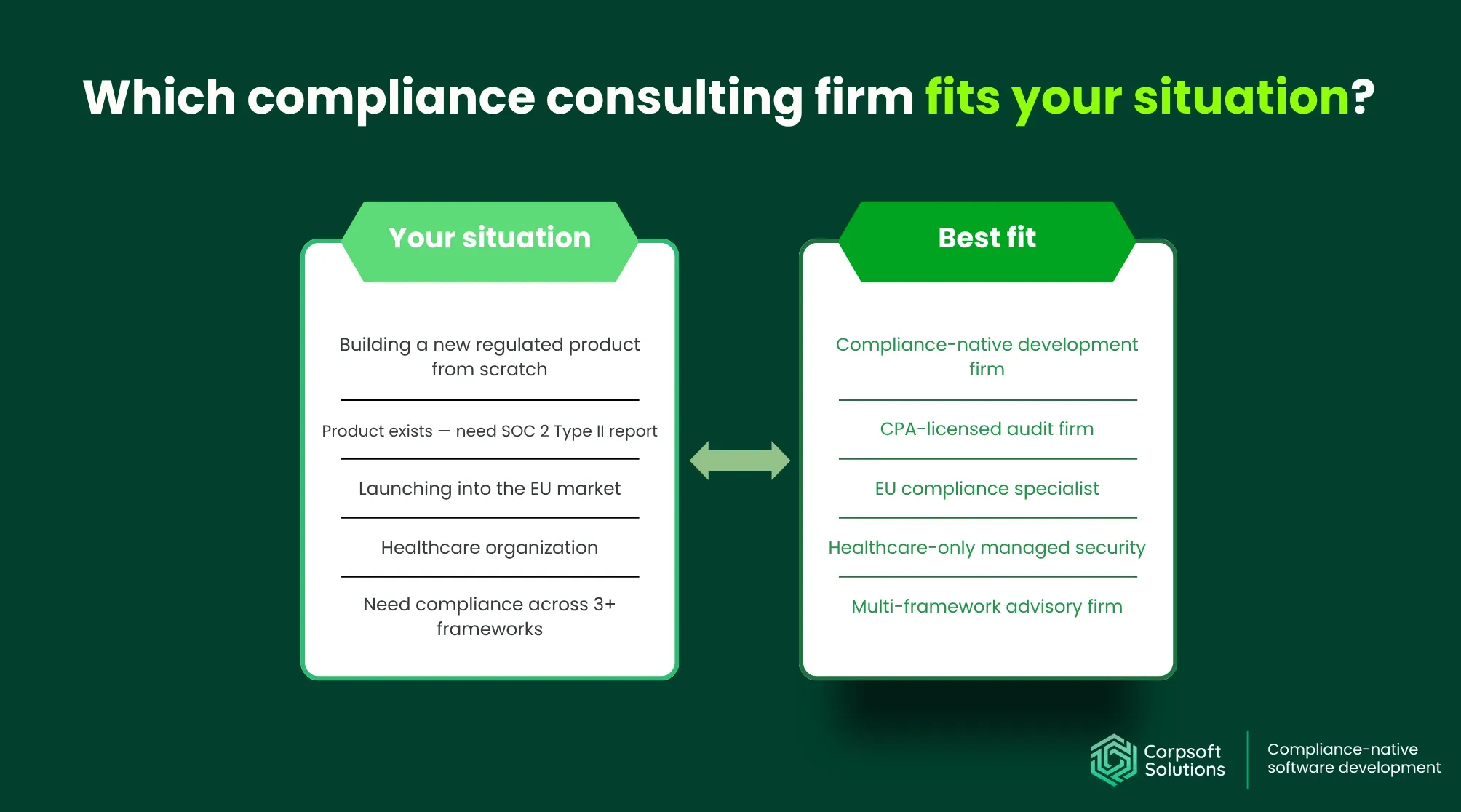
| Building a new regulated SaaS, healthcare, or AI product | Compliance-native development firm |
| Product exists — need SOC 2 Type II report | Audit & certification firm |
| Need to understand what HIPAA requires for your architecture | Framework / regulatory consultant |
| Have a roadmap, need execution support | IT compliance implementation partner |
| Operating in the EU or launching there — GDPR, NIS2, EU AI Act | Regulatory compliance consulting firm |
| Need ongoing compliance posture management | Managed security + compliance |
Common mistakes when hiring a compliance consulting firm
Even organizations that select the right type of firm frequently make execution mistakes that cost them months.
The five most common:
- Hiring an auditor before remediation is complete. An audit firm can only attest to what exists. Engaging them before controls are implemented yields a gap report — at audit rates — rather than a remediation roadmap.
- Treating ISO 27001 as a documentation exercise. ISO 27001 requires a functioning information security management system, not a policy library. Firms that deliver templates without implementation leave clients exposed at certification.
- Engaging Big Four for startup investment levels. Big Four advisory is calibrated for enterprise procurement cycles. Mid-market SaaS and healthcare startups typically exit the engagement with a roadmap they cannot execute at the pace or investment level they expected.
- Underestimating the engineering effort. Compliance controls are engineering work — access management, audit logging, encryption, and data handling. Organizations that treat compliance as a policy and documentation exercise consistently fail technical audit components.
- Choosing consultants without regulated industry experience. HIPAA’s operational safeguards, EU AI Act’s risk classification requirements, and SOC 2’s availability criteria have industry-specific nuances that generic security frameworks do not capture.
How we selected the best compliance consulting firms
Each firm on this list was evaluated across five criteria. Firms that did not meet minimum thresholds in any category were excluded.
|
Criterion |
Editorial weight |
| Demonstrated framework expertise & coverage |
25% |
| Verified case studies in regulated industries |
25% |
| Industry specialization |
20% |
| Mid-market accessibility |
15% |
| Market reputation & peer recognition |
15% |
Weights reflect our editorial priorities for this list’s target audience — technology companies, SaaS platforms, healthcare software teams, and AI product builders.
- Demonstrated framework expertise & coverage (25%). At least one covered framework from: HIPAA, SOC 2 Type II, ISO 27001, GDPR, EU AI Act, NIS2. Firms specializing in HR, environmental, pharmaceutical, OSHA, customs, or PCI-only compliance were excluded.
- Verified case studies in regulated industries (25%). Minimum three publicly verifiable engagements in tech, SaaS, healthcare software, or AI-adjacent industries. General-purpose firms without documented work in regulated software environments were excluded.
- Industry specialization (20%). Preference given to firms with demonstrable depth in one or more of: healthcare, SaaS/cloud, AI governance, or EU regulatory compliance.
- Mid-market accessibility (15%). Firms with minimum contract investment above $200,000 were not included. The Big Four — Deloitte, KPMG, PwC, EY — are capable firms. They are also outside the realistic range for most SaaS companies, healthcare startups, and AI product teams. Cybersecurity compliance consulting at enterprise scale operates on a different investment model than this list targets.
- Market reputation & peer recognition (15%). Credentials, industry certifications, and verifiable third-party recognition (AICPA, HITRUST, KLAS, Clutch, G2) were considered as reputation signals.
Disclosure: Corpsoft Solutions is the publisher of this article and one of the firms included in the comparison. The analysis is based on publicly available information, verified customer references where available, service positioning, and our experience building regulated software products.

The 10 best compliance consulting firms for tech, SaaS & AI in 2026
#1 Tevora — best multi-framework compliance consulting firm
Type: Multi-framework consulting | Assessment | Advisory
Best for: Mid-to-large organizations running simultaneous compliance programs across SOC 2, HIPAA, HITRUST, PCI DSS, and CMMC
Frameworks: SOC 2, HIPAA, HITRUST, ISO 27001, PCI DSS, CMMC, FedRAMP
Tevora’s strongest credential is volume: 10,000+ completed audits across 2,000+ client organizations over 20+ years, per their published data. At that scale, the consistency of their methodology across frameworks and industries is an asset that boutique firms cannot replicate.
Their positioning distinguishes them from pure audit firms: Tevora explicitly frames compliance as a continuous program, not a point-in-time event. Advisory services include vCISO support, AI security programs, and threat management — making them viable as a long-term compliance partner rather than a periodic auditor.
Choose Tevora if: your organization needs to maintain SOC 2, HIPAA, and CMMC simultaneously and cannot afford the coordination overhead of managing three separate firm relationships.
Limitations: US market-focused. Limited depth on EU regulatory frameworks (GDPR, NIS2, EU AI Act).
#2 Corpsoft Solutions — best for compliance-native software development
Type: Compliance-native software development
Best for: Product teams building new regulated software HIPAA compliance consulting for healthcare platforms, SOC 2-ready SaaS architecture, GDPR-native products, EU AI Act-compliant AI systems
Frameworks: HIPAA, SOC 2 Type II, ISO 27001, GDPR, EU AI Act, NIS2
Most firms on this list primarily deliver a report, a roadmap, or a set of remediation recommendations. Corpsoft Solutions delivers the software — with compliance controls, audit logging, access management, PHI handling, and regulatory documentation built into the architecture from the first sprint.
In practice, this applies to one scenario specifically: you are building a new product in a regulated industry. The investment in compliance-native architecture at build time is a fraction of the investment required to retrofit a non-compliant system after a failed audit or a rejected enterprise deal.
AI compliance engineering in the context of EU AI Act requirements is a particular strength: Corpsoft Solutions builds AI systems with governance documentation, inference traceability, and risk classification embedded as engineering deliverables — not as post-deployment additions.
Verified results:
- Remote Patient Monitoring platform — HIPAA-native architecture designed and delivered in production.
- Pediatric AI platform — AI-powered clinical workflow with AI governance built from the first sprint.
- Vision Screening platform — 10,000+ active users, in production since 2020, no reported compliance incidents during operation.
#3 BARR Advisory — best SOC 2 and HIPAA compliance partnership
Type: Audit & Certification | Advisory | vCISO
Best for: Mid-market SaaS and healthcare organizations seeking a long-term compliance partner, not just a point-in-time auditor
Frameworks: SOC 2 (Type 1, 2, 3, for Cybersecurity), HIPAA, ISO 27001, ISO 27701, ISO 27017, ISO 27018, ISO 42001, HITRUST, FedRAMP, GovRAMP, PCI DSS, CMMC, GDPR, CCPA, GLBA
SOC 2 compliance consulting through BARR operates on a partnership model that addresses a real gap in the market. Most audit firms deliver a report and disengage. BARR’s embedded advisory model, virtual CISO programs, and continuous monitoring offerings allow organizations to maintain a compliance posture between audit cycles — closing the window where most organizations quietly drift out of compliance after their last attestation.
Credentials: AICPA, HITRUST, PCI, CSA Trusted Cloud Consultant.
Typical engagement: Readiness assessment → gap remediation support → SOC 2 Type II audit → continuous monitoring program.
Limitations: Primarily the North American market. The partnership-model scope places investment above pure audit-only alternatives.
#4 DataGuard — best for GDPR, NIS2, and EU AI Act compliance
Type: EU compliance platform + expert advisory
Best for: Technology companies with EU market exposure — GDPR compliance consulting for data-processing products, NIS2 readiness for digital infrastructure, EU AI Act compliance for AI systems entering the European market
Frameworks: GDPR, ISO 27001, NIS2, EU AI Act, TISAX
DataGuard combines platform automation with certified expert oversight — their AI-assisted compliance tooling handles documentation, data mapping, and ROPA management, while specialists oversee regulatory interpretation. At 4,000+ client organizations across 50+ countries per their published data, DataGuard operates at a scale that reflects genuine European market penetration, not a “global” label applied to a US-centric practice.
AI compliance consulting for the EU AI Act is a growing practice within DataGuard’s portfolio — covering risk classification, governance documentation, and technical conformity assessment for AI systems entering the EU market.
Choose DataGuard if: your product processes personal data of EU residents, falls under NIS2 digital infrastructure requirements, or needs to demonstrate EU AI Act conformity for enterprise procurement in European markets.
Limitations: EU-market native. Limited HIPAA and SOC 2 coverage for US-specific compliance requirements.
#5 Fortified Health Security — best for healthcare compliance consulting
Type: Healthcare-specific managed security + compliance
Best for: Hospitals, health systems, healthcare compliance consulting for medical device companies, and healthcare technology organizations requiring clinical operational context alongside security controls
Frameworks: HIPAA, HITRUST, healthcare risk assessment
Sixteen years of exclusive focus on the healthcare sector is a specific credential. Fortified Health Security’s team understands that certain clinical system vulnerabilities cannot be patched on the same timeline as commercial software, that HIPAA’s operational safeguards intersect with clinical workflow in ways that general security firms consistently miss, and that medical device compliance operates under a different risk model than software products.
Average client profile: hospitals, health systems, and healthcare technology companies that need security expertise calibrated to clinical operations — not security controls that ignore the realities of patient care environments.
Limitations: Healthcare-only. Not appropriate for SaaS, AI products, or fintech outside the healthcare sector.
#6 KirkpatrickPrice — best for CPA-Licensed audit attestation
Type: Audit & Certification (licensed CPA firm)
Best for: Organizations requiring an independent, CPA-licensed auditor for SOC 2 Type II reports, HIPAA audit letters, or PCI DSS assessments — particularly when audit independence is a procurement or investor requirement
Frameworks: SOC 1, SOC 2, ISO 27001, ISO 42001, HIPAA, HITRUST, PCI DSS, CMMC, NIST, FedRAMP
SOC 2 compliance consulting through KirkpatrickPrice is delivered by a licensed CPA firm — a credential that carries weight when enterprise procurement, investor due diligence, or insurance requirements specify independent third-party attestation. 2,000+ completed audits.
ISO 42001 (AI management systems) coverage means KirkpatrickPrice can attest to AI governance requirements alongside SOC 2 and HIPAA — relevant for AI product teams navigating enterprise procurement alongside EU AI Act readiness.
Their Online Audit Manager platform reduces evidence-collection friction — a consistent bottleneck in SOC 2 Type II audits that extends timelines and strains engineering teams.
Not recommended when: your controls are not yet fully implemented. Engaging an auditor before remediation produces a gap report at audit rates. Complete implementation first, then bring in KirkpatrickPrice for attestation.
Limitations: Audit and attestation scope only. Does not provide implementation or remediation services.
#7 GuidePoint Security — best for simultaneous HIPAA, PCI DSS, and government compliance
Type: Advisory + Assessment | Multi-sector
Best for: Technology companies with simultaneous compliance requirements across healthcare (HIPAA), payments (PCI DSS), and government (CMMC, FedRAMP) — particularly SaaS companies serving regulated enterprise clients
Frameworks: HIPAA, PCI DSS, CMMC, FedRAMP, SOC 2
GuidePoint’s vendor-agnostic evaluation across 800+ security technology vendors is a differentiator for organizations running active technology selection alongside compliance work. Their government contract vehicles (GSA, OASIS+, SeaPort-NxG) make them accessible to organizations selling into US federal agencies.
Limitations: Primarily advisory and assessment. Limited EU regulatory coverage.
#8 Linford & Co — best for SOC 2 and FedRAMP specialist audits
Type: Audit & Certification specialist
Best for: Cloud service providers, SaaS companies, and government contractors requiring SOC 2 attestation, FedRAMP authorization, or HIPAA audit letters from a specialized independent firm
Frameworks: SOC 2, SOC 1, FedRAMP, GovRAMP, HIPAA, HITRUST, CMMC, ISO 27001, ISO 42001, ISO 27701, PCI DSS, CSA STAR
ISO 42001 coverage alongside SOC 2 and FedRAMP means Linford & Co can issue AI governance attestation — an increasingly common enterprise procurement requirement for AI product vendors. Operating since 2008. Accreditations: A2LA, HITRUST, FedRAMP.
Choose Linford & Co if: you are a cloud SaaS provider that needs both SOC 2 Type II and FedRAMP authorization — a combination that most generalist audit firms handle separately and less efficiently.
Limitations: Audit-only scope. Does not provide implementation or remediation services.
#9 RSM US — best for mid-market business-context compliance
Type: Risk advisory | Mid-market business consulting
Best for: Mid-market organizations where compliance is part of a broader business risk agenda — boards, CFOs, and senior leadership evaluating compliance investment alongside growth decisions )
Frameworks: SOC 2, HIPAA, ISO 27001, GDPR (advisory scope — framework specifics vary by engagement)
RSM US explicitly positions as “the first-choice advisor to middle market leaders globally” — a framing that reflects a different advisory relationship than pure-play technical security firms. Where specialist firms translate compliance into engineering requirements, RSM translates compliance into business risk language: board-level reporting, investor communication, and enterprise risk management integration.
Typical engagement: enterprise risk assessment → compliance gap analysis → board-level reporting framework → ongoing advisory.
Limitations: Broader risk advisory focus means less framework-specific technical depth than specialist firms. Limited AI and EU regulatory coverage.
Choose RSM US if: your organization’s leadership team — board, CFO, or senior management — needs compliance framed as business risk rather than a technical security program. RSM’s middle market focus means their advisors speak the language of growth-stage executives, not just security engineers.
RSM US is the U.S. member firm of RSM International, a global network operating across multiple countries — giving mid-market organizations access to cross-jurisdictional advisory without Big Four pricing.
#10 Kroll — best for global cybersecurity compliance and AI Governance advisory
Type: Global risk & cybersecurity compliance advisory
Best for: Organizations with multi-jurisdictional compliance exposure — HIPAA, GDPR, NIS2, CMMC, CCPA/CPRA — and companies implementing AI systems under EU AI Act and NIST AI RMF
Frameworks: HIPAA, GDPR, NIS2, CMMC, CCPA/CPRA, EU AI Act, NIST AI RMF
Kroll’s primary differentiator is not global scale alone — it is local regulatory expertise that actually corresponds to the jurisdictions where their clients operate. The team includes 650+ certified cybersecurity specialists, among them former regulators from the FCA, SEC, and AMF. That background translates directly into compliance advisory: these are practitioners who have sat on the regulatory side of the table, not consultants who have only read the frameworks.
Their AI governance practice covers the design and execution of AI compliance programs under the EU AI Act and NIST AI RMF — including model risk monitoring and AI-specific vulnerability testing. For organizations building AI products with cross-jurisdictional exposure, this combination of regulatory pedigree and technical AI governance depth is rare at this scale.
Choose Kroll if: your organization operates across the US, EU, and UK simultaneously — or if your AI system must satisfy both EU AI Act requirements and US enterprise procurement frameworks in parallel.
Limitations: Kroll’s compliance practice has historically centered on financial services. Tech and SaaS companies will find the expertise relevant, but the firm’s primary frame of reference is financial regulation rather than software product compliance.
Compliance consulting firms — comparison at a glance
| Firm | Primary engagement | Service model | Key frameworks |
Best for |
| Tevora | Continuous advisory | Multi-framework advisory | SOC 2, HIPAA, HITRUST, ISO 27001, PCI DSS, CMMC | Multi-framework enterprise programs |
| Corpsoft Solutions | Development | Software development | HIPAA, SOC 2, ISO 27001, GDPR, EU AI Act | Building regulated software from scratch |
| BARR Advisory | Audit | Audit + advisory | SOC 2, HIPAA, ISO 27001, HITRUST, GDPR | Mid-market SaaS — partnership model |
| DataGuard | Platform | EU compliance platform | GDPR, ISO 27001, NIS2, EU AI Act | EU market & AI Act readiness |
| Fortified Health Security | Continuous advisory | Healthcare managed security | HIPAA, HITRUST | Healthcare organizations |
| KirkpatrickPrice | Audit | CPA audit | SOC 2, HIPAA, ISO 27001, PCI DSS, ISO 42001 | CPA-attested audit reports |
| GuidePoint Security | Advisory | Advisory + assessment | HIPAA, PCI DSS, CMMC, FedRAMP | Healthcare + government sectors |
| Linford & Co | Audit | Audit specialist | SOC 2, FedRAMP, HIPAA, ISO 42001 | Cloud providers + gov contractors |
| RSM US | Advisory | Risk advisory | Risk & regulatory advisory | Mid-market executive-level compliance |
| Kroll | Advisory | Global risk advisory | HIPAA, GDPR, NIS2, CMMC, EU AI Act, NIST AI RMF | Multi-jurisdictional + AI governance |
Regulatory compliance consulting firms for tech and SaaS differ from general compliance practices in one consistent way: framework specificity matters more than firm size. A firm with 10 relevant audits in your industry is worth more than a firm with 10,000 audits in irrelevant sectors.
What we learned evaluating the 2026 compliance consulting market
Four patterns emerged consistently across our review of firms, client engagements, and the regulated software projects Corpsoft Solutions has worked on.
- Most regulated product teams engage in compliance consulting too late. The typical trigger is a failed audit, a lost enterprise deal, or a regulatory inquiry — not proactive planning. Organizations that build compliance requirements into their product architecture from the first sprint often spend a fraction of what remediation-stage organizations spend to reach the same audit-ready state. The earlier the engagement, the lower the total investment.
- EU AI Act demand is cross-jurisdictional — not EU-exclusive. US companies building AI products for enterprise clients increasingly receive EU AI Act compliance requirements as part of procurement checklists — even when their primary market is domestic. The demand for AI compliance consulting under the EU AI Act is not limited to European companies. US firms that dismiss EU AI Act as a regional concern are encountering it in US enterprise sales cycles.
- EU compliance expertise remains rare even among firms that list GDPR as a covered framework. GDPR, NIS2, and EU AI Act require engineering-level implementation — not just policy documentation. The majority of firms on this list that cover EU frameworks do so through a legal and documentation lens. Firms with genuine engineering-level EU compliance expertise — architecture review, data flow mapping, DPIAs conducted at the code level — are a small subset of those who list “GDPR” in their service catalog.
- Most firms separate consulting from implementation — and most clients pay for that gap twice. Most compliance programs end at the roadmap — a document that identifies what needs to change without providing the hands to change it. The transition from compliance consulting to engineering implementation is typically a separate engagement with a separate firm.
In our experience, organizations managing this handoff between two providers often lose weeks to context transfer, scope reconciliation, and re-explaining regulatory requirements to a new team. Firms that bridge advisory and engineering execution — rather than stopping at the report — represent a minority of the market.
No single firm on this list excelled across every category. The strongest providers consistently demonstrated depth in a specific service model, industry, or regulatory domain — rather than attempting to cover every framework equally.
How to choose the right compliance consulting firm for your situation
“We are building a new regulated product from scratch.”
An audit firm cannot help here — they evaluate what already exists. A framework consultant will give you a roadmap; implementation requires a separate engagement. The highest-leverage approach for a new build is a compliance-native development firm that architects security and compliance requirements into the product from day one.
→ See: Secure Custom Software Development Services
“We have a product and need SOC 2 Type II.”
Engage a CPA-licensed audit firm. If controls are not yet fully implemented, engage a framework consultant first, then the auditor once remediation is complete. Before engaging either, it’s worth auditing your codebase for common security gaps that surface during SOC 2 audits.
“We operate in or are launching into the EU.”
GDPR, NIS2, and the EU AI Act have engineering and documentation requirements that most US-based firms cover superficially.
→ See: EU AI Act Compliance Services
“We are a healthcare organization.”
Healthcare compliance consulting requires a clinical operational context alongside security controls — HIPAA’s administrative and physical safeguards frequently intersect with clinical workflow in ways general security firms miss.
→ See: Healthcare Compliance Development
“We operate across multiple jurisdictions or build AI systems with global market exposure.”
For organizations navigating HIPAA in the US, GDPR in the EU, and CCPA or NIS2 simultaneously, or building AI products that must meet both EU AI Act and NIST AI RMF requirements.
→ See: AI Governance Services
Share this post: