



The General Data Protection Regulation (GDPR) is the main data privacy and security law in the European Union. It applies to any organization worldwide that targets or collects data about people in the EU. Because it covers many economic sectors and imposes fines of tens of millions of dollars, developing GDPR-compliant software can be daunting for companies wanting to operate or promote digital products in Europe.
In this article, we’ll explore the seven main principles of GDPR and show how you can enforce them during the software development lifecycle (SDLC). We’ll also explain common misconceptions about data protection in Europe and the consequences of building non-compliant products.
Importance of data protection in Europe: More than just a regulation
Personal data is like currency today, and concerns over its privacy in storage and transit are rising. CISCO’s 2025 Data Privacy Benchmark study says personal privacy is both a business need and a key to customer trust.
The study also finds that 95% of users avoid buying from companies that do not protect their data. If you do not meet data protection rules, you cannot expect to succeed in large markets like Europe.
Moreover, the GDPR sets rules for businesses. Therefore, address compliance at the beginning of software or product development. Waiting until after launch can result in fines or penalties and might block entry to the European market.
Why does achieving General Data Protection Regulation (GDPR) compliance feel unexpectedly complex for businesses?
Most US-based companies, especially in healthcare or FinTech, know how to develop compliant software. However, industry-related regulations such as HIPAA and standards such as SOC 2 and PCI DSS apply only to specific data types or operational contexts.
Explore our detailed guide on developing healthcare compliant software solutions to learn more about industry-specific regulations and how they are enforced in SDLC.
GDPR operates differently. It’s most similar to another US data protection directive, the California Consumer Privacy Act (CCPA), which has become a benchmark for data privacy regulations in the United States. Below, you’ll find a comparison of these regulations along with some industry-related compliance laws:
| Parameter | GDPR | CCPA/CPRA |
| Definition of personal data | Any information relating to an identified or identifiable natural person (“data subject”). This includes directly identifying information, such as name or an ID number, and indirect identifiers (IP addresses, location data, cookies) that can be combined to identify an individual. | Any information that identifies, relates to, describes, directly or indirectly, a particular California resident or household. This includes names, SSNs, email addresses, IP addresses, browsing history, geolocation data, and inferred profiles. |
| Industries covered | Industry-agnostic | Industry-agnostic |
| Scope | Any entity worldwide that collects, processes, or stores the personal data of European Union (EU) residents, regardless of the company’s location. | For-profit entities that collect California residents’ data, meet specific revenue thresholds (>$25M+), or process data of 100,000+ consumers/households, regardless of physical location. |
| Regions covered | Companies — worldwide Data subjects — European Union |
Companies — worldwide Data subjects — California state |
As you can see, CCPA’s scope is more narrowly targeted to businesses and doesn’t include non-profits, for example. On the other hand, GDPR’s intentionally broad definitions of personal data and user rights make achieving compliance in the EU significantly harder.
Common misconceptions around GDPR compliance for businesses
The flip side of the all-encompassing scope and broad personal data definitions is that many US-based companies underestimate the GDPR or equate it with other compliance regulations and standards.
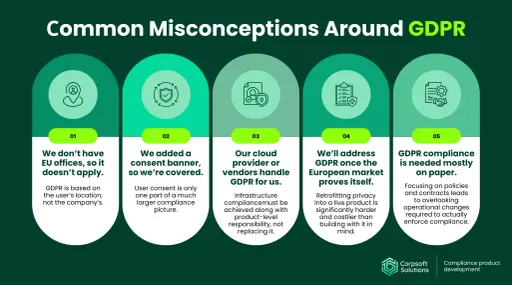
Here are a few of the most common misconceptions businesses have about GDPR software compliance and the ways they can backfire:
- “We don’t have EU offices, so it doesn’t apply.” — GDPR is based on the user’s location, not the company’s.
- “We added a consent banner, so we’re covered.” — Consent banners and cookies cover only one user right under GDPR and are a part of a much larger compliance picture.
- “Our cloud provider or vendors handle GDPR for us.” — Vendors and third-party services may have different definitions of personal data in the context of their products that may not correspond to yours.
- “We’ll address GDPR once the European market proves itself.” — Retrofitting privacy into a live product is significantly harder than building with it in mind. Moreover, you may face enforcement action and significant legal risk without first achieving GDPR compliance for software.
- “GDPR compliance is needed mostly on paper.” This mindset shifts the team’s focus to policies and contracts, overlooking the product design, engineering, and operational changes required to actually enforce compliance.
What does the term “GDPR compliant software” actually imply?
To answer this question, we need to discuss user rights under GDPR and how they inform business decisions and GDPR-compliant software requirements.
GDPR establishes and governs eight key rights of the data subject:
- Right to Be Informed — users can demand that businesses disclose what type of personal information they collect, store, share, or sell.
- Right to Access — users can request confirmation whether an organization is collecting and processing their personal data.
- Right to Rectification — users can ask businesses to correct the inaccurate data at any time.
- Right to Erasure/Right to Be Forgotten — users can request the complete deletion of their personal data when it’s no longer needed, or withdraw their consent if the data has been unlawfully used.
- Right to Object — users have the right to object to data processing for marketing or advertising purposes.
- Right to Restrict Processing — users can ask an organization to limit processing of their data, especially if they object to processing or to the accuracy of their data.
- Right to Data Portability — Users can request their data in a structured, commonly used, and machine-readable format to transfer it to another service provider.
- Rights Related to Automated Decision-Making and Profiling — Users should be protected and have control over decisions made solely by automated systems that significantly affect them, like credit approvals, hiring screening, or automatic ticket pricing.
Where many businesses fall short, though, is in translating the aforementioned user rights into clear policies and decisions, and in tailoring these policies to GDPR software requirements from the outset.
Here are some recommendations on how you can weave GDPR user rights into your business expansion and software development decisions
| GDPR user right | What it means for the business | What it means for software development |
| Right to Be Informed (Articles 13-14) | The company must clearly communicate what data is collected, why, how it’s used, and who it’s shared with | Products need transparent notices, consent flows, and mechanisms to surface up-to-date data use information |
| Right to Access (Article 15) | Must be able to respond to data requests within legal timelines and know where user data resides across systems. | Systems need centralized data visibility and the ability to retrieve all user-related records in a structured format. |
| Right to Rectification (Article 16) | Processes must be in place to update incorrect customer information quickly and consistently. | Data models and workflows must allow safe editing and synchronization across databases and services. |
| Right to Erasure/Right to be Forgotten (Article 17) | The company must be able to fully remove user data when legally required. | Requires deletion logic across databases, backups, logs, and integrated third-party systems. |
| Right to Data Portability (Article 20) | Businesses must provide user data in a usable, transferable format. | Systems need export functionality that compiles user data into structured, machine-readable files. |
| Right to Restrict Processing (Article 18) | Organizations must be able to pause certain uses of data without deleting it. | Requires flags, permissions, and workflow controls that limit how data can be processed. |
| Right to Object (Article 21) | Businesses must stop certain types of data use (e.g., marketing) when users object. | Requires granular consent tracking and logic to automatically enforce processing restrictions. |
| Rights Related to Automated Decision-Making and Profiling (Article 22) | Businesses must ensure individuals are not subject to purely automated decisions that significantly affect them without safeguards. | Systems must provide transparency into algorithmic decisions, allow human review where required, and enable users to contest automated outcomes. |
The cost of being non-compliant
Getting huge fines and penalties is only one part of the risk that comes with failing to build GDPR compliant software, as the non-compliance impacts most companies way earlier and in much subtler ways:
- Blocked market entry. Enterprise customers, partners, and procurement teams in the EU often require GDPR assurances before doing business. Non-compliance can stop expansion before it starts.
- Lost deals and longer sales cycles. Gaps in GDPR compliance can surface during security reviews and due diligence, delaying or derailing revenue, especially in B2B and enterprise sales.
- Costly product rework. Adding privacy controls to a live product typically requires significant architectural changes, engineering time, and operational disruption.
- Reputational damage and loss of trust. Privacy expectations are higher in Europe. A single incident or public enforcement action can undermine your credibility in the market.
- Ongoing operational risk. Without enforceable controls and GDPR management software, every new feature increases exposure, making compliance harder and more expensive over time.
Learn about our process for developing GDPR-compliant solutions that help us handle challenges and minimize business risks.
7 main principles of GDPR for software and how to enforce them during SDLC
So, what should you do to tackle the compliance regulation as tough as GDPR?
First, familiarize yourself with the seven main principles of GDPR compliance for businesses in regard to software development:
- Lawfulness, fairness, and transparency: Data processing must be lawful, fair, and transparent to the data subject.
- Purpose limitation: Data processing should be done for the legitimate purposes specified explicitly to the data subject when you collected it.
- Data minimization: Collect and process only the data absolutely necessary for the specified purposes.
- Accuracy: Keep personal data accurate and up to date.
- Storage limitation: Store personally identifying data only for as long as necessary for the specified purpose.
- Integrity and confidentiality: Ensure appropriate security, integrity, and confidentiality (e.g., by using encryption) for all data processing activities.
- Accountability: Take responsibility as a data controller to demonstrate GDPR compliance with these principles.

How to ensure that your company develops GDPR compliant software?
Incorporating compliance efforts into the SDLC from the very start is a proven way to ensure the final product passes the audit. To do that, the companies must understand several foundational GDPR requirements that shape how privacy must be embedded into products from the outset:
- Data Protection by Design & Default (Article 25): This article requires organizations to integrate privacy safeguards as core design elements of system architecture, workflows, and user experiences.
- Data Protection Impact Assessment (DPIA): The GDPR mandates this assessment to identify and mitigate potential harms before development proceeds. It’s especially important in cases where data processing may pose elevated risks to individuals, such as credit scoring, location tracking, and behavioral profiling.
- Cross-border data transfer rules: For companies operating internationally, these rules help to ensure that personal data leaving the EU remains protected through mechanisms such as Standard Contractual Clauses (SCCs) or adequacy decisions
Applying these foundational principles helps companies develop compliant, scalable, and market-ready software.
Additionally, several recommendations will help business owners ensure that data collection, processing, retention, and deletion processes remain compliant with GDPR requirements.
#1 Know the definition of personal data in the context of your business
Under GDPR, personal data includes any information that can directly or indirectly identify an individual. This leads organizations to underestimate how broadly this definition applies to their products.
To build GDPR compliant software, companies must:
- map where personal data enters their systems
- understand how it moves between features and third-party services
- know which teams interact with it.
This visibility helps reduce hidden risks and ensures informed decision-making when developing new functionality. Without a clear understanding of what constitutes personal data in your workflows, it becomes difficult to enforce privacy principles consistently across both technical and operational processes.
#2 Clearly outline the conditions and purpose of data collection
GDPR requires organizations to collect personal data only for specific, clearly defined purposes and to communicate those purposes transparently to users.
In practice, this means businesses must move beyond generic statements like “to improve our services” and instead define precise use cases for each data category they collect.
This clarity should be embedded into product requirements, ensuring engineers understand why data is needed and how it will be used. When purpose is well documented and communicated internally, it becomes easier to align legal, product, and engineering teams, reducing compliance risks while strengthening trust with users.
#3 Minimize data collection to only essential points
The data minimization principle of the GDPR requires organizations to collect only the data strictly necessary to deliver a specific function or service. GDPR outlines certain scenarios in which data collection is legitimised, also known as Lawful bases for processing. There are six of them.:
- Consent: data processing is allowed when an individual has freely given, specific, informed, and unambiguous permission.
- Contractual necessity: data processing is lawful when it is necessary to fulfill a contract with the individual or to take steps before entering into one
- Legal obligation: data processing is allowed when required to comply with a lawful requirement imposed on the organization.
- Vital interests: data processing is permitted in the case when it’s necessary to protect an individual’s life or physical safety.
- Legitimate interest: data processing is allowed when necessary for an organization’s legitimate business interests, provided those interests do not override individuals’ rights and freedoms.
- Public task: data processing is allowed when it is required to perform a public-interest task, for example, in the banking or public health sector.
To implement the data minimization principle effectively, teams should evaluate whether each data point directly supports a defined purpose or is supported by a corresponding Lawful basis for processing before they start collecting sensitive personal information, and remove any optional or speculative fields.
#4 Establish data retention periods
GDPR requires that personal data be stored only for as long as necessary to fulfill its intended purpose, making clear retention policies an essential component of compliant software development.
Organizations should:
- define retention timelines for different types of data, such as customer records, analytics logs, and operational data, based on legal, business, and functional requirements
- support these timelines by establishing automated processes that archive or delete data once it is no longer needed. This is especially important because, without automation, retention rules often remain theoretical and are difficult to enforce at scale.
Modern technologies, such as AI compliance agents, can handle low-level work for you by automating data archiving and deletion processes, notifying you of policy updates, and tracking legal and business requirements so you won’t fall behind.
#5 Build accountability at a high level
GDPR compliance for businesses places strong emphasis on accountability, meaning organizations must be able to show compliance with data protection principles, not just claim it.
Clear ownership should be assigned for data governance decisions, and organizations should maintain documentation that explains how personal data is processed throughout the system lifecycle.
Regular internal reviews, training, and oversight mechanisms help ensure compliance responsibilities remain visible and a top priority.
#6 Design for user control
One of the core principles of GDPR is to assign users meaningful control over their personal data.
For software companies, this requires designing systems and interfaces that make it easy for users to understand, manage, and exercise their data rights.
This includes:
- providing clear information about how data is used
- enabling users to update or correct their information
- supporting requests such as access, deletion, or restriction of processing
- integrating privacy considerations into user experience decisions from the start.
#7 Appoint a vendor with a proven track record
For many US-based companies, handling GDPR compliance challenges may require expertise beyond their internal capabilities. In this case, partnering with a third-party organization that can help close gaps in technical, legal, and operational knowledge might be an option.
A qualified GDPR management software vendor should demonstrate a proven track record in GDPR readiness assessments, privacy-by-design implementation, and compliance process development.
Along with consulting, qualified vendors often help translate regulatory requirements into practical system changes and governance frameworks, enabling you to build compliant solutions and successfully expand into the European market.
Underlining point: The earlier you embed GDPR compliance into your product, the fewer product changes are required later, the lower the cost of compliance overall
Late awareness is one of the most common reasons GDPR turns into a blocker.
Conclusion
Achieving GDPR software compliance is a daunting task for companies seeking to enter the European market. However, addressing this challenge at the very start of product development and weaving GDPR regulations into high-level decision-making will help businesses avoid legal repercussions and significant financial and operational risks later on.
Corpsoft Solutions’ team of highly qualified compliance experts can serve as your technology partner in addressing compliance issues. We can help organizations with:
- creating transparent and specific policies and scope for data collection;
- embedding GDPR compliance requirements into SDLC and business processes;
- building automation workflows for data management processes, such as collection, storage, use, transit, archival, and deletion;
- establishing compliance management processes and tracking policy updates so that your business stays in good standing with EU laws and regulations;
- assisting with scaling your business on the European market without breaking the compliance regulations.
Share this post: