



GDPR software compliance development isn’t easy to achieve and is even harder to maintain, especially as you scale. The moment your organization starts to feature multiple products, data stores, and third-party vendors, policies and spreadsheets stop serving as controls and become statements without a corresponding mechanism to enforce them.
This article serves as a guide to developing a custom set of these mechanisms: data inventory and mapping, rights workflows, retention automation, processing security, breach-response runbooks, and transfer controls that match where data actually flows.
It will walk you through a delivery path from audit → architecture/design → build → verification/operations, and give you practical tips on embedding GDPR software compliance into software development lifecycle (SDLC) without turning into legal advice.
Definitions and scope: what does GDPR software compliance development mean (and doesn’t)
GDPR software compliance development is the process of building or integrating controls into your existing product and data architecture, often alongside a purchased toolset. This approach delivers real system behaviors, such as:
- Data Subject Access Request (DSAR) workflows that find data across services
- Retention logic that actually deletes the data
- Access controls that enforce least privilege
- Logging sequences that produce trackable evidence.
Custom GDPR compliance for businesses does not mean building a bespoke GRC platform from scratch unless the organization has a compelling reason, such as operating at a regulated scale or with a unique data topology.
In most cases, the custom work is “glue and governance”: connectors, orchestration, data lineage, policy-as-code, audit trails, and integrating compliance requirements into the SDLC.
Core GDPR compliance rules that drive software controls
The majority of GDPR software development obligations that repeatedly translate into software requirements are baked into safeguards under GDPR Article 25 (Privacy by design and by default) and Article 32 (Security of processing).
They include:
- data protection by design and by default
- security of processing (risk-based technical and organizational measures)
- data subject rights handling (repeatable workflows and deadlines)
- breach notification readiness (process + evidence).
This is why technical teams need a control-first lens: the law sets outcomes, and engineering implements the mechanisms that consistently deliver them.
Check our extensive guide on GDPR regulations for software development with tips on how to implement them in your SDLC!
The base of GDPR-compliant software development: compliance-to-controls translation layer
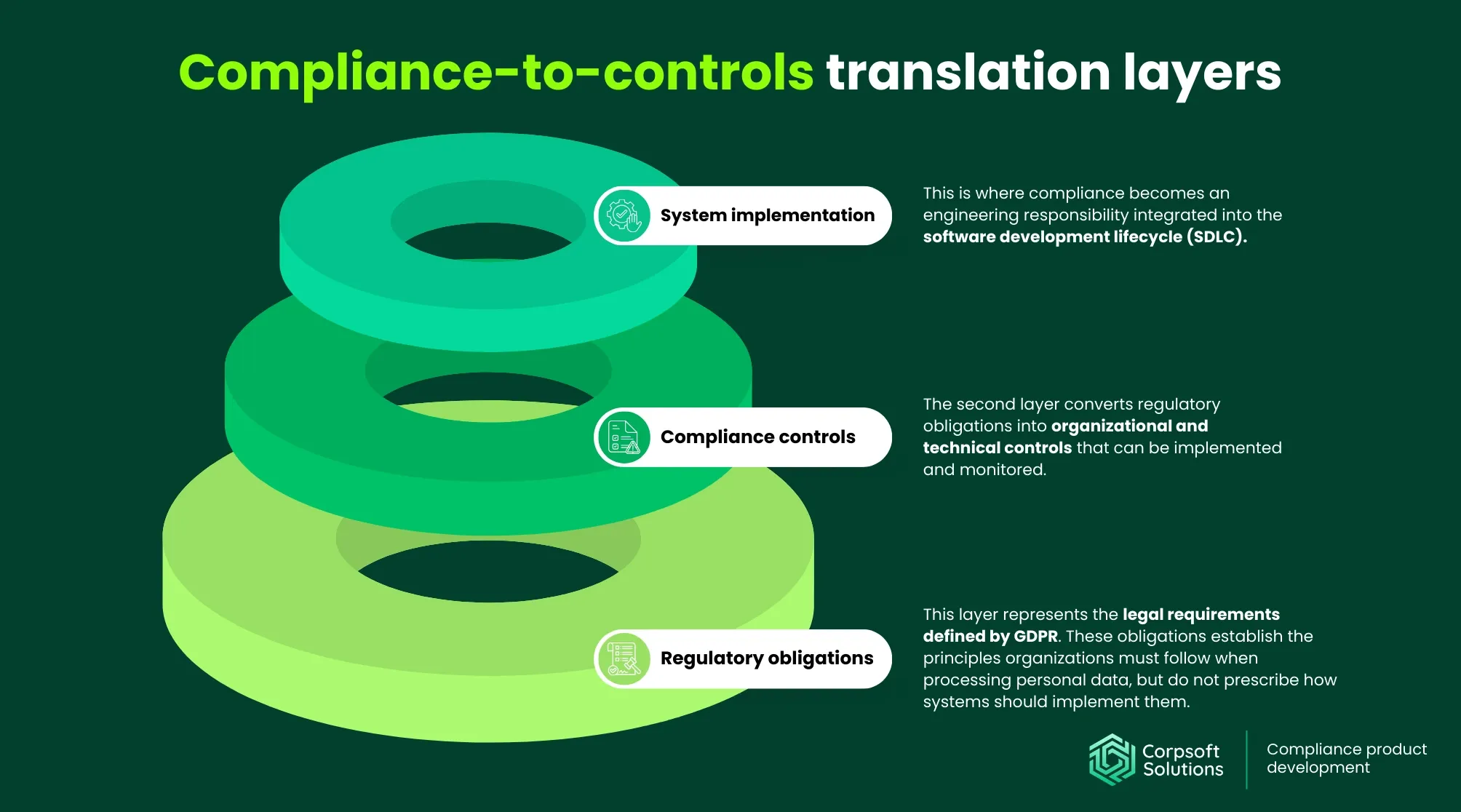
Regulatory guidance explains what organizations must do under the GDPR, while many compliance tools promise to simplify the process. What’s often missing is the implementation layer inside the software stack itself.
Personal data flows through APIs, databases, analytics pipelines, and third-party integrations. If GDPR software compliance controls aren’t embedded directly in those systems, policies, and tools, those policies and tools alone cannot ensure that obligations are consistently enforced.
The real challenge lies in translating GDPR requirements into architecture constraints, automated workflows, system safeguards, and auditable evidence. This translation layer is what turns compliance from a theoretical requirement into an operational capability.
#1 Aim for the repeatable outcomes
The result of your GDPR software compliance efforts should be the ability to demonstrate compliance for every single processing activity when asked by a regulator. And this effective repeatable outcome is more than just “we have a policy” on paper.
The strongest regulator guidance emphasizes effectiveness and lifecycle thinking for privacy by design/default. When incidents like missed DSAR deadlines, incomplete deletions, and unclear transfer bases occur, your only defense is an engineered process backed by evidence.
#2 Map obligations to control families
Mapping the main processes and system behaviors into control families helps work through them more easily and establishes a continuous basis of foundational activities aligned with the NIST Privacy Framework.
- Inventory & mapping: systems and vendors that process personal data, flows, and ownership
- Access control & auditability: least privilege, role design, logs, reviews
- Rights workflows: DSAR, deletion, rectification/objection where applicable
- Retention & deletion: rules, holds, exceptions, proof of execution
- Incident response: detection, triage, breach notification, and communication artifacts
- Transfers: SCCs, supplementary measures, transfer mapping, vendor boundary enforcement
#3 Define acceptance criteria early
Acceptance criteria are the areas where the “data privacy by default” principle of Article 25 becomes a real and tangible outcome, because if defaults are wrong, your system is noncompliant by design, even if a policy says otherwise.
Here are some examples of acceptance criteria for data privacy:
| Requirement |
Acceptance criteria |
| Data minimization | The registration API stores only email, password, and user ID.
Optional fields (phone, address) are disabled by default and only collected when explicitly required for a feature. Application logs do not store full email addresses or identifiers unless explicitly required for debugging. |
| DSAR data retrieval | DSAR service retrieves user data from all systems listed in the data inventory.
Export includes structured data from the primary database, the support platform, and, where applicable, analytics identifiers. DSAR export completes within the configured SLA after identity verification. |
| Retention and deletion | Records older than the retention threshold trigger a deletion job.
The deletion job runs daily and removes expired records from all primary stores. System logs deletion activity and stores a deletion confirmation record. |
| Access control | Only users with the customer support or admin roles can view personal profile data.
Unauthorized roles receive a 403 response. All access events are logged with timestamps, user IDs, and action types. |
| Breach detection | The system generates an alert when more than X user records are accessed within a defined timeframe.
Alerts are logged in the incident management system. The incident record contains a timestamp, the affected system, and an initial classification. |
The idea behind acceptance criteria for each of the GDPR compliance rules is that it’s specific, testable, and produces evidence
Learn more about our GDPR compliance development services!
Stage 1. Audit & discovery: Produce a buildable backlog
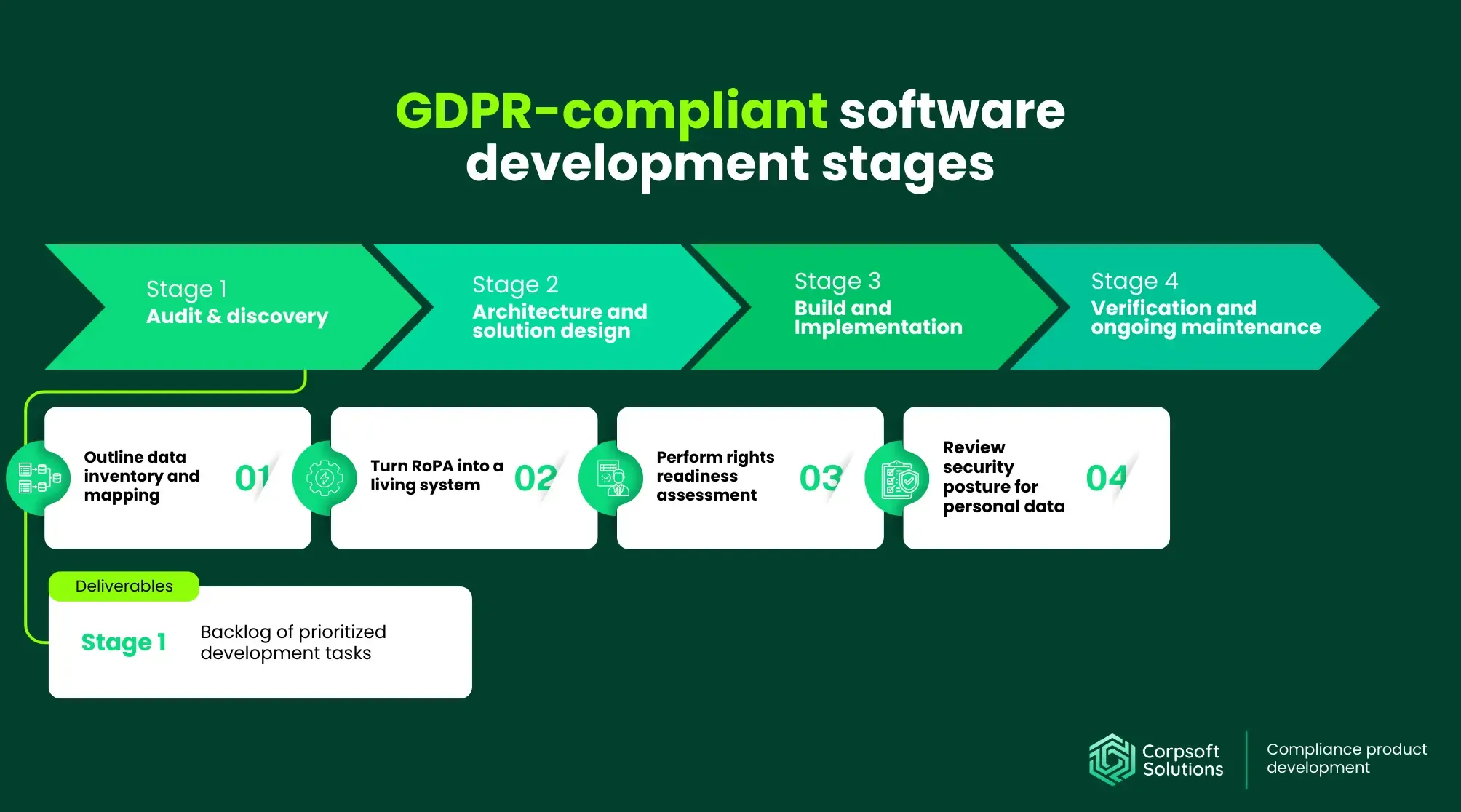
The first stage of GDPR compliance platform implementation spans beyond a compliance audit and is more like a system discovery exercise that feeds directly into the development backlog.
Instead of producing a static report, a well-structured audit identifies the controls that must be built, modified, or integrated into existing systems. These outputs become backlog items that engineering teams can implement during upcoming development cycles.
Outline data inventory and mapping
Start with understanding where personal data exists and how it flows between systems. From an engineering perspective, this is equivalent to building a data topology map that aligns with system architecture.
The mapping process typically includes:
- applications and services that process personal data
- databases and storage layers that hold user information
- data pipelines, logs, and analytics systems
- third-party processors and integrations
- identifiers used to link records to individuals
This mapping becomes a foundational artifact for GDPR-compliant software development documentation, as well as for architecture reviews and development planning within the SDLC. New features introduced during development should reference this inventory so that data processing changes remain visible.
Turn RoPA into a living system
Records of Processing Activities (RoPA) are often treated as a static compliance requirement. In practice, they should function as a living inventory tied to the development lifecycle.
Each time a new feature, integration, or analytics workflow is introduced during the SDLC, it potentially changes how personal data is processed. Connecting RoPA updates to development processes ensures documentation stays accurate without requiring periodic rediscovery exercises.
This approach prevents a common problem: documentation that becomes outdated the moment the product evolves.
Perform rights readiness assessment
A major part of the GDPR-compliant software requirements audit phase involves evaluating whether the organization can handle data subject access, correction, and deletion requests.
Working these requests reliably requires workflows that interact with multiple systems. During the audit phase, teams assess:
- Where identity verification will occur
- Which systems must be queried during a request
- How records are identified across services
- Whether data exports or deletions can be automated
Regulatory guidance requires organizations to respond to subject access requests within 1 month, with possible extensions for complex cases.
From an engineering perspective, this requirement means DSAR handling must become a repeatable operational workflow integrated into the SDLC backlog rather than a manual process.
Review security posture for personal data
The audit of GDPR compliance for businesses also evaluates how well current systems protect personal data. This review typically examines authentication mechanisms, access controls, logging, encryption practices, and environment separation.
In the SDLC context, the outcome is a list of security improvements to implement during development, such as enhancing audit logging, strengthening access controls, or isolating production data.
Audit outputs: the compliance engineering backlog
A successful audit ends with a backlog of prioritized development tasks. Instead of abstract recommendations, the outputs resemble standard engineering work items:
- implementation of DSAR automation workflows
- retention and deletion mechanisms
- improved logging and access monitoring
- vendor data-sharing controls
- breach detection and response mechanisms
These tasks are then scheduled into GDPR compliant software development cycles to ensure that compliance improvements progress alongside product development.
At this point, engineering teams typically also define the architectural principles that will guide implementation, such as data minimization patterns, access control models, and logging standards.
The next step is translating audit findings into a coherent solution design, where privacy requirements are embedded directly into the system architecture.
Examine website GDPR compliance requirements and build an actionable implementation plan with our guide that explains the crucial steps in detail!
Stage 2. Architecture and solution design: Privacy-by-design that ships
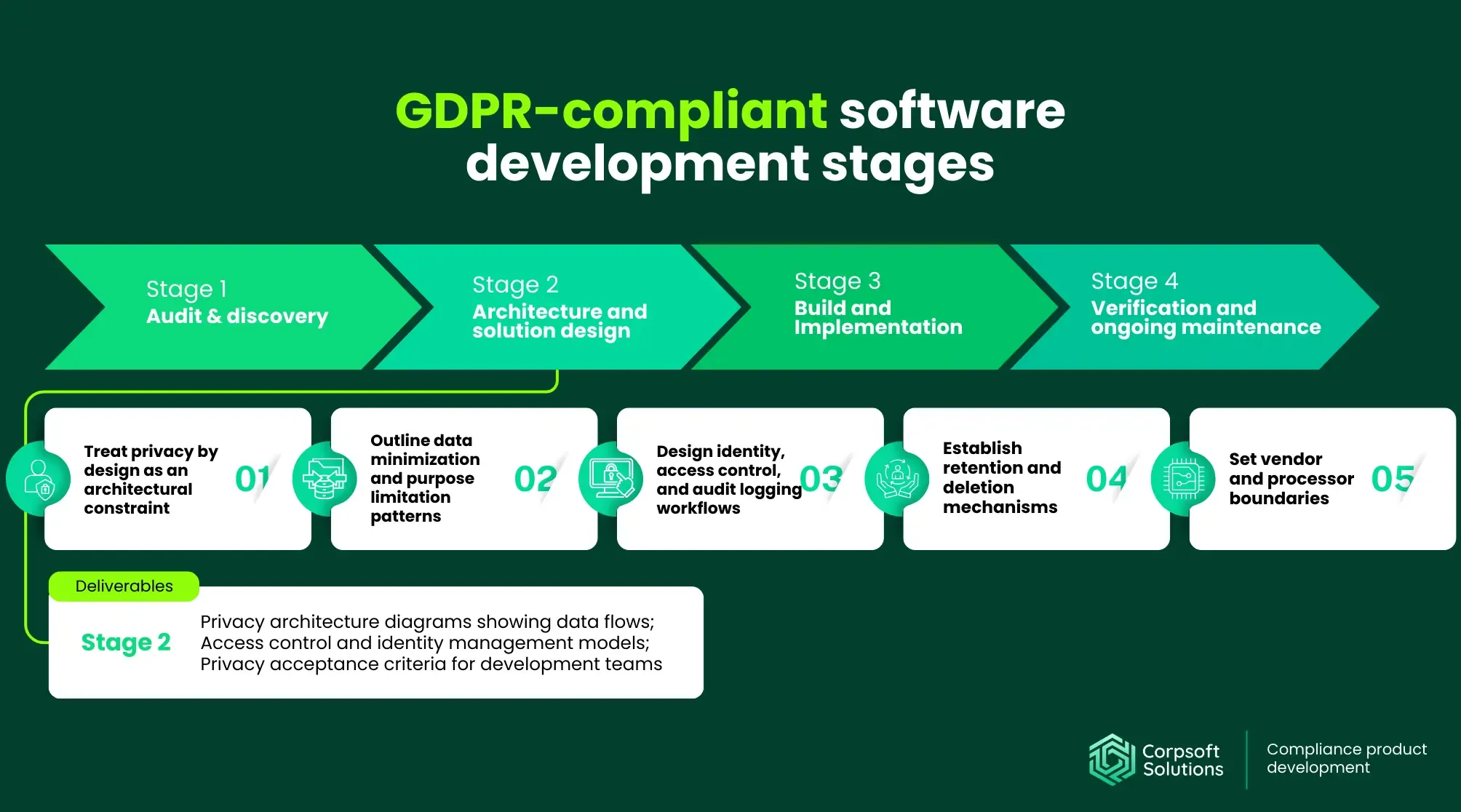
Once the audit identifies GDPR software compliance gaps, the solution design stage translates those findings into architecture decisions and system design patterns that can be implemented during development.
At this stage, GDPR principles begin to influence the design phase of the software development life cycle, particularly architecture reviews and system modeling.
Treat privacy by design as an architectural constraint
GDPR requires organizations to implement data protection by design and by default, meaning safeguards must be incorporated throughout the data processing lifecycle.
For engineering teams, this becomes an architectural constraint applied during system design. Decisions about data collection, storage, and processing should incorporate privacy safeguards before code is written.
Examples include:
- limiting the amount of personal data stored in system logs
- using pseudonymization for analytics systems
- designing APIs that expose only necessary data fields
Embedding these safeguards during the design phase of the SDLC prevents expensive retrofitting later.
Outline data minimization and purpose limitation patterns
Design patterns that support privacy often revolve around reducing unnecessary data processing.
Common strategies include:
- separating operational and analytical data pipelines
- collecting optional attributes only when needed for specific features
- using pseudonymous identifiers in non-core systems
When these principles are integrated during design reviews within the SDLC, privacy becomes an embedded system property, producing repeatable outcomes when regulators visit for an audit.
Design identity, access control, and audit logging workflows
Access control is another architectural component closely tied to data protection requirements in the EU.
Designing roles, permissions, and logging structures during the system design phase ensures that only authorized personnel can access personal data and that all access events are traceable.
GDPR’s security of processing requirement encourages organizations to implement measures such as encryption, access control, and system resilience based on risk assessments.
Integrating these GDPR management software controls into the SDLC design stage ensures they are implemented consistently across services.
Establish retention and deletion mechanisms
Retention is often defined in policies but rarely implemented systematically. Designing retention mechanisms requires defining rules that can be executed programmatically.
During system design, teams typically specify:
- retention timelines for different data categories
- triggers that initiate deletion
- exceptions such as legal holds
- methods for verifying deletion
These rules then become components implemented during development sprints.
Set vendor and processor boundaries
Architectural design also defines how personal data moves between the organization and external vendors.
During design reviews, teams should examine whether integrations share only necessary data and whether additional safeguards are needed.
These architectural decisions ensure that data sharing aligns with both contractual obligations and system design.
Stage 3. Build & implementation: Deliver controls + evidence

Once architecture is defined, GDPR software development moves into the implementation phase of the SDLC. The focus shifts from planning to delivering working systems that automatically enforce privacy safeguards.
Implement a phased roadmap
Because the efforts required to achieve GDPR compliance for US businesses can be substantial, development work is typically delivered in phases. Prioritization focuses on controls that reduce operational risk first.
Initial development cycles often focus on:
- DSAR automation
- breach detection and response workflows
- improvements to data access logging
Later phases typically address retention automation and transfer safeguards.
This phased approach allows organizations to demonstrate measurable progress while integrating compliance improvements into regular development releases.
Automate DSAR workflows
Handling subject access requests reliably requires coordination between multiple systems. Development teams often implement DSAR workflows as service pipelines that include request intake, identity verification, data discovery across systems, review steps, and final response generation.
Automating these workflows—for example, by integrating agentic AI—ensures that requests are processed within regulatory timelines and reduces reliance on manual cross-departmental coordination.
Engineer breach response procedures
Breach response procedures must also be integrated into system operations.
GDPR requires that certain data breaches be reported to supervisory authorities within 72 hours of becoming aware of them.
To meet this requirement, development teams typically implement:
- incident detection and alerting mechanisms
- structured incident logging
- workflow automation for classification and escalation
Embedding these mechanisms within operational systems allows security and compliance teams to act quickly during incidents.
Carry out security controls
During GDPR compliant software development, teams implement technical measures to protect personal data, including encryption, secure authentication, and environment isolation.
Security guidance from regulators provides practical examples of these measures and helps organizations align their implementations with recognized best practices. These measures are integrated into the development pipeline through secure coding standards, code reviews, and automated testing.
Execute international transfer safeguards
Organizations that transfer personal data outside the EU must implement appropriate safeguards such as Standard Contractual Clauses (SCCs).
In practice, this may require several technical safeguards for data shared with external services, including:
- Data encryption in transit and at rest. Personal data is encrypted both in transit and at rest to prevent unauthorized interception or exposure. Encryption may also involve controlling encryption keys so that external processors cannot access readable data without authorization.
- Restricted access to personal data. Only systems or personnel that require the data for a defined purpose may retrieve or process it.
- Controlled export mechanisms. Data transfers to external services occur through predefined interfaces such as APIs or secure pipelines that limit which fields can be exported and log each transfer.
These controls ensure transfers align with both contractual commitments and system architecture.
Stage 4. Verification & continuous compliance operations
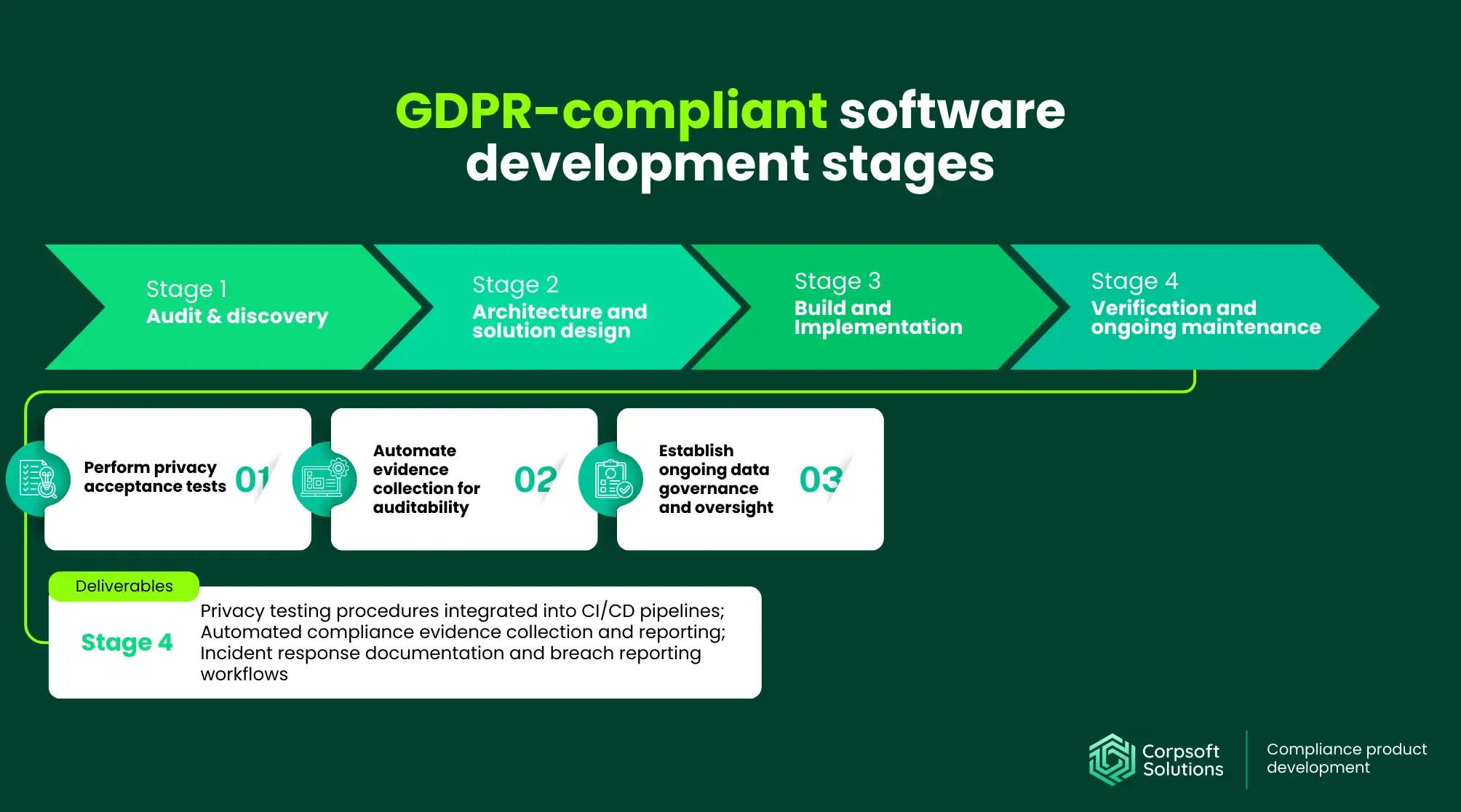
The final stage of GDPR compliance for software aligns with the testing, release, and operational phases of the SDLC. At this level, the focus shifts to ongoing compliance maintenance and adapting to the requirements as systems evolve. Here’s how you can achieve that
Perform privacy acceptance tests
Privacy safeguards should be tested just as functional features are. Incorporating privacy-focused tests into the development lifecycle helps ensure that compliance controls continue working as the system evolves.
Typical test scenarios include:
- Retention rule validation. Tests confirm that records exceeding the retention threshold are automatically deleted or anonymized in accordance with defined policies.
- DSAR workflow verification. Test cases ensure the DSAR process retrieves complete datasets from all systems listed in the data inventory and produces the correct export format.
- Access control testing. Tests verify that only authorized roles can view or modify personal data and that unauthorized requests are blocked and logged.
- Regression testing of privacy controls. Regression tests ensure that new code releases do not unintentionally break existing privacy safeguards. For example, when a new feature introduces additional data fields or modifies APIs, regression tests confirm that retention rules, access permissions, logging, and data export mechanisms continue functioning as intended.
Incorporating these tests into CI/CD pipelines and release validation processes allows organizations to detect compliance issues early and maintain privacy safeguards as systems evolve.
Automate evidence collection for auditability
GDPR compliance for businesses must demonstrate that controls are working. Evidence may include logs of deletion processes, records of access events, and documentation of incident responses.
Automating evidence collection reduces administrative overhead and ensures documentation remains current.
Establish ongoing data governance and oversight
Continuous compliance monitoring requires oversight mechanisms that align with product development cycles. Privacy reviews may be incorporated into architecture discussions, release approvals, or vendor onboarding processes.
Frameworks such as the NIST Privacy Framework emphasize integrating privacy risk management into organizational governance structures. Embedding these reviews into the SDLC ensures compliance remains aligned with evolving systems and business processes.
Discover the tools organizations use to track privacy controls, detect compliance gaps early, and maintain regulatory readiness over time in our GDPR compliance monitoring guide!
How to evaluate a GDPR software compliance development partner
Even if you know what to do and have the roadmap outlined before you, developing functional system controls that work across complex software environments can still turn into a challenge.
Poorly designed compliance programs can lead to regulatory exposure, operational disruption, and expensive system redesigns. Choosing the right partner early in the process is essential.
Questions that reveal vendor’s maturity (and red flags to watch for)
A reliable technology partner that aims to help you achieve GDPR compliance in software development demonstrates maturity in its approach to system discovery, architecture design, and implementation planning.
Some of the most revealing vetting questions include:
- How do you approach data mapping and system inventory? Mature partners build a structured data inventory aligned with system architecture rather than relying on static spreadsheets. This inventory becomes the foundation for DSAR workflows, retention automation, and vendor data transfer governance.
- How do you process DSAR requests? Experienced teams describe a workflow-based approach involving request intake, identity verification, system queries, and response generation. Vendors that rely heavily on manual processes may struggle to support large volumes of requests.
- How are GDPR retention and deletion policies enforced technically? Reliable partners treat retention policies as automated system rules, including deletion triggers, verification mechanisms, and monitoring processes.
- How do you secure personal data in operational systems? Look for answers that include role-based access controls, encryption strategies, monitoring, and logging mechanisms integrated into development and operational workflows.
- How do you manage international data transfers? Experienced partners should explain how contractual safeguards, such as Standard Contractual Clauses, interact with technical controls, including encryption, restricted access, and controlled export mechanisms.
Red flags typically appear when vendors emphasize policies, templates, or compliance documentation but cannot clearly explain how those requirements translate into system architecture and automated workflows.
Build vs buy vs hybrid: a comparison of main operating models
Organizations implementing GDPR compliance for companies usually choose between three models:
- Custom development (build)
- Compliance platforms (buy)
- Hybrid implementations combining both
Each model has advantages depending on the complexity of the organization’s infrastructure and regulatory exposure.
| Model | Build (Custom development) | Buy (Compliance platform) |
Hybrid approach |
| Best suited for | Enterprises and digital platforms with complex infrastructure | Small or mid-size organizations with simpler architectures | Mid-to-large organizations with evolving architectures and multiple systems |
| Budget | High | Low-Medium | Medium-high |
| Timeline | Medium | Short | Short to medium |
| Constraints | Requires extensive internal resources and long development cycles | Limited flexibility and integration options | Requires integration between platforms and custom systems |
| Outcome | Fully tailored compliance infrastructure | Fast deployment but limited customization | Balanced solution with flexibility and scalability |
While all three models are viable, mature organizations increasingly adopt the hybrid approach.
A purely custom solution may take too long to deploy, while relying solely on a platform may not address system complexity. The hybrid model provides the flexibility to combine specialized GDPR compliance management tools with custom integrations and architectural safeguards.
This approach also supports organizations launching products in multiple markets or integrating new services, because compliance controls can evolve alongside system architecture.
How can Corpsoft Solutions assist you in developing GDPR compliant software?
Corpsoft Solutions positions itself as a technology partner focused on translating GDPR compliance rules into production-ready system capabilities. Instead of treating compliance as a documentation exercise, we emphasize architecture-driven compliance design by:
- Performing a thorough system architecture audit during the discovery phase. This analysis allows our team to map data flows, processing activities, system dependencies, and vendor integrations, and define solution design principles that guide the implementation of system controls across services and infrastructure.
- Integrating compliance safeguards into the SDLC. Privacy controls are embedded into architecture reviews, CI/CD pipelines, and testing processes, ensuring that safeguards remain effective as systems evolve.
- Addressing infrastructure gaps and legacy system constraints. By combining specialized compliance tools with custom connectors, automated workflows, and monitoring capabilities, Corpsoft Solutions’ experts help organizations maintain flexibility while ensuring GDPR controls operate consistently across complex environments. This approach is particularly valuable for organizations that operate across multiple jurisdictions or plan to expand into new markets.
- Prioritizing continuous compliance monitoring. We provide tools and reporting mechanisms that help organizations track privacy safeguards in real time. Automated logging, reporting dashboards, and audit-ready documentation allow both engineering and compliance teams to verify that controls remain effective as systems change.
By combining regulatory knowledge with engineering expertise and scalable implementation strategies, Corpsoft Solutions enables organizations to transform GDPR software compliance from a one-time project into a sustainable operational capability.
Conclusion
Achieving GDPR compliance in software development demands treating it as a core requirement when building products for the European market. That’s why modern organizations choose a structured approach that allows them to embed compliance safeguards at each stage of the software development lifecycle.
This guide explains how to embed privacy-by-design safeguards into SDLC and how to customize it for your processes. It also shows how to take the next step and create a continuous compliance monitoring system that will transform GDPR compliance into a self-sustaining process.
Share this post: