

Executive summary
Corpsoft Solutions built a HIPAA-ready, cloud-based remote vision screening platform that enables clinically validated eye tests to be performed outside traditional ophthalmology clinics.
The platform supports ophthalmology and optometry practices with secure remote patient monitoring, clinician oversight, and scalable care coordination workflows.
Key outcomes:
- Scalability: Supporting 10,000+ monthly active users across multiple clinics
- Efficiency: Patient onboarding reduced from up to 2 days to ~5 minutes
- Operational impact: 50%+ reduction in administrative workload for healthcare professionals
- Compliance: Built-in readiness for HIPAA, GDPR, SOC 2, and ISO 27001
Telehealth, remote vision care, and the U.S. healthcare reality in 2026
In 2026, telehealth in the U.S. healthcare system will increasingly encompass remote patient monitoring (RPM), asynchronous diagnostics, and longitudinal care models that extend clinical oversight into patients’ homes.
Vision care is one of the most promising, yet technically challenging, areas of remote patient care. Ophthalmology relies on precise measurements, controlled testing environments, and strict clinical workflows. Translating these processes into a HIPAA-compliant telehealth platform requires far more than a generic telemedicine app.
Measuring visual acuity, contrast sensitivity, and visual fields remotely presents unique engineering challenges:
- Device Calibration: Ensuring tests on standard consumer devices yield results comparable to those from a test on a desktop monitor.
- Data Integrity: Securely transmitting high-resolution diagnostic imagery without latency.
- Strict Compliance: Processing Protected Health Information (PHI) requires rigorous adherence to HIPAA and SOC 2 standards.
For healthcare organizations looking for HIPAA-compliant telehealth platforms, Corpsoft Solutions applies a compliance-first approach grounded in real-world medical workflows. This article explains how that approach works in practice, using a real-world U.S. remote vision screening platform as an example.
Project overview: Remote vision monitoring for ophthalmology
This article is based on a long-term real-world telehealth implementation delivered by Corpsoft Solutions for a U.S.-based digital health company in the ophthalmology domain.
The platform extends the capacity of ophthalmology and optometry clinics by enabling patients to complete clinically validated vision screenings at home or in satellite locations. Diagnostic results are transmitted securely and reviewed asynchronously by licensed healthcare professionals, reducing the need for in-person visits while preserving clinical oversight.
Project Snapshot:
- Client type: U.S.-based digital health platform
- Market focus: Ophthalmology, telehealth, remote patient monitoring
- Product type: Web-based healthcare platform
- Project duration: 2020 – present
- Compliance scope: HIPAA, GDPR, SOC 2, ISO 27001
- End users: Ophthalmology practices and clinics, optometry clinics, individual patient
From initial request to a clear product vision
When the client first approached Corpsoft Solutions, they already had an early version of the product built on WordPress — a common starting point for healthtech startups seeking rapid market entry.
However, limitations in scalability, system integrations, and security quickly became barriers to deploying robust remote patient monitoring (RPM) workflows and managing sensitive patient data at scale.
At a strategic level, the client’s goal was to enable remote vision monitoring that would:
- Democratize patient access to eye care
- Reduce the operational burden on ophthalmology practices and clinics
- Enable earlier diagnosis and more effective management of eye diseases
Delivering on this strategy required a purpose-built, HIPAA-compliant telehealth platform designed around real-world clinical workflows, regulatory requirements, and long-term scalability.
Initially, the client considered assembling a distributed remote development team. During the discovery phase, Corpsoft Solutions proposed an alternative delivery model: taking full ownership of product development with its in-house engineering team. This approach meant assuming responsibility not only for software development, but also for system architecture, compliance logic, and operational reliability.
Ultimately, the client selected Corpsoft Solutions as its technology partner for building a HIPAA-compliant telehealth platform due to several decisive factors:
- A deep combination of software engineering expertise and hands-on healthcare domain knowledge
- A reliable delivery approach spanning the entire product lifecycle
- A compliance-first approach grounded in healthcare security best practices
This decision became the inflection point for the project’s success.
Highlights of cooperation with Corpsoft Solutions
| Client Concern | Corpsoft Solutions Response |
| Compliance risk | Built-in HIPAA-aligned software
architecture from day one |
| Unclear requirements | Structured discovery and technical clarification |
| Scalability doubts | Modular, cloud-native system design |
| Long-term ownership | Full product responsibility, not staff augmentation |
By assuming ownership of the entire product lifecycle — from requirements clarification and architectural design to infrastructure, security, and long-term platform evolution — Corpsoft Solutions delivered a scalable, compliance-ready digital healthcare platform built for real-world clinical use.
How the custom software platform by Corpsoft Solutions redefined at-home vision monitoring
The result of collaboration is a modular, cloud-native vision testing platform designed specifically for vision testing. It serves three distinct user groups: clinics (administrators), doctors (providers), and patients.
Value Proposition
The platform allows patients to perform clinically validated vision tests — such as visual acuity and perimetry — from the comfort of their homes, ensuring the following benefits:
- For patients: Removes the barrier of frequent travel to clinics.
- For doctors: Provides a steady stream of diagnostic data to detect glaucoma or AMD progression early.
- For clinics: Monetize remote care via reimbursements and streamline operations.
Core platform functionality: Bridging remote testing with clinical workflows
The platform digitizes traditionally in-clinic eye tests and enables clinicians to review results, diagnose conditions, and coordinate follow-up care — all while maintaining the diagnostic validity and security required for clinical practice.
| Feature | Purpose | Clinical Impact |
| Digitized Vision Tests | Remote equivalents of in-clinic exams for glaucoma, AMD, diabetic retinopathy | Eliminates geography as a barrier to screening |
| Eye-Tracking Diagnostics | Cross-device pupil movement and visual fixation capture | Detects early glaucomatous changes without expensive equipment |
| Clinic-Driven Onboarding | Doctors create patient accounts during in-clinic visits | Patients complete home tests at their convenience; seamless continuity |
| Real-Time Clinical Workflows | Data flows securely to clinicians; results reviewed, treatment prescribed | Faster diagnosis, earlier intervention |
| Multi-Clinic Scalability | Organizations manage dozens of doctors/staff across locations | Practices scale beyond physical locations; revenue growth |
The challenges in building HIPAA-compliant telehealth platforms for vision care
Building HIPAA-compliant platforms for telehealth in ophthalmology introduces a unique set of challenges.
Complexity of remote eye testing and device integration
The issue: The system needed to integrate advanced eye-tracking libraries and custom calibration algorithms for users’ devices. Integrating eye-tracking libraries (for pupil measurement), tonometry devices (for intraocular pressure), and fundus imaging (for retinal photography) required secure, auditable data flows and handling of vendor-specific APIs.
Corpsoft’s Solution:
- Custom device calibration algorithm that normalizes measurements across desktop computers, laptops, tablets, and smartphones — accounting for screen size, DPI, refresh rate, and ambient lighting. This ensures consistent diagnostic accuracy regardless of the testing environment.
- Secure ingestion pipelines: encrypted transmission, validation, and audit logging for all diagnostic data.
- Abstraction layers for medical device APIs, isolating vendor-specific logic from the core platform
Ensuring platform scalability and expanding its functionality
The issue: The system needed to be scalable as the number of clinics, doctors, and patients grows, avoiding performance bottlenecks. In addition, it is necessary to ensure the ability to add new features demanded by increasing customer requirements.
Corpsoft’s Solution:
- Technology stack optimization: Migration to Laravel 9 (PHP 8.1) with strict Model–View–Controller (MVC) layer separation, enabling independent scaling of business logic, controllers, and data access.
- Containerized microservices (Docker) for web application, MySQL database, Redis caching, and MongoDB analytics — each with isolated failure domains.
- Cloud-native deployment on AWS with managed services (RDS for relational data, S3 for files, Lambda for integrations, SNS for notifications).
- Event-driven architecture for CRM synchronization and async workflows, reducing coupling and improving resilience.
Accessibility and usability for elderly and non-technical users
The issue: Even technically sound platforms fail if patients can’t complete tests and clinicians can’t access results without friction. Manual steps, email delays, and unclear instructions can become barriers for patients on their path to medical care.
Corpsoft’s Solution:
- Streamlined patient onboarding: Doctors create accounts during in-clinic visits; patients receive SMS and email invitations with direct links and instructions.
- Simplified test interfaces: Minimal steps to initiate tests, clear visual feedback, automatic result submission.
- Clinic-side efficiency: Dashboards showing pending tests, results awaiting review, and follow-up actions — reducing manual status-checking.
Complex regulatory and audit-readiness requirements
The issue: Building HIPAA, SOC 2, and ISO 27001 compliance incrementally after deployment is costly and risky. Postponing retrofitting encryption, audit logging, and access controls introduces rework and gaps. Telemedicine software solutions must ensure secure transmission of sensitive diagnostic data from the start.
Corpsoft’s Solution: Embedded compliance into the foundation:
- Role-based access control (RBAC) using Spatie Laravel Permission, with granular roles (Super Admin, Clinical Staff, Practice Owner, Doctor, Patient).
- Encryption at rest and in transit: Laravel-native field encryption, HTTPS enforcement, TLS for email (SendGrid), signed URLs for sensitive actions.
- Comprehensive audit logging: Every user action, data access, and system change is logged to persistent storage accessible only to administrators.
Corpsoft Solutions expert insight: Compliance-ready architecture from day one
HIPAA compliance cannot be “added later” through policies alone. In this project, Corpsoft Solutions embedded compliance logic directly into system architecture — from role-based access to audit logging. This approach reduces long-term risk, simplifies audits, and allows healthcare organizations to scale without reworking core systems.
Setting goals and defining success
The primary goal of the cooperation was to create a scalable, secure remote patient monitoring platform for ophthalmology that organizations and doctors could safely use in real-world medical workflows.
Main goals included:
- Building a modular custom telehealth platform with high scalability, security, excellent UX, and easy onboarding for new clinics, doctors, and patients
- Enabling remote eye screening by digitalization of traditional in-clinic vision tests while maintaining their clinical validity
- Increasing patient reach and care capacity for ophthalmology and optometry practices beyond physical locations and without additional overhead.
- Allowing eye care practices (ophthalmology & optometry) to monetize remote care by providing complete visibility into patient data, time spent per case, and simplified insurance reimbursement.
- Designing the HIPAA-ready platform with the ability to easily adapt to other regulations (e.g., GDPR for Europe, PIPEDA for Canada, etc.).
From the cooperation’s outset, project participants defined success criteria in measurable terms:
- 10,000+ monthly active users
- Patient onboarding time: reduced from ~2 days to ~5 minutes
- Zero-downtime onboarding of new clinics and practices
These goals shaped every technical and product decision.
Corpsoft Solutions’ approach & delivery model
For complex healthcare platforms, Corpsoft Solutions consistently recommends a model of full ownership of product development over fragmented outsourcing. Such a model, in particular, includes:
- Requirements analysis and domain modeling
- System architecture and compliance design
- Backend and frontend development
- Third-party and medical device integrations
- Ongoing platform evolution
Corpsoft Solutions provided a dedicated, cross-functional project team. Having all specialists — software architects and engineers, compliance experts, UI/UX designers — in-house enabled Corpsoft Solutions to navigate the complexities of custom healthcare software development far more quickly than a fragmented remote team could.
The сase for full ownership of telehealth platform development
- Domain expertise bridges requirements: Healthcare software has hidden complexities (consent flows, insurance reimbursement logic, physician workflows) that engineers unfamiliar with the domain often miss or implement incorrectly. Corpsoft Solutions’ team had built complex healthcare systems before; therefore, they anticipated gaps the client hadn’t articulated or was not aware of.
- Risk mitigation in compliance-sensitive domains: HIPAA violations carry legal penalties and reputational damage. An in-house team with healthcare experience and accountability for long-term support reduces risk and ensures continuous compliance improvement.
- Long-term sustainability: Telehealth platforms aren’t static. Regulatory changes (e.g., new HIPAA audit standards), market demands (e.g., interoperability with new EHRs), and technical debt require ongoing investment. Full-cycle delivery includes this maintenance as a core responsibility.
Designing a modular, cloud-based platform for secure and scalable remote vision monitoring
To eliminate geographical barriers to patient care, Corpsoft Solutions created a custom healthcare system that orchestrates complex diagnostic data in real time. The platform ensures that complex clinical workflows remain performant and secure across a diverse range of patient devices, providing a stable foundation for digitized ophthalmic exams.
Digitizing clinically validated vision tests
To make remote patient monitoring software effective, the data must be trustworthy. Corpsoft Solutions transformed in-clinic vision exams into remote equivalents while preserving diagnostic reliability.
This includes macular function assessment, peripheral field testing, visual acuity, and fundus photography, and requires:
- Precise calibration logic
- Device normalization algorithms
- Controlled testing workflows
- Third-party system integrations
Integrations, in particular, are needed for an external library for automated medical image analysis and a secure remote API connection to tonometers for intraocular pressure measurement.
Eye-tracking driven diagnostics
The custom telehealth platform uses cross-device eye-tracking technology to collect pupil and eye movement data — forming the foundation for digital vision diagnostics.
There was a barrier to home vision screening that Corpsoft Solutions overcame. The fact is that traditional ophthalmology practices use expensive, calibrated eye-trackers that patients don’t have at home.
That’s why one of the platform’s pivotal innovations is the cross-device eye-tracking integration.
Corpsoft Solutions developed calibration logic that normalizes data across screens, resolutions, and devices. A custom algorithm normalizes measurements across different screens, ensuring the “physical” size of the optotypes (test letters) remains medically accurate.
The platform captures pupil position and eye movement data using consumer devices — laptops, tablets, smartphones — by:
- Calibrating each device’s screen dimensions and refresh rate
- Measuring pupil coordinates relative to display coordinates
- Applying correction algorithms for screen angle, distance, and ambient light
- Comparing against normative databases to flag abnormal patterns
This approach democratizes eye-tracking diagnostics, enabling patients from rural and underserved areas to screen for conditions like glaucoma, which manifest as abnormal pupil responses or eye movement restrictions.
Corpsoft Solutions expert insight: Device integration expertise is critical for RPM software platforms
Remote diagnostics and monitoring fail without consistent measurement standards. Therefore, healthcare software development teams should be ready to create custom solutions in this area.
An example of this approach is that the Corpsoft Solutions team built a device-agnostic calibration system that ensures reliable results of remote vision testing regardless of whether a patient uses a laptop, tablet, or an external monitor.
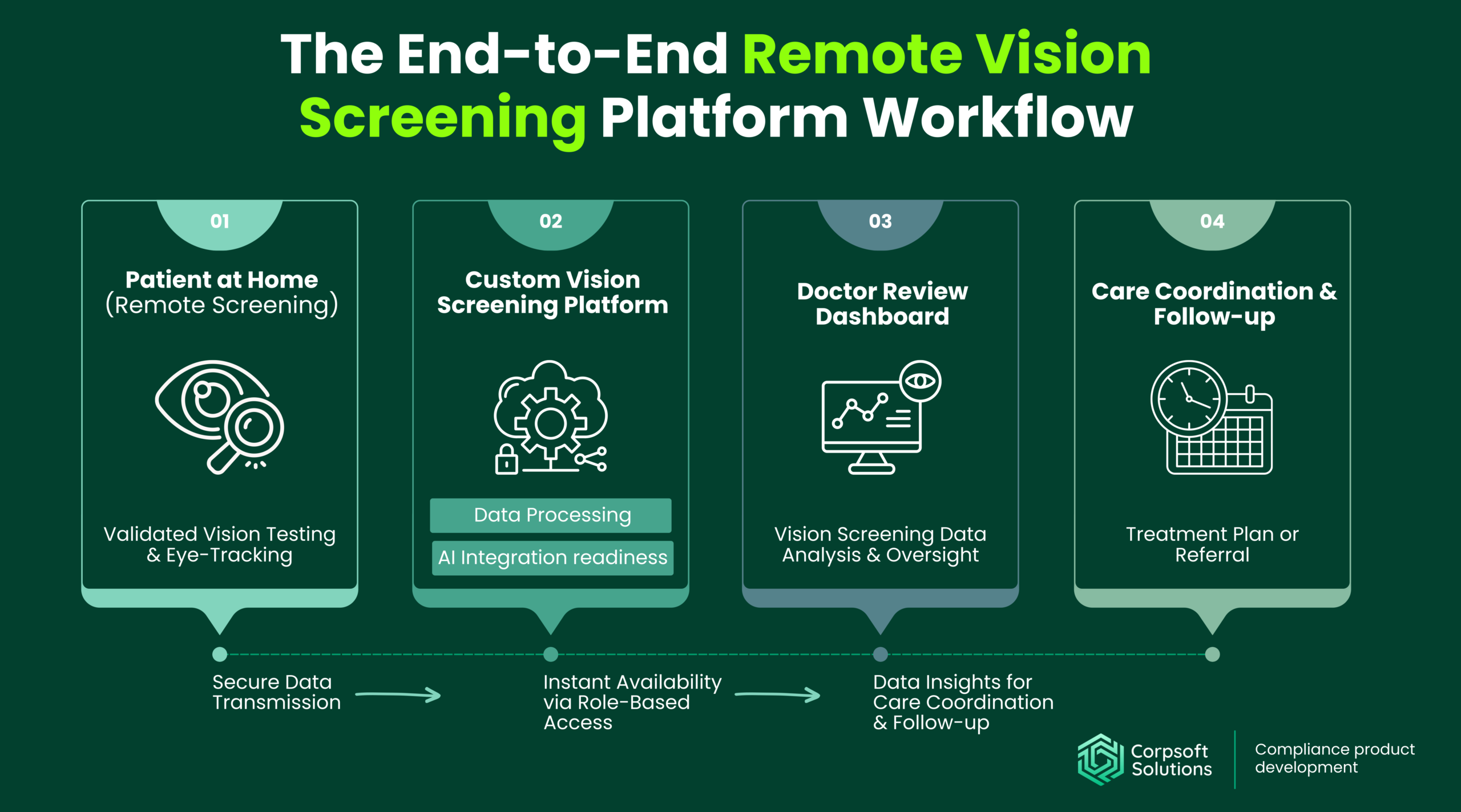
End-to-end remote clinical workflow
The platform supports a complete care loop:
- Patient at home: Logs in, calibrates the screen, and performs the prescribed vision test.
- Secure transmission: Data is encrypted and sent to the cloud.
- Doctor review: The ophthalmologist views the results on a high-fidelity dashboard.
- Follow-up: The doctor updates the treatment plan or schedules an in-person visit if anomalies are detected.
Such a remote digital workflow aligns with real operations in ophthalmology practices.
System architecture and tech stack overview
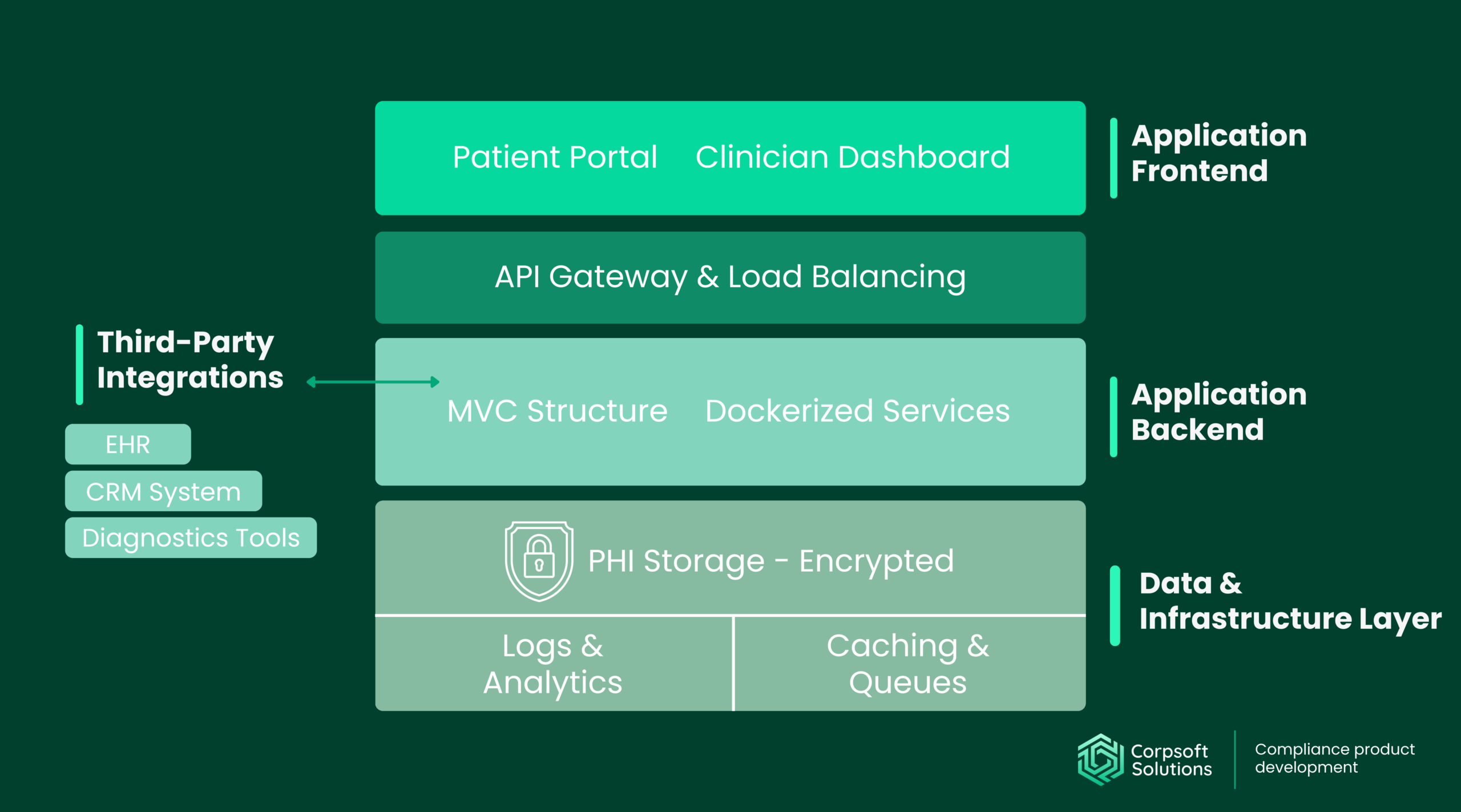
To ensure the HIPAA-compliant telehealth platform was robust and scalable, Corpsoft Solutions experts utilized a layered architecture based on the Model-View-Controller (MVC) pattern.
| Layer | Technology | Purpose |
| Backend Framework | Laravel 9 (PHP 8.1) | MVC architecture, rapid development, HIPAA-friendly ecosystem |
| Database (Relational) | MySQL 8.0.3 (AWS RDS) | Patient records, test results, medical history |
| Database (Logs) | MongoDB | Audit trails, analytics, unstructured event data |
| Caching & Sessions | Redis | Query caching, task queues, session management |
| Cloud Infrastructure | AWS (EC2, S3, SNS, Lambda) + Azure CRM | Scalable compute, secure file storage, CRM sync |
| Containerization | Docker | Consistent dev/staging/prod environments |
| Authentication | JWT + 2FA (Twilio Verify) | API security, multi-factor admin access |
| Encryption | AES-256 (at rest), TLS 1.2+ (in transit) | Protected Health Information (PHI) security |
A technological foundation for AI-supported remote vision screening
Although the remote vision monitoring platform does not require custom ML models, it securely integrates vendor-provided AI-powered diagnostics.
More importantly, with in-house AI expertise, Corpsoft Solutions designs the telehealth platform architecture that is prepared for future AI extensions without refactoring core systems.
Third-party integrations powering telehealth operations
When you build a modern remote patient monitoring system, you can enrich its functionality by combining your own feature development with the integration of well-proven third-party systems.
Key integration points:
| Integration | Purpose |
| EHR | Patient record synchronization |
| CRM | Case management, lead tracking |
| Payments | Payment processing |
| Billing | Invoicing and financial reporting |
| Communications | SMS notifications, 2FA |
| Transactional emails | |
| Monitoring | Alert notifications |
| Medical: IOP | Intraocular pressure data |
| Medical: Retinal Images | Fundus photo analysis |
Telehealth platform for HIPAA, SOC 2, and ISO 27001 compliance from day one
Compliance is the bedrock of healthcare digital solutions, and telemedicine software is no exception.
With extensive experience in regulatory healthcare compliance, Corpsoft Solutions engineers developed a HIPAA-compliant telehealth platform that incorporates capabilities to comply with other national and regional regulations, as well as industry-standard practices.
The primary objective was to minimize compliance risk for practices and platform operators by embedding security, traceability, and access control directly into the system architecture. This approach ensured that the platform could support HIPAA requirements from day one while remaining structurally aligned with SOC 2 and ISO 27001 principles as the product scaled.

Authentication & role-based access control (RBAC)
Rather than relying on a single “security layer,” Corpsoft Solutions implemented defense-in-depth, where each architectural component reinforces compliance guarantees:
- Role-Based Access Control (RBAC) was introduced to ensure that clinicians, administrators, and patients can access only the minimum data required for their role. This directly reduces the risk of unauthorized PHI exposure.
- Strong authentication mechanisms (JWT-based authentication for APIs and Two-Factor Authentication (2FA) for all administrative access, environment isolation) were selected to balance clinical usability with identity assurance.
- Strict environment separation (development, staging, production) prevents accidental data leakage and supports audit-readiness.
These measures map directly to HIPAA’s administrative and technical safeguards.
Encryption and data protection
Remote vision screening involves high-resolution diagnostic data and sensitive patient identifiers. To mitigate data integrity and confidentiality risks:
- In transit: All PHI is transmitted exclusively over encrypted channels (TLS/HTTPS).
- Sensitive fields are encrypted at rest, reducing blast radius even in the event of infrastructure compromise.
- Signed URLs: Platform uses signed URLs and controlled access policies for medical reports, ensuring time-limited, auditable data access and preventing unauthorized direct access to files.
These controls collectively ensure that diagnostic data remains protected throughout its lifecycle — from patient device to clinician review.
Audit logging & governance
Compliance is not only about prevention, but also about traceability. The platform was engineered to support continuous oversight:
- User activity logs: Comprehensive audit logging records user actions related to PHI access and clinical workflows.
- Alerting: Centralized monitoring and alerting enable rapid detection of anomalous behavior or operational issues.
- Consent Management & traceability: Integrated workflows for capturing HIPAA consent and Privacy Policy acknowledgments ensure full access traceability, supporting both regulatory accountability and clinic governance
To meet healthcare software compliance standards, every interaction with PHI is logged. This design allows healthcare organizations to demonstrate due diligence during audits without retrofitting logging mechanisms later.
Preparing for AI-enhanced healthcare operations — securely
By integrating AI-powered diagnostic technologies from specialized third-party vendors, Corpsoft Solutions engineered transparent and controlled data pipelines. This strategic approach ensures that:
- Clinical Decision Support (CDS): AI-driven insights function as assistive tools for doctors.
- Secure ingestion: Diagnostic data processing is governed by the same PHI-aware access controls and encryption standards as traditional clinician workflows.
- Future-ready architecture: The system is intentionally designed to support future regulated AI extensions without compromising existing security boundaries.
These safeguards ensure that technological innovation never outpaces regulatory responsibility.
Mitigating the compliance burden for healthcare organizations
By embedding compliance logic directly into the platform’s DNA, Corpsoft Solutions shifted a significant portion of regulatory complexity away from clinics and platform operators. Healthcare organizations leveraging this system inherit a compliance-ready technical foundation, significantly reducing:
- Internal security overhead
- Risk exposure during audits
- Long-term cost of retroactive compliance fixes
For healthcare leaders evaluating telehealth software, this compliance-first engineering approach translates directly into operational confidence, regulatory resilience, and sustainable growth.
Corpsoft Solutions expert insight: HIPAA-compliant telehealth platforms need operational modeling
It’s not enough for HIPAA-compliant telehealth platforms to merely meet technical security requirements. In the case of the digital vision monitoring platform, the project team conducted a workflow modeling that reflects how ophthalmology practices actually work — across doctors, graders, and administrators.
At Corpsoft Solutions, we design telehealth software by mapping real clinical roles, handoffs, and decision points before writing code. This allows the remote patient monitoring solutions to scale across practices and hospitals without forcing medical staff to adapt their workflows to software limitations. In regulated healthcare environments, operational realism is just as critical as technical compliance.
Project outcomes & measurable impact
Corpsoft Solutions delivered a technically resilient, compliance-ready telehealth software platform designed to scale safely and predictably as clinics, clinicians, and patients were onboarded over time.
Business Impact
User growth & accessibility:
- Over 10,000 monthly active users across participating practices
- Zero-downtime clinic onboarding: New practices can launch diagnostic workflows in hours, not weeks
Geographic Reach:
- Practices can serve patients in rural areas without establishing satellite clinics
- Remote screening increases patient accessibility, particularly for elderly and mobility-impaired populations
Operational Efficiency:
- Patient onboarding reduced from 2 days to ~5 minutes: Eliminates manual scheduling, verification, and education steps
- More than 60% reduction in operational workload for healthcare professionals (based on user testimonials): Clinicians spend less time on administrative tasks, more on clinical decision-making
- 48% improvement in workflow efficiency (client-reported): Streamlined test ordering, result review, and follow-up coordination
Technical impact
Scalability & architectural resilience
- Modular platform architecture with clearly separated core domains (practice management, user management, vision testing, reporting, CRM), enabling independent scaling of system components based on load.
- Proven architectural scalability supporting stable operation from early-stage deployment to 10,000+ active users per month, while continuously onboarding new clinics, doctors, and administrative staff without requiring architectural changes.
- Flexible clinic onboarding and configuration layer allowing each practice to define its own workflows, roles, patient groups, and operational settings without enforcing a rigid, one-size-fits-all model.
Device-agnostic diagnostics & data reliability
- Device-agnostic test calibration ensuring consistent diagnostic accuracy across desktops, laptops, tablets, smartphones, and external monitors with varying screen sizes, resolutions, DPI, and aspect ratios.
- Normalization mechanisms that compensate for hardware variability, preserving the clinical reliability of remote vision screening results.
- Data reliability and continuity engineering, including automated backups, secure data export capabilities for clinics, and infrastructure designed to minimize the risk of data loss for critical medical records.
Compliance readiness & security controls
- HIPAA-ready architecture with technical safeguards implemented, including encryption of sensitive data, PHI-aware role-based access controls, comprehensive audit logging, and restricted administrative access.
- Additional infrastructure-level protections, such as VPN-secured administrative access, to further reduce the attack surface in production environments.
- Operational readiness for SOC 2 Type II controls and alignment with ISO 27001 information security management practices.
Infrastructure & technology governance
- Production-grade cloud infrastructure optimized for both performance and cost efficiency, leveraging monitoring, load balancing, and resource management to maintain stability under growing load.
- Sustainable technology stack governance, keeping frameworks and dependencies aligned with LTS and stable versions, and selecting open-source components with appropriate licensing to ensure long-term maintainability and security.
Key takeaways for digital health founders & executives
1. Full-cycle software product ownership matters in regulated domains
Outsourced development teams can excel at feature implementation but often lack the domain expertise and accountability required in healthcare. Full-cycle delivery (strategy → architecture → coding → testing → deployment → maintenance) ensures continuity, quality, and regulatory alignment.
2. Scaling requires a modular architecture
Outdated architectural systems hit walls at 1,000–10,000 users. Apply a modular approach, microservices, containerization (Docker), and cloud-native infrastructure from the start. The incremental investment pays dividends as you grow.
3. Compliance must be architectural, not bolted-on
HIPAA, SOC 2, and ISO 27001 are not checkboxes — they’re frameworks for secure system design. Embed necessary functionality from day one, not as afterthoughts. The cost of retrofitting security is exponentially higher than building it in from the start.
4. Medical device integration requires specialized expertise
Connecting proprietary medical APIs is complex. Partner with developers who have healthcare integration experience and understand vendor certification requirements, data formats, and security protocols.
5. User experience is clinical
Clinicians and patients won’t adopt poorly designed software, regardless of features. Focus on workflow and test with actual users iteratively. For example, a 5-minute seamless onboarding process (vs. 2 days) and CRM integration reduce doctor burnout and directly impact adoption and revenue.
6. Long-term support is part of the telehealth software product
Telehealth isn’t static. Regulatory changes, EHR updates, medical device firmware patches, and security vulnerabilities require continuous maintenance. Plan for ongoing engineering support as a core element.
Why healthcare leaders choose Corpsoft Solutions for building HIPAA-compliant telehealth platforms
Building a HIPAA-compliant telehealth platform for ophthalmology required far more than engineering — it demanded deep healthcare domain knowledge, relentless focus on user experience, and unwavering commitment to regulatory compliance. Corpsoft Solutions’ five-year engagement with this client demonstrates that custom telehealth software development is neither quick nor straightforward, but the return on investment is profound.
The platform now serves 10,000+ active users monthly, reduces operational burden by over 60%, and enables ophthalmology practices to scale beyond geographic limitations while maintaining diagnostic accuracy and regulatory integrity. As telehealth adoption accelerates — driven by aging populations, rising chronic disease prevalence, and persistent healthcare access gaps — demand for specialized, compliance-first platforms will only intensify.
For healthcare organizations and digital health founders considering custom telehealth development, the core lesson is clear: invest in full-cycle delivery with partners who bring healthcare expertise, architectural rigor, and long-term accountability. The competitive edge, confidence in compliance, and patient outcomes justify the investment.
Frequently asked questions
How does remote patient monitoring work in ophthalmology specifically?
In ophthalmology, remote patient monitoring (RPM) relies on patients performing structured vision tests at home, with clinicians reviewing results asynchronously. A compliant remote patient monitoring platform must ensure diagnostic consistency, secure data transmission, and role-based clinical oversight.
Corpsoft Solutions specializes in remote patient monitoring software, including RPM solutions for vision care, enabling clinics to detect disease progression early without unnecessary in-person visits.
Are remote patient monitoring devices required for vision care RPM?
Not always. While some remote patient monitoring devices (such as tonometers) can be integrated, many ophthalmology RPM workflows rely on calibrated digital tests performed via standard consumer devices.
Corpsoft Solutions designs remote patient monitoring solutions that combine device-agnostic testing with optional medical device integrations, depending on clinical needs.
Can telehealth platforms support insurance billing and reimbursement?
Yes — but only if billing logic is designed alongside clinical workflows. Corpsoft Solutions integrates billing, reporting, and CRM workflows directly into telehealth software platforms, allowing clinics to track time, services, and reimbursement-ready data from day one.
Why not use an off-the-shelf telemedicine app?
Off-the-shelf telemedicine apps rarely support complex diagnostics, RPM workflows, or multi-role clinical operations. They also limit architectural control over compliance and scalability.
Healthcare organizations that require long-term growth typically choose custom healthcare software development, where Corpsoft Solutions provides full ownership and regulatory alignment.
What makes a telehealth platform HIPAA-compliant?
HIPAA compliance requires implementation of three core safeguards: Administrative (policies, training, access controls), Physical (facility security, device encryption), and Technical (encryption, audit logging, secure authentication).
Specifically, platforms must include end-to-end encryption (AES-256 at rest, TLS 1.2+ in transit), role-based access control with multi-factor authentication, comprehensive audit logs, secure data storage with regular backups, and signed Business Associate Agreements (BAAs) with all vendors handling Protected Health Information (PHI).
How do you ensure HIPAA compliance without slowing down development?
HIPAA compliance slows teams down only when it’s treated as a checklist. Corpsoft Solutions has substantial in-house compliance expertise and embeds healthcare software compliance directly into system architecture, access control, and data flow design.
This approach allows rapid feature development without introducing compliance regressions.
Share this post: