



TL;DR:
- Your AI system works. It will not survive a regulatory compliance review — a different exam than a buyer’s security questionnaire. Three failure points recur: architecture not built for accountability, no decision logging, and documentation that doesn’t exist yet.
- This article introduces the AI Compliance Stack, Corpsoft Solutions’ three-layer framework: data governance, model governance, regulatory compliance.
- Failing a review has consequences beyond a lost deal: a regulator can order a fix, restrict the system’s use, or force its withdrawal from the market.
- Most of this is architectural work, decided long before the review lands.
Your AI system works. It will not survive a regulatory review.
Six months ago the model was a notebook experiment. Now it’s in production, and a CTO is trying to work out what stands between a working demo and a signed enterprise contract. The instinct is familiar: ship first, worry about AI regulatory compliance once a client actually asks.
That instinct is what fails. A regulatory review checks the system itself against the applicable regulatory framework — a different question than an enterprise buyer’s evaluation. Enterprise AI Security: What Buyers Actually Ask Before They Sign covers what a buyer checks before signing; this article covers what a regulator or an auditor checks against a statute, the exam most technical teams haven’t prepared for.
Three reasons AI pilots fail regulatory review
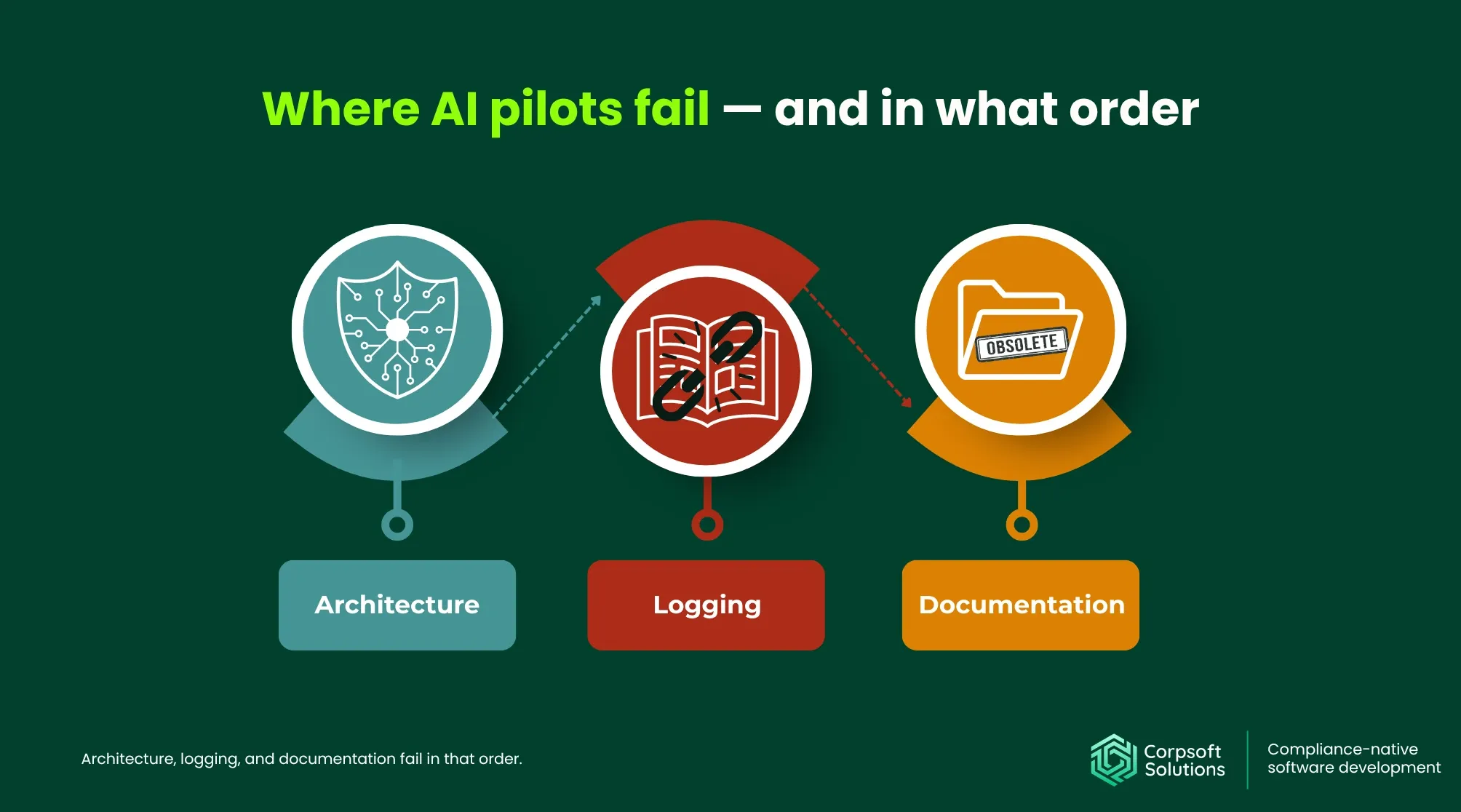
Three gaps recur across AI regulatory reviews, whatever framework is asking — the EU AI Act, GDPR, or a comparable domestic regime. The architecture wasn’t built to be accounted for, nobody can reconstruct what the model did, and the paperwork a reviewer expects doesn’t exist yet.
Architecture that ships fast leaves no room for accountability.
Most AI pilots move from notebook to production the way any feature does: fast, with decisions hardcoded to unblock a demo instead of survive scrutiny. The tenant boundary that should stop one customer’s data from reaching another’s context is enforced by convention, not by the query layer, and retention lives in a wiki page instead of the database.
Decisions made to hit a ship date rarely get revisited once the demo works. There’s little reason to question them until someone outside the team asks to see the evidence.
A team moving an AI pilot to production usually hasn’t decided:
- Which store keeps customer inputs, and for how long
- Whether a vendor processing them can move that data across a border the contract never mentioned
The corner most often cut is logging. A team debugging a flaky pilot turns on full prompt-and-response logging to see what’s happening, and rarely turns the granularity back down once things stabilize. That log now holds exactly the data the tenant boundary was supposed to separate, sitting in a tool with its own retention policy and its own access list.
Corpsoft Solutions calls this Compliance-Native Architecture: designing the data path so isolation, retention, and consent are enforced by the system itself. The same failure pattern shows up outside the compliance context too — see: AI Data Governance: What Breaks at Scale, and What Fixes It.
Without model governance, nobody can reconstruct what happened.
A regulator’s question is rarely “does the model work.” It’s “show me what it did on a specific date, for a specific input, under a specific model version.” The answer isn’t hidden. In many cases, nobody logged it.
Imagine a model’s decision is disputed six months later: can you replay exactly which version produced it, and why? AI model governance means treating every model call like a financial transaction: versioned, timestamped, traceable to a specific request, with human oversight recorded whenever a person actually intervenes.
The gap usually isn’t total silence — most teams log something. What’s missing is the link between a specific output and the exact conditions that produced it:
- Which prompt template version was active
- Which retrieved context fed into the prompt
- Which model checkpoint generated the response
Without that link, a logged output stays a data point instead of evidence. What Is Explainable AI — and When Does the EU Actually Require It? covers the related question of when a model has to explain itself.
The documentation doesn’t exist yet.
By the time a reviewer asks for a data flow diagram or a model card, the team is usually building it for the first time, under a deadline. Documentation assembled this way describes the system as someone remembers it, not as it runs today. A regulatory review surfaces architectural debt that was already there before anyone asked to see it.
Two details make hastily-assembled documentation unreliable in practice:
- Whoever can answer fastest usually ends up writing it, working from memory and old pull requests.
- It captures one moment, and nothing prompts an update until the next review forces one.
Many high-risk AI systems under the EU AI Act must go through a conformity assessment before going to market — either an internal check or, for some systems, one that involves a notified third party. EU AI Act Risk Categories Explained: Is Your AI System High-Risk? covers classification in depth. AI compliance requirements at this layer mean generating documents from a system that already produces the evidence.
The AI Compliance Stack: the framework in full
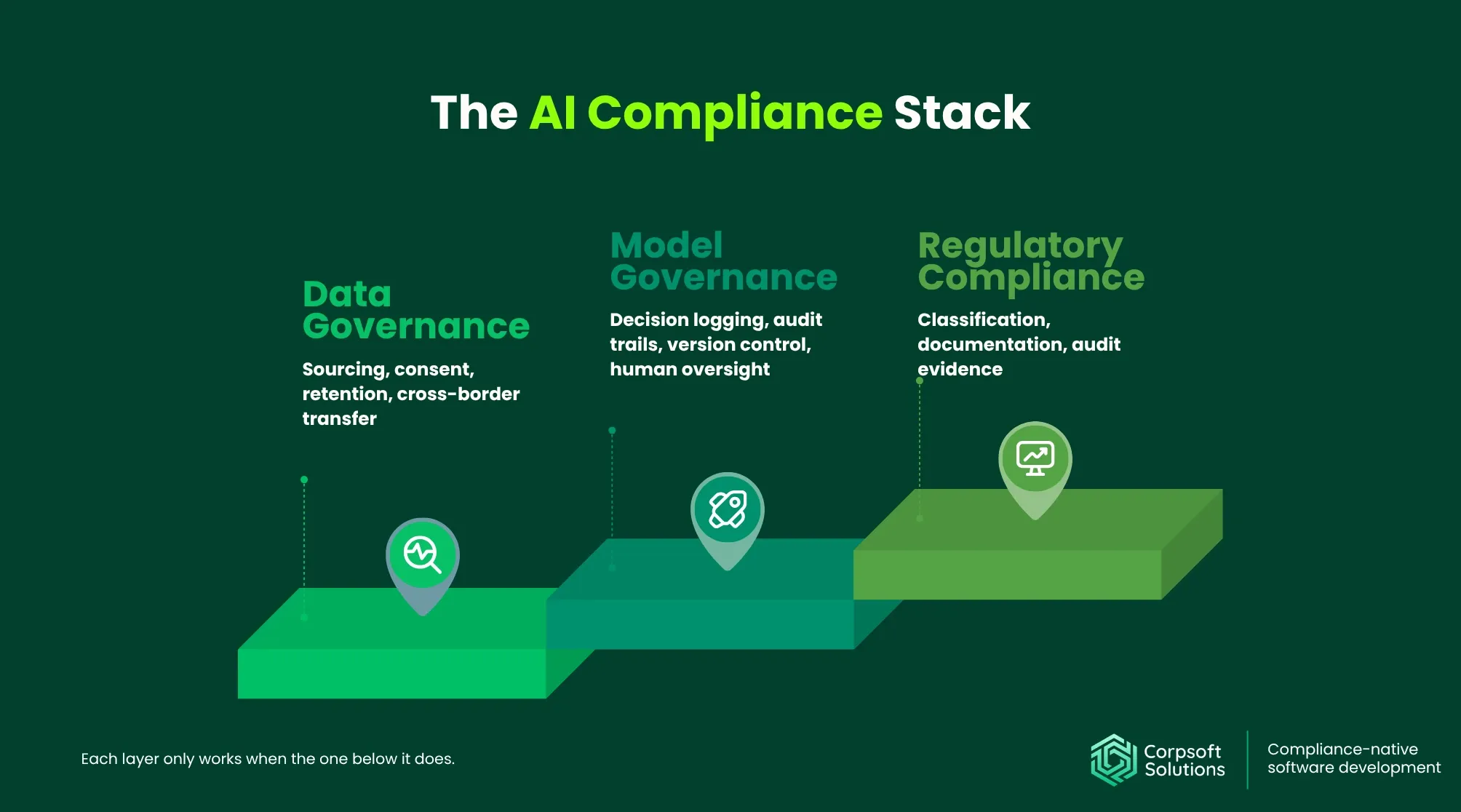
Every reason above traces back to the same gap: no structural answer to “can you prove it.” Corpsoft Solutions’ AI Compliance Stack organizes this work into three layers, each mapped to a build decision instead of a document written after the fact.
An AI governance framework built around the stack holds up under review because each layer answers a different question a reviewer asks: what data went in, what the model did with it, and what evidence proves both.
| Layer | What it governs | What a reviewer asks to see | What breaks without it |
| 1. Data Governance | Sourcing, consent, storage, retention, cross-border transfer, anonymization | A data flow diagram and a record of consent for each source | Data goes where nobody tracked it, and stays past its retention window |
| 2. Model Governance | Decision logging, audit trails, version control, explainability, human oversight | Logs tying a specific output to a specific model version and input | No one can reconstruct what the model did or when a human intervened |
| 3. Regulatory Compliance | Classification, documentation, technical standards, audit evidence | Technical documentation and evidence that matches the system as it runs today | Every review starts from zero, rebuilding evidence the system should already produce |
Layer 1: Data Governance
This layer decides what a model is allowed to see and what survives once it’s done processing.
- Sourcing determines whether the data had a valid legal basis behind it — consent is one, but far from the only one.
- Retention determines how long a customer’s input lives in a prompt log, a vector store, or a backup nobody remembers configuring.
For an AI system, this layer carries two problems ordinary data governance doesn’t:
- Training data governance is separate from runtime data governance: the provenance of a training dataset and the consent behind each record inside it don’t disappear once training finishes. A deletion request against that data hits a hard technical wall — erasing a database record is easy, but a model already trained on it has absorbed patterns that don’t erase the same way.
- Cross-border transfer covers more than storage: routing an inference call to a third-party model hosted in another jurisdiction moves the input itself across that border every time the model runs.
Layer 2: Model Governance
This is where AI model governance lives operationally: which model version served a specific request, what decision it produced, and whether a person reviewed it before it reached a customer.
Two details separate this from ordinary software versioning:
- Treat a model version as more than a code commit: the trained weights, the date they were produced, and a snapshot of the dataset used to train them. Rolling back code doesn’t roll back a model that already learned from different data.
- An audit trail here means binding one specific output to one specific model version and one specific input, with a record of whether a person reviewed that output before it went out.
Decision logging and audit trails are what make the system answerable months after a specific call was made.
Layer 3: Regulatory Compliance
This layer turns the first two into something a regulator recognizes:
- Classification under the relevant law
- Technical documentation that matches what the system actually does
- An evidence trail an auditor can follow without asking engineering to reconstruct it from memory
It only works when Layers 1 and 2 already generate the evidence it needs.
In practice, that documentation describes:
- The system’s architecture
- The methodology behind it
- How risks were assessed during development
- The performance metrics used to evaluate it
These are the same categories of information a technical reviewer would want, regardless of which specific law is doing the asking.
What failing a regulatory review actually costs
A failed regulatory review costs more than a delayed deal: a regulator or an auditor can restrict what the system is allowed to do, and enforcement doesn’t wait for a convenient sprint.
For the CTO who built the system, the real cost is architectural. Fixing the gaps a review surfaces after a large deal is already on the table means re-architecting under a deadline nobody chose, instead of building it in from the start. That’s the fear behind “we’ll do compliance when a client asks” — the asking comes with a clock attached.
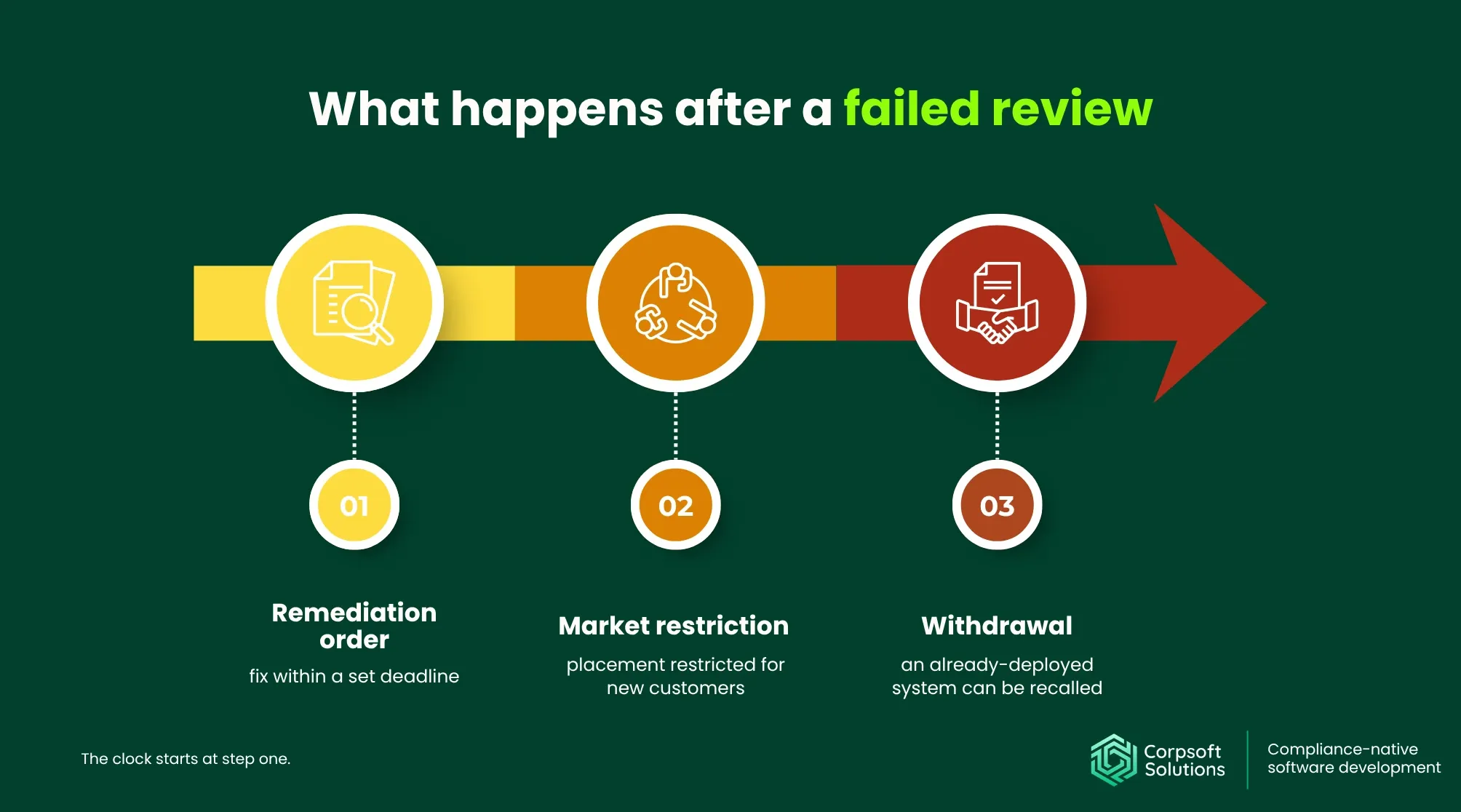
Enforcement generally follows an escalating pattern, though the specifics vary by regulator and regime:
- Remediation order: fix the specific gap within a set deadline
- Market restriction: if the gap isn’t closed, placing the system on the market gets restricted or prohibited for new customers or new markets
- Withdrawal: an already-deployed system can be ordered withdrawn or recalled entirely — a different problem than losing a pending deal
A readiness check before the deal forces it
The teams that pass a regulatory review without a scramble share one habit: they check readiness before a client asks. That’s what AI audit readiness looks like in practice: checking the same three questions a reviewer will ask, before the deal forces the question.
These three questions make a workable AI compliance checklist — short enough to revisit before every enterprise conversation.
- Can we show what data entered the system, where it’s stored, and when it’s deleted?
- Can we reconstruct what a specific model version did for a specific request?
- Does our documentation describe the system as it runs today?
Each question maps to one layer of the stack: the first to Layer 1, the second to Layer 2, the third to Layer 3 — the same order the three reasons above were introduced in.
Corpsoft Solutions runs this as a 7-Day Risk Assessment: a focused review of the stack, mapped against what a regulator would actually check. The output is a gap map organized by layer, showing exactly where the architecture, the logging, or the documentation falls short.
Related questions worth exploring
Handling a commercial security review instead of a regulatory one? Enterprise AI Security: What Buyers Actually Ask Before They Sign covers what an enterprise buyer asks before signing. The questions differ from a regulator’s, but the stack that answers a regulator’s questions answers a buyer’s too.
Wondering what it costs to wait? The hidden cost of ignoring AI governance until your first enterprise deal makes the commercial case for building this before a deal forces it.
New to the concept entirely? AI Governance in Practice: How to Manage Risk, Compliance, and Accountability at Enterprise Scale is the broader starting point.
Share this post: