



TL;DR
- 88% of organizations use AI, but only 8% maintain a functioning AI governance system
- Enterprise procurement doesn’t just check security — it checks AI-specific architecture: decision logs, model versioning, explainability, human oversight
- The real cost of delayed governance isn’t a regulatory fine — it’s a lost deal, a frozen roadmap, and an Audit-to-Fix Gap that compounds under pressure
- Governance isn’t a document. It’s architecture. If auditability wasn’t built in from day one, no policy will cover for it during a security review
- Whether you’re building from scratch, modernizing an existing system, or unsure where you stand — the starting point is the same: a 7-day architecture audit
88% of organizations use AI in at least one business function. Yet only 8% maintain a fully operational AI governance system — not because they don’t know it matters, but because they keep pushing it to later.
The problem is that “later” isn’t theirs to choose.
For most teams, the moment arrives like this: the system is in production, the product is working, and a serious enterprise lead has appeared in the pipeline. Procurement sends a security questionnaire. The buyer’s legal team requests documentation on how the model makes decisions. Or it turns out that without audit logs, the DPA won’t be signed.
And that’s when it becomes clear that “the system works” and “the system is enterprise-ready” are two different things. Over 70% of IT leaders cite AI compliance and governance as one of the biggest challenges in deploying AI systems. The gap between those two states has a real cost. This article breaks down what that cost consists of — and what to do about it.
What enterprise buyers actually evaluate — and why most AI systems don’t pass
When an enterprise buyer evaluates an AI vendor, the standard security checklist — encryption, access controls, backups — is just the first layer. Behind it comes a specific set of questions about the AI system itself. And that’s exactly where most teams get stuck.
It’s worth understanding why. Most technical teams treat procurement questions as a formality. In reality, every question checks a specific risk — and procurement knows exactly what it’s looking for. Here’s what that block looks like in a real vendor security questionnaire — with the logic behind each question:
| Question from enterprise procurement | What they’re actually evaluating | Typical response from an unprepared team |
| Provide documentation on which model version is currently in production, when it was deployed, and what changes were made. | Change control — can the vendor prove that the system behaves predictably and that changes are made in a controlled way? | “We have git history, we can provide deployment logs.” |
| How does your system log model decisions — inputs, outputs, user context? Can a specific decision be reproduced six months from now? | Decision reproducibility — critical for regulatory investigations and the buyer’s internal audits | “We log errors and key events, but we don’t store full decision traces.” |
| Describe the mechanism by which a human can review or override an automated decision. | Risk management — is there meaningful human control over automated decisions that may affect people | “We have a support team that can intervene manually when necessary.” |
| How does your system handle user requests for explanations of automated decisions under GDPR Article 22? | Legal liability — is the buyer protected from user complaints about automated decisions? | “We comply with GDPR; our privacy policy reflects this.” |
| Provide evidence of how personal data is isolated from the training pipeline. | Data accountability — who is responsible if personal data enters the model? | “We apply anonymization before model training.” |
None of these answers is untrue. But none of them satisfies enterprise procurement. In projects where we participated in enterprise security reviews, questions about decision logging and model lineage came up consistently — regardless of company size or product maturity. And the issue was almost never an absence of policies. It was an absence of technical artifacts that could actually be shown to an auditor.
The difference between a team that passes a review and a team that fails it isn’t intent. It’s architectural decisions made months earlier.
The most expensive mistake
Teams often treat AI governance and compliance as documentation. Write a privacy policy, draft a data processing agreement, prepare an architecture overview — and consider governance done.
Governance isn’t documentation. Governance is architecture.
If a system wasn’t designed with auditability in mind — meaning decision logging, model versioning, and explainability aren’t part of the architecture from day one — documentation will have to be reconstructed manually before every review. And each time, that “documentation” will describe not what the system actually does, but what the team remembers or can piece together after the fact.
Enterprise procurement sees the difference between a system that generates audit evidence as part of its normal operation — and a system where that evidence is assembled by hand before each audit. The first passes the review. The second gets a list of gaps.
This mistake is expensive not because anyone broke the rules. It’s expensive because architectural decisions that seemed neutral at an early stage become blockers at the moment of the first enterprise deal. Responsible AI governance models are built into the architecture — not bolted on afterward.
The real cost: three levels
This cost breaks down into three levels, each with a different nature. Most teams only count the first one — which is exactly why the true scale of the problem comes as a surprise.
The Cost of Rebuilding Architecture Under Pressure
Adding a governance layer to a system that wasn’t designed for it isn’t “adding a module.” It touches several layers simultaneously.
An audit trail that wasn’t built in from day one can’t be inserted without reworking the logging infrastructure. Model versioning, which wasn’t part of the original design, requires changes to the data pipeline. Decision logging affects the API layer, storage, and retention policies simultaneously. Consent capture for AI decision flows isn’t a cookie banner — it’s an architectural component that needs to be present at every point where the model makes decisions involving personal data.
A typical scenario looks like this. An AI company is negotiating with an enterprise buyer — a $200K ARR contract. At the security review stage, procurement requests a decision audit log for the past six months. It turns out the system only logs errors and system events — not model decisions. Adding structured decision logging requires changes to the API layer, a separate logging infrastructure, and a revised retention policy. The team’s estimate: 8–10 weeks of work from two senior engineers. One of them is fully pulled off the product roadmap. The buyer isn’t willing to wait — they have an alternative vendor with documentation already in place. The deal is lost.
Every compliance gap adds 2–4 weeks of remediation work and extends the legal review. Six gaps — and the deal either dies or gets delayed by 3–6 months. In 2025, companies lost $4.4 billion due to AI-related compliance failures.
The cost of a lost or delayed contract
Enterprise procurement doesn’t wait for fixes. If a security review returns critical gaps — that’s not a pause. It’s either a lost deal or 3–6 months of re-engagement with an uncertain outcome.
The average enterprise sales cycle for B2B SaaS runs 6–12 months. On top of the direct loss from a collapsed deal comes the cost of the sales cycle already spent: account executive time, legal review, technical demos — all of it invested before the compliance gap was discovered. And the entire cycle has to start over — if the buyer agrees to re-engage at all.
If the target contract is worth $200K ARR — losing three such deals in a year to vendor security assessment failures creates a revenue gap that no SMB pipeline will fill fast enough. There’s another dimension that rarely gets counted: enterprise procurement communities are small and tightly connected. Information about a failed security assessment travels — and can reach other enterprise buyers.
The cost of the audit-to-fix gap
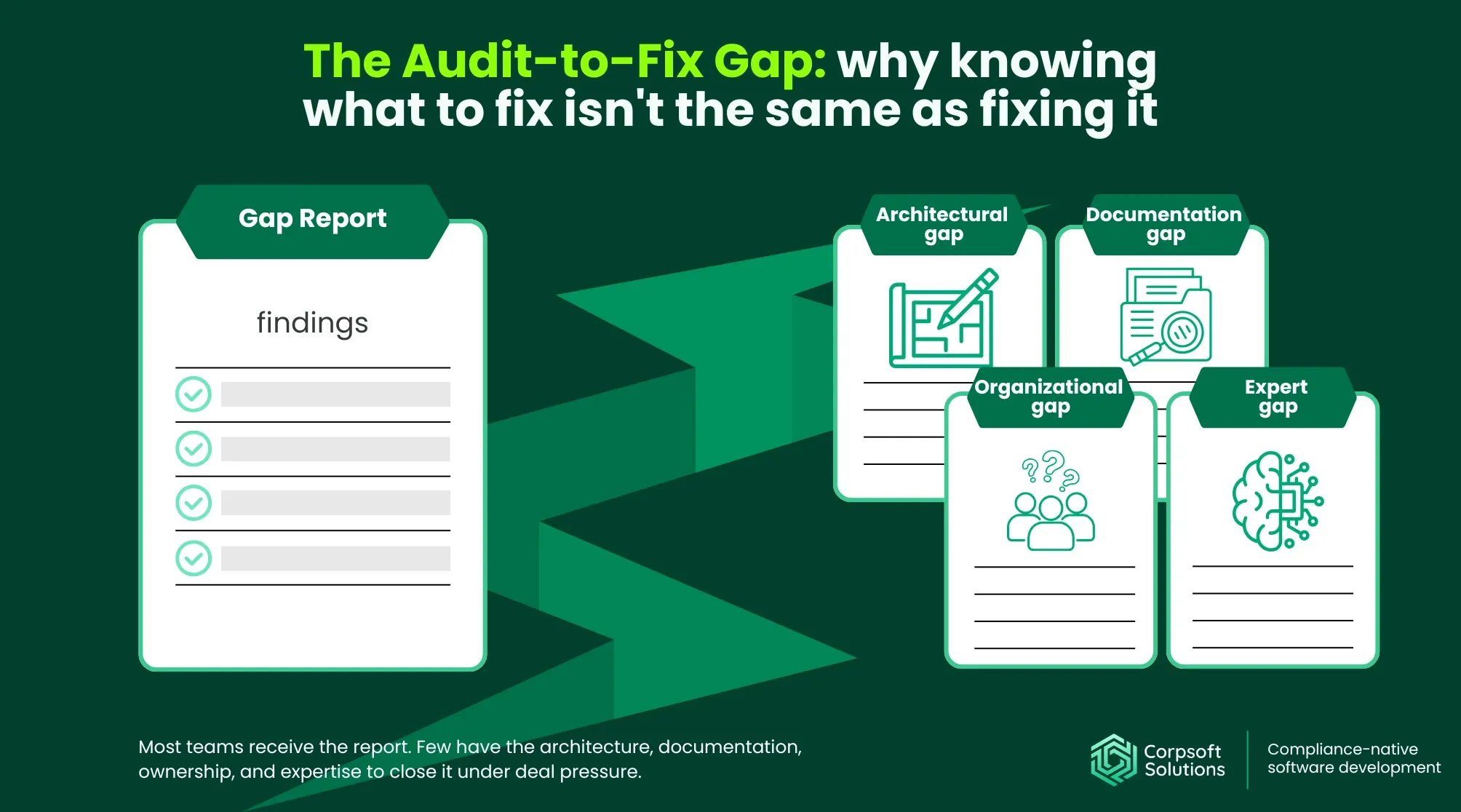
Even if the deal isn’t immediately lost, the team faces a third level of cost. Most receive a gap report from an auditor or procurement and find themselves knowing what needs to be fixed but lacking the tools to fix it quickly.
This is the Audit-to-Fix Gap. But to understand why it’s so expensive, it needs to be broken down into components. It’s not one gap — it’s four, existing simultaneously.
The architectural gap. The system wasn’t designed for auditability. Decision logging, model versioning, and explainability aren’t part of the architecture — they need to be added to a system already in production, with dependencies that complicate any change. This isn’t technical debt that can be closed in a sprint. It’s a fundamental difference between a system designed for auditability and one that must be made auditable after the fact.
The documentation gap. Artifacts are either missing or scattered across locations in formats that don’t satisfy an auditor. Model cards were written at some point for internal use. Data flow diagrams exist but don’t reflect the system’s current state.
Retention policies live in engineers’ heads but aren’t documented. Assembling a documentation package for enterprise review from all of this is a separate effort that takes weeks.
The organizational gap. Nobody in the company owns governance as a distinct function. When a gap report arrives, it’s unclear who’s responsible for fixing it. Engineering? Legal? Product? Everyone considers it outside their lane — or doesn’t have bandwidth to step away from their primary work. Compliance work is estimated to cost companies $80,000–$130,000 per FTE per year — and that’s only direct costs, not counting the value of lost deals.
The expertise gap. Engineers hired to build the product weren’t hired for compliance architecture. They may be technically strong — but lack experience with enterprise security reviews, EU AI Act requirements, or the technical implementation of GDPR Article 22. The consultant who wrote the gap report’s recommendations doesn’t work on production systems.
The result: the team knows what needs to be done — but not how to actually implement it within their specific architecture under deal pressure.
It’s the combination of all four gaps that makes the Audit-to-Fix Gap so expensive. Each one in isolation would be manageable. Together — under the pressure of an active enterprise deal with a hard deadline — they become a blocker.
Is your AI system ready for enterprise review?
Before moving on — a quick self-assessment. Answer “yes” or “no” to each question.
| # | Question | Yes / No |
| 1 | We know which model version is currently in production and when it was deployed. | |
| 2 | We can reproduce a specific model decision from six months ago. | |
| 3 | We have a model registry linked to training datasets and evaluation metrics. | |
| 4 | We have a structured decision audit log that includes the model version ID and user context. | |
| 5 | We have a documented and technically implemented human review process. | |
| 6 | We can show a data flow diagram that reflects the current state of the system. | |
| 7 | We know exactly what data enters the training pipeline and on what legal basis. | |
| 8 | We have a retention policy for AI decision logs reviewed by our legal team. | |
| 9 | We can respond to a GDPR Article 22 request regarding an automated decision. | |
| 10 | We can prepare a complete documentation package for enterprise procurement review within one week. |
Results:
8–10 “yes” — high readiness level. Your system has the foundation to pass an enterprise security review.
5–7 “yes” — risks exist. Some gaps may become blockers at the procurement stage. It’s worth running an audit before your first serious lead appears.
0–4 “yes” — AI governance may block your first enterprise deal. The earlier you start, the less it will cost.
If, in answering these questions, you found that some artifacts “exist but not in the right format” or “exist somewhere but need to be found” — that’s also a gap. Enterprise procurement doesn’t accept “we have it but need to pull it together.” They accept a ready documentation package.
What a system with built-In governance looks like — concretely
Imagine that the enterprise buyer’s procurement team receives from you not a list of links to your privacy policy — but a documentation package. It contains: a model registry with version history and deployment dates; structured decision logs with a retention policy; a data flow diagram with personal data isolation points; sample explanation objects for typical system decisions; and human review process documentation with an audit trail for the past quarter.
This isn’t a report prepared ahead of an audit. These are artifacts the system generates as part of its normal operation — when governance is built into the architecture from day one. That’s what distinguishes Compliance-Native Architecture from the “we’ll add compliance when someone asks” approach.
Here’s what this looks like in the context of a real procurement questionnaire:
| Question from enterprise procurement | Response from a team with built-in governance |
| Provide documentation on model versions in production | Here is the model registry with versions, deployment dates, artifact hashes, and a link to the training run for each version |
| Can a specific decision be reproduced six months from now? | Yes. Every decision event is logged with model version ID, input hash, output, and user context. Retention — 24 months |
| How can a human review or override an automated decision? | A human review queue is integrated into the workflow for decision categories X and Y. Here is the audit trail of reviews for the past quarter |
| How does the system handle requests for explanations of decisions under GDPR Article 22? | Every decision generates an explanation object. Here is an example for a typical use case |
| How is personal data isolated from the training pipeline? | Here is the data flow diagram with isolation points, the anonymization pipeline, and lawful basis documentation for training datasets |
The difference between these responses and the typical gap responses from the previous section isn’t a knowledge gap. It’s the difference in architectural decisions made at the beginning of development.
Here’s what sits behind each of these documents — and what needs to be documented before an enterprise security review:
- Audit logging — a structured decision log with model version ID, timestamp, input summary, output, and user context for every decision. Stored separately from application logs with a retention policy reviewed by the legal team. The critical distinction: not “we log events” — but “here is a log of every model decision for the past 24 months in a structured format accessible to an auditor.”
- Model versioning and lineage — a model registry where each version is linked to its training dataset, evaluation metrics, and deployment record. Without this, it’s impossible to answer the basic questions posed by the EU AI Act and GDPR Article 22. This is the first thing requested at an enterprise review — and the first thing most teams don’t have when their first serious lead appears.
- Explainability — an explanation object generated as part of every decision and stored alongside the decision log. The difference between “we can explain if asked” and “the system generates an explanation as part of every decision” is the difference between an architecture that passes a review and one that fails it.This is a core part of how governance practices support explainable AI in production environments.
- Consent capture — an architectural component that verifies the presence of appropriate consent before every AI decision flow involving personal data. Not an entry in a privacy policy — a check in the code at every point where the model makes a decision.
- Human-in-the-loop checkpoints — documented categories of decisions that require human review before execution. With an audit trail showing who reviewed, when, and what decision was made. For high-risk classifications under the EU AI Act, this isn’t optional — it’s a requirement.
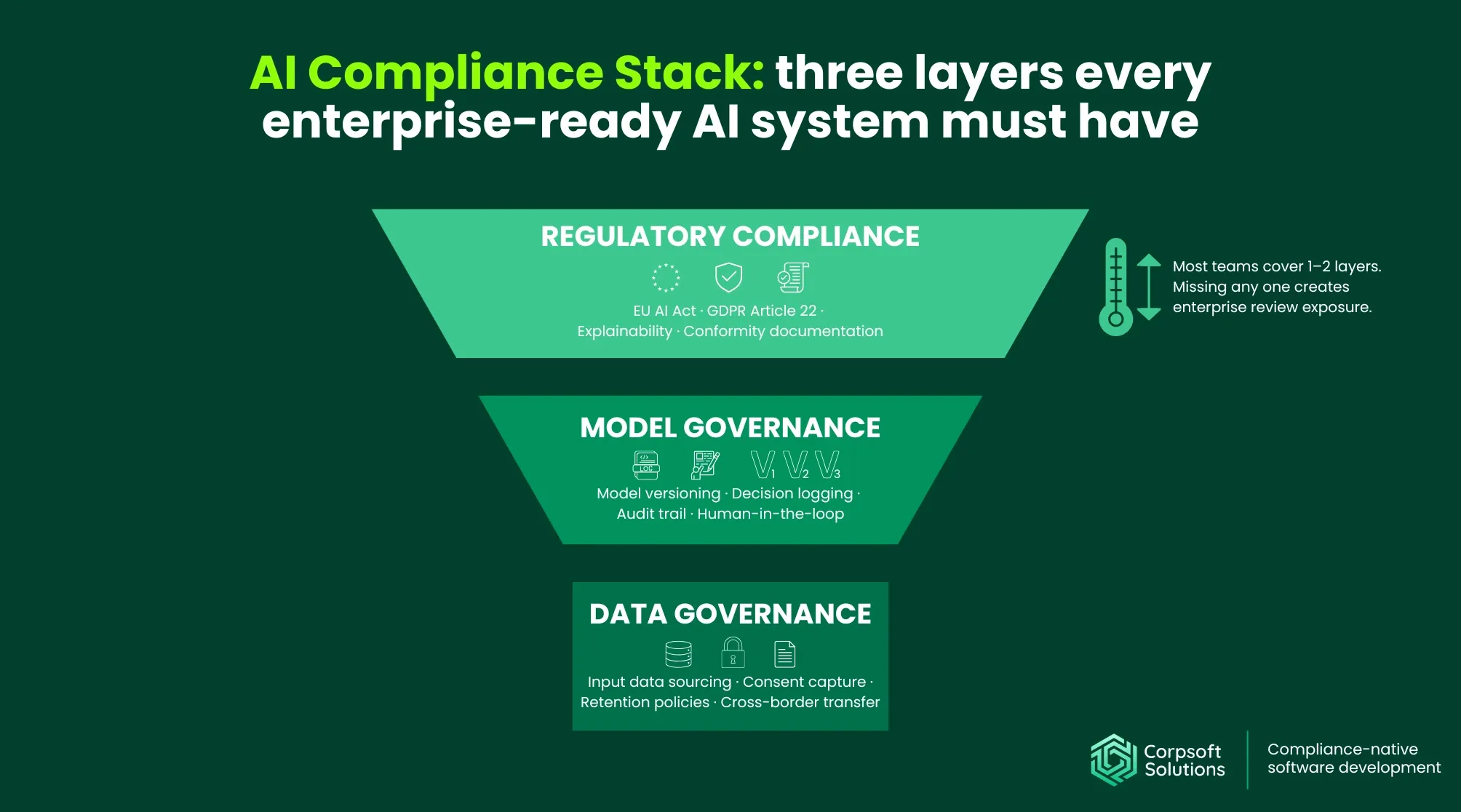
All five components together form the AI Compliance Stack — three layers that must be covered simultaneously: data governance, model governance, and regulatory compliance. Most teams cover one or two. The absence of any one of the three creates regulatory exposure — and that’s exactly what enterprise procurement uncovers.
For more on how these components fit into a broader AI compliance architecture — see our materials on AI governance and AI data governance for enterprise.
If your system uses AI in specific industries — healthcare, finance, HR — it’s also worth reviewing industry-specific AI governance requirements.
If you only have 30 days
Not every team has the time and resources to close all gaps simultaneously. If an enterprise deal appeared earlier than expected — here’s where to start.
Three components that most frequently become the subject of first questions during enterprise review — and that deliver the highest impact with limited time:
- Decision logging. Launch a structured decision log with the minimum required fields: model version ID, timestamp, input summary, output, user context. Even basic logging is better than none — and provides a foundation to build on. This is what procurement asks about first and what’s easiest to demonstrate.
- Model versioning. Create a model registry — even in a simple format. Document the current production version, deployment date, and link to the training dataset. This takes a few days but closes one of the most common review questions.
- Data flow documentation. Prepare an up-to-date data flow diagram showing where personal data enters the system, where it’s processed by the model, and where it’s isolated from the training pipeline. This isn’t a technical diagram for engineers — it’s a document for an auditor.
These three elements won’t replace a full governance layer. But they make it possible to get through the first round of a procurement questionnaire and buy time for systematic work.
Implementation roadmap
For teams ready to act systematically, here is a sequence that delivers predictable results without stopping development.
Stage 1: Visibility — knowing what exists and where
Goal: get a complete picture of the AI system’s current state from a governance perspective.
- Audit logs: do they exist, in what format, what do they cover
- Model registry: does it exist, how current is it
- Model inventory: which models are in production, which are in development
- Data flows: where personal data enters the system and where it exits
- Third-party integrations: which external APIs process user data
The output of this stage isn’t a document. It’s a clear understanding of the gaps between the current state and what’s needed for enterprise review.
Stage 2: Control — adding governance mechanisms
Goal: embed components into the system that give control over AI decisions and data.
- Consent management: verification of consent before every AI decision flow
- Retention policies: documented and technically implemented for decision logs
- Human review: documented categories of decisions requiring human oversight
- Access controls: who has access to models, training data, and decision logs
The output: a system where every AI decision flow is controlled and documented.
Stage 3: Governance — sustained practice, not a one-time preparation
Goal: transform compliance from a one-time pre-audit exercise into a continuous process.
- Risk assessments: regular evaluation of new AI components before deployment
- Explainability: explanation objects as a standard part of every decision
- Continuous monitoring: drift detection and compliance alerting as part of the MLOps pipeline
- Documentation lifecycle: a process for updating documentation when the system changes
The output: a system that generates audit evidence as part of normal operation. The next enterprise review requires no separate preparation. This is what responsible AI governance looks like in practice — not a policy document, but a running system.
For teams evaluating enterprise AI governance tools and platforms to support this roadmap — the choice of tooling matters less than the architectural decisions that determine what those tools will actually monitor. AI model governance tools and ai governance tools and technologies are only as effective as the logging and versioning infrastructure beneath them.
Honest about the cost of built-In governance
Compliance-Native Architecture has its own price. It’s worth being direct about this.
Longer design phase. Building in a governance layer from day one means more time on architectural decisions before development begins. Under pressure to move fast, this is a real tradeoff.
Additional logging infrastructure requirements. A structured decision log with full context means more data, more complex infrastructure, and higher storage costs. For systems with high decision volume, this is a noticeable line item.
More complex data pipeline. Consent capture, data lineage, and training data governance add layers to the pipeline that need to be designed, maintained, and updated as the system evolves.
Higher upfront investment. Organizations report up to a 40% increase in compliance burden when adding governance after the fact — but proactive implementation has its own cost too.
But these costs are predictable. They can be budgeted, distributed across sprints, and implemented in parallel with the product roadmap. The cost of rebuilding during an active enterprise deal is unpredictable. It’s not a budget line. It’s a crisis that stops the team at the worst possible moment.
The difference between the two approaches isn’t just the total amount. It’s the difference between controlled costs and uncontrolled ones.
Why this doesn’t stop development — and what Parallel Track means
The most common objection when a team realizes the scale of governance work is: “If we tackle this now — the roadmap freezes for a quarter.”
This is a false dilemma. But only if governance implementation runs in parallel with the product track — not instead of it.
Parallel Track isn’t a “do everything at once” methodology. It’s a clear separation of responsibilities with defined synchronization points where two tracks intersect just enough to stay aligned — and no more.
How it works in practice:
Product track continues at its normal pace — feature development, sprint cycles, product roadmap. Nothing stops.
The compliance track runs in parallel and covers architecture fixes for the governance layer, controls implementation, audit evidence generation, and documentation for enterprise review.
This is separate work with a separate scope — it doesn’t compete with the product roadmap for resources.
Synchronization happens at defined points — not a constant intersection of two tracks, but specific moments of alignment:
|
Sprint gate |
What compliance track checks |
Who’s involved |
| Architecture review | Does the new component have decision logging? Does it touch the consent flow? Are changes to the model registry needed? | Tech lead + compliance engineer |
| Pre-release | Is the model registry updated for the new version? Are there explanation objects for new decision types? Does documentation reflect the current state? | Engineering + legal |
| Post-release | Are audit logs generating correctly in production? Is the retention policy being enforced? Have any new gaps appeared after deployment? | DevOps + compliance engineer |
The result: the product team keeps shipping. The compliance track closes gaps in parallel. By the time an enterprise lead appears, the system already has most of the artifacts that procurement will ask for.
The security questionnaire becomes a formality rather than a crisis.
It’s important to understand that Parallel Track isn’t only for new products. Modernizing existing systems and implementing AI governance on a live system are also possible — just with a different sequence of steps and certain architectural constraints to account for at the start.
For more on the full range of scenarios — see our material on AI compliance for business.
When to act — and what changes if not now
There are two moments when teams take AI governance seriously. The first — before the first enterprise lead appears. The second — after it falls through.
The difference between them isn’t just emotional. It’s an architectural reality: a governance layer built before the first enterprise deal costs significantly less than the same layer added under the pressure of an active deal. Some components — particularly audit logging and model lineage — are far more expensive to retrofit into a system that’s been in production for months than to build in from day one. Organizations report up to a 40% increase in compliance burden when trying to bring AI systems into compliance after the fact rather than building with those requirements from the start.
One clear signal to act: if there’s even one enterprise lead in the pipeline or EU market intent — this is the moment. Not after the first deal. Before it.
But there’s an important nuance. Governance isn’t exclusively for teams building from scratch. There are several realistic scenarios:
- You’re building a new AI product — the best moment to build the governance layer correctly, without compromises or rework later. Compliance-Native Architecture from day one means the system generates audit evidence as part of normal operation.
- Your system is already in production, an enterprise deal is on the horizon — modernization of an existing system is possible. This is a different sequence of work: first, an audit of the current state; then prioritization of gaps by criticality for enterprise review; then parallel implementation via Parallel Track.
- You’re not sure where you stand — that’s normal, too. Most teams don’t have a complete picture of their compliance gaps until someone external starts asking specific questions. Some think they “almost have everything” — only to discover that audit logging exists, but not in a format an auditor will accept. Others think they need to “rebuild everything from scratch” — only to discover that key components already exist and that what’s needed is documentation and a few architectural changes.
For all three scenarios, there’s a concrete entry point — a technical audit of the AI architecture. Not a general security review, but a specific assessment of the governance layer: what exists, what’s missing, what needs to be fixed first, and how long it will realistically take.
Without a clear picture of the current state, any plan is blind. The audit provides that picture in 7 days. And regardless of what it reveals — the work that follows runs on Parallel Track: compliance closes in parallel with the product roadmap, without stopping development.
Most AI teams defer governance until the moment it becomes necessary. The problem is that the moment isn’t theirs to choose. It’s chosen by the first enterprise buyer who sends a security questionnaire. And by that point, it’s too late to decide whether auditability was part of the architecture — it either is, or it isn’t.
What happens after the audit: from gap report to signed contract
The audit isn’t the finish line. It’s the beginning of a predictable process with a clear outcome at every stage.
|
Stage |
What happens |
Output |
| Architecture Audit | Our AI agent connects to your environment with read-only access and scans the current state of your AI architecture against governance requirements. | Complete picture of your system’s current state. |
| Gap Report | A full inventory of what exists and what’s missing: which components are absent, which exist but in the wrong format, which require architectural changes.
For teams looking for a responsible AI and data governance consultancy rather than a generic audit — this is where we differ: findings are specific to your architecture, not templated recommendations. |
Specific findings for your system — no generic recommendations. |
| Priority Ranking | Gaps are ranked by criticality for enterprise review: what blocks the deal first, what can be closed quickly, what requires bigger architectural changes. | A clear starting point instead of a list of twenty equally weighted tasks. |
| Parallel Track Implementation | Fixes run in parallel with your product roadmap. Engineering keeps shipping. Compliance gaps are closed on a separate track with synchronization at sprint gates. | Compliance closes without stopping development. |
| Enterprise Review | The system undergoes a security review with a complete documentation package: model registry, decision audit logs, data flow diagrams, and human review protocols. | Procurement gets answers to their questions on the first request. |
| Contract Readiness | Compliance stops blocking the deal. | Security questionnaire becomes a formality, not a crisis. |

Your first enterprise contract shouldn’t fall through because of a security review.
Wherever you are right now — building an AI product from scratch, modernizing an existing system, or simply unsure what needs to be fixed before your first enterprise deal — the first step is the same: understand the real state of your AI architecture.
Unlike traditional consulting engagements, we use AI agents for compliance and governance scanning. Our AI agent connects to your environment with read-only access, scans the architecture, and returns a prioritized report in 7 days: a concrete list of compliance gaps in your AI governance layer, a prioritized remediation map, and effort estimates for each finding. Start within 48 hours.
Share this post: