



TL;DR:
AI data governance rarely fails all at once — it breaks at four predictable points as a system moves from pilot to production scale.
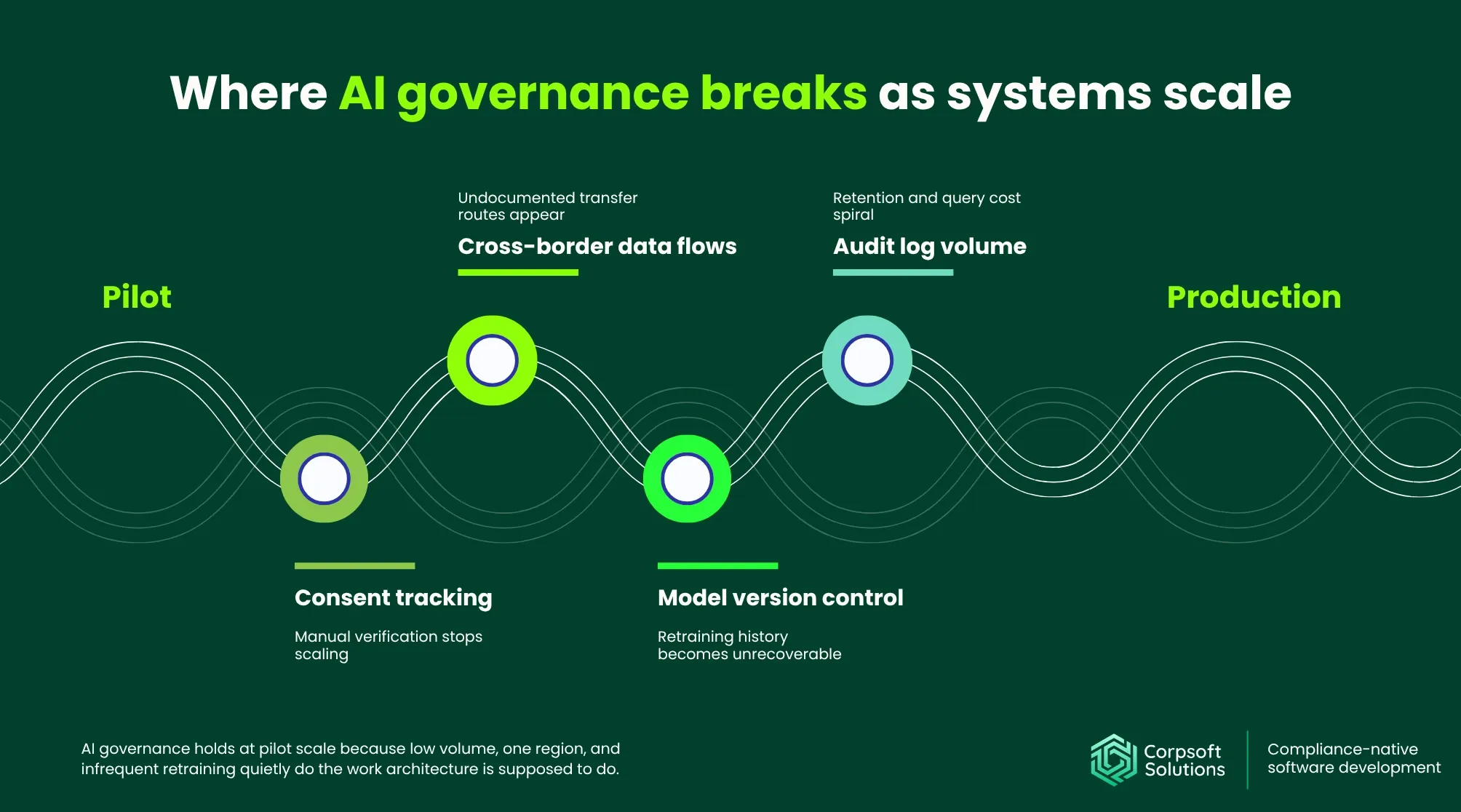
- Consent tracking breaks when data volume outpaces manual review.
- Cross-border data flows create compliance gaps most teams don’t map until an enterprise buyer asks.
- Model version control gets lost once retraining becomes routine instead of a rare, deliberate event.
- Audit log volume grows faster than most teams planned to store or query it.
Why does AI data governance hold at pilot scale and break in production?
AI data governance holds at pilot scale because three conditions quietly do the work that architecture is supposed to do: low record volume, a single region, and infrequent retraining.
- Consent tracking works because someone can still check it manually.
- Data residency works because there is only one region.
- Model history works because everyone remembers the last training run.
None of those are governance decisions. They are side effects of being small, and they expire without anyone deciding to end them.
Credo AI’s State of AI Governance Report 2026, based on a survey of 371 senior leaders, found that 60% of organizations are already deploying AI across multiple departments, while only 4% are governing it at scale. The report frames the top barriers as operational rather than technical: incomplete AI inventories and manual workflows that break under pressure.
This is the problem Corpsoft Solutions’ AI Compliance Stack is built around. The Stack treats AI compliance as three layers engineered together, not three separate checklists owned by different people at different times:
- Layer 1: Data Governance — input data sourcing, consent, storage, retention, cross-border transfer, anonymization.
- Layer 2: Model Governance — decision logging, audit trails, version control, explainability, human-in-the-loop requirements.
- Layer 3: Regulatory Compliance — classification under relevant regulations, documentation, technical standards, audit evidence.
The four failure points below each map to a specific layer. Consent tracking and cross-border data flows sit in Layer 1. Model version control sits in Layer 2. Audit log volume spans Layer 2 and Layer 3 — an engineering problem and the evidence an auditor will ask for, at the same time.
For the broader picture of what AI data governance covers end to end, see our overview of AI data governance for enterprise systems. This piece narrows in on where that governance stops holding once a system leaves pilot scale.
Where does consent tracking break first?
Consent tracking breaks the moment record volume exceeds what a person can still verify by hand. Below that point, a compliance lead can open a spreadsheet and confirm which records carry valid consent, which expired, and which were withdrawn. Above it, the same spreadsheet still looks current — and nobody can prove that it is.
The failure is silent because nothing stops working. Training jobs complete. Models ship. The gap only surfaces when an auditor, an enterprise buyer, or a data subject access request asks one specific question: can you show that this individual’s data was used with valid consent, and when that consent was last confirmed?
Effective consent tracking requires three things to exist as data rather than as institutional memory:
- A timestamp for when consent was granted.
- A defined scope covering what that consent actually permits, not a blanket “yes.”
- A withdrawal mechanism that updates the training pipeline, not just a marketing preference center.
Production control: an immutable consent ledger keyed to record ID, capturing timestamp, scope, and withdrawal events as they happen — not reconstructed afterward from application logs.
Evidence it produces: a queryable consent record for any single record, retrievable in minutes rather than assembled through a manual search across systems.
Teams that rely on user consent tracking held together by shared understanding rather than by these elements don’t see the failure coming, because it arrives all at once, on the day someone outside the team asks for proof.
Where do cross-border data flows create compliance gaps?
Cross-border risk appears the moment training data, inference calls, or a third-party API cross a jurisdiction boundary nobody documented. Pilots are single-region by default. Production systems rarely stay that way: a customer signs from the EU, an inference endpoint gets load-balanced into a second region for latency, a vendor integration routes data through infrastructure the original architecture diagram never accounted for.
What counts as a transfer is broader than most engineering teams assume. Under the European Data Protection Board’s guidance on international transfers, personal data made available to a recipient outside the EEA can constitute a restricted transfer even where the data is not physically exported — the concept extends to remote access scenarios, including cases where data is displayed on a screen for IT support or troubleshooting. In practice, that means remote support access belongs in the data-flow inventory rather than being treated as automatically outside the transfer analysis.
A cross-border data transfer in an AI pipeline therefore does not require anyone to have written a line of code that says “send this data abroad.” It can happen through access patterns nobody classified as a data flow at all.
Production control: a data-flow inventory that tags every system, vendor, and remote-access path by jurisdiction, updated when a region or vendor is added — not audited retroactively once a deal depends on it.
Evidence it produces: a transfer record for each flow, showing the legal basis and safeguard actually in place.
The same GDPR data transfer analysis applies whether the recipient is an email provider or an AI API. For how this plays out with specific vendors in a real stack, see our breakdown of popular SaaS tools that create third-party compliance risk.
Why doesn’t “we’ll track model versions later” survive scale?
Model version control gets skipped early because retraining is rare enough that everyone remembers which version is live. It breaks once retraining becomes routine — weekly, triggered by new data, or automated inside a pipeline — and “which model produced this decision six months ago” stops having an obvious answer.
Teams whose model versioning covers weights alone tend to find the gap the hard way. As documented in MLOps versioning practice, reproducibility still breaks when only weights are versioned, because the surrounding context changed without a record: training data, feature definitions, code, environment. AI model version control that stops at the model file misses exactly the context an incident review or an auditor asks about first.
Provable model lineage requires four things captured at training time, not reconstructed afterward:
- The specific model version that produced a given decision.
- A snapshot or reference to the training data used for that version.
- The hyperparameters and configuration for that training run.
- A record of who approved the model for production.
Production control: a model manifest generated at deployment time, tying each deployed model to its training data snapshot, configuration, and approval record automatically.
Evidence it produces: a reconstructable path from any production decision back to the exact model version and data behind it.
Once a model has been retrained several times without that record, earlier versions and the data that trained them are frequently unrecoverable rather than merely undocumented. This is the one failure point on this list that cannot be fixed retroactively.
What happens when audit logs outgrow the system built to store them?
Audit logging that works at pilot volume becomes an infrastructure problem at scale. CubeAPM’s analysis of enterprise observability strategy describes the pattern concretely: in one frequently cited scenario, log retention goes from 30 to 90 days to meet audit trail requirements without modeling the storage impact, and finance flags the resulting observability budget as unsustainable. A compliance decision quietly became an infrastructure decision that nobody had scoped.
The economics behind that are not marginal. Cribl’s 2026 Trends and Predictions Report found that median annual spend on a single observability platform now exceeds $800,000, with year-over-year increases regularly topping 20%. Audit logging that was affordable during a pilot stays affordable only if retention, storage tiering, and query cost were designed in — not bolted on once an auditor asks for a two-year-old record.
What makes this failure easy to miss is that the logging system continues to look healthy. It accepts writes. Dashboards render. What degrades is the ability to answer a question after the fact: given a decision made four months ago, can you reconstruct what happened, or has that record already been rotated out, aggregated away, or made too expensive to query?
Production control: tiered, immutable audit log with retention windows and query cost modeled into the architecture before volume grows.
Evidence it produces: a reconstructable event trail for a specific decision, retrievable within the required audit window at predictable cost.
Gaps in audit trail compliance rarely travel alone. Teams whose AI systems expose data through APIs often find the same weaknesses alongside the access-control problems covered in our piece on API key exposure in frontend code.
What does audit-ready AI data governance look like in production?
Knowing where governance breaks answers half the question. The other half is what replaces each failure point once it’s addressed architecturally, and what evidence demonstrates that the fix holds.
| Failure point | What breaks | Production control |
Evidence it produces |
| Consent | Manual verification stops scaling | Immutable consent ledger | Per-record consent history |
| Cross-border flows | Undocumented data routes | Data-flow inventory tagged by jurisdiction | Transfer record with legal basis |
| Model versions | Decisions can’t be reproduced | Model, data, and config manifest | End-to-end lineage per decision |
| Audit logs | Retention and query cost spiral | Tiered, immutable logging by design | Reconstructable event trail |

A 15-minute production governance check
Run these before assuming a system is audit-ready:
- Can you identify every system that receives training data?
- Can you retrieve proof of consent for one specific record right now?
- Can you list every jurisdiction where personal data is processed, including remote-access paths?
- Can you map one production decision back to a specific model version?
- Can you retrieve the training-data reference for that model version?
- Can you reconstruct an audit event from more than 90 days ago?
- Can you identify who approved the currently deployed model?
- Can you list every third-party API that receives personal data?
If more than one or two of these take longer than a few minutes to answer, that is the failure point closest to breaking.
What criteria matter when choosing a partner for audit-ready AI infrastructure?
Most teams reach this point with a gap they can name but not close on their own. Four criteria separate a useful engineering partner from a compliance report:
- Architecture-level work, not assessment alone. An audit tells you what is broken; closing the gap means changing how the system captures consent, lineage, and evidence.
- Demonstrated evidence generation, not just controls. Ask to see what an auditor would actually receive, rather than a slide describing what will exist.
- Delivery experience in your regulatory context. HIPAA, GDPR, and the EU AI Act impose different technical requirements, and experience with one does not transfer cleanly to another.
- Compliance work that runs alongside product development. Compliance-Native Architecture, not a bolt-on before an audit. Re-architecting under deal pressure costs significantly more than building the controls in from the start.
What does this look like on an actual production system?
System: A HIPAA-compliant dermatology telemedicine platform built by Corpsoft Solutions. It processes patient images for AI-assisted diagnosis, serving clinicians who need a diagnostic read on an uploaded image.
Problem: Handling patient images creates requirements around access control, auditability, and model governance from the first record onward. Those requirements do not arrive later, once volume grows — they apply to the first image the system ever processes.
Risk: Sensitive patient images moving between services create access paths that, left uncontrolled, make audit reconstruction difficult. When a diagnostic output needs to be traced back to who accessed the image and which model version produced the read, the answer has to come from the system, not from someone’s recollection.
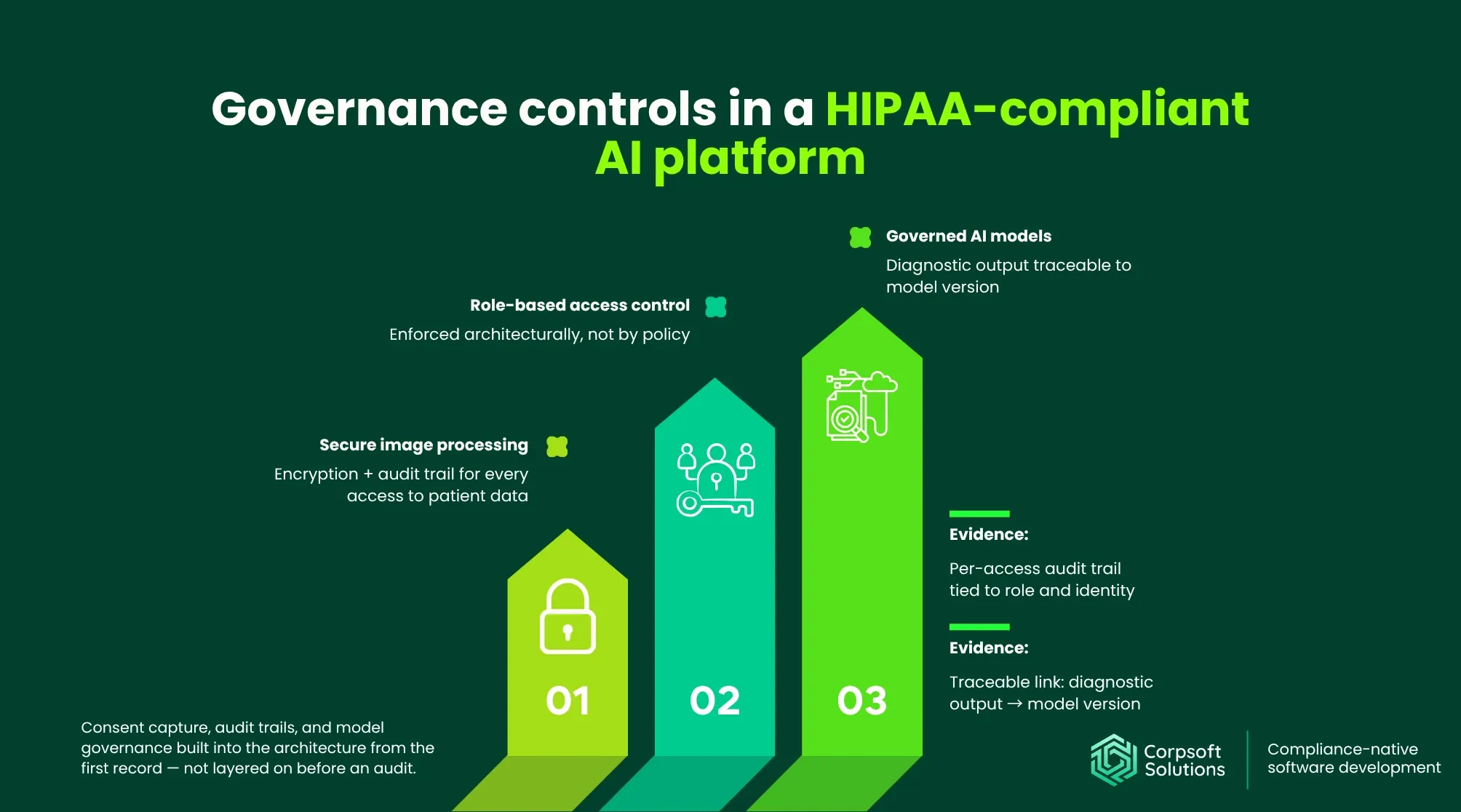
Architecture decision: Consent capture, audit trails, and model governance were built into the platform’s architecture rather than layered on as configuration. That meant secure image processing with encryption and audit trails covering every access to patient data, role-based access control enforced architecturally rather than by policy, and governed AI models where diagnostic output can be traced to the model version behind it.
Evidence generated: a per-access audit trail tied to role and identity, and a traceable link between each diagnostic output and the model version that produced it.
Client-specific implementation details and scaling metrics are omitted for confidentiality; the architecture pattern described above reflects the production approach documented in Corpsoft Solutions’ published case material.
Four failure points, one question: which is closest to breaking in your system? We map data flows, model governance, and audit evidence against all three layers of the AI Compliance Stack.
Share this post: