


The bar for EdTech solutions is rising: AI is no longer optional, compliance is no longer a checklist, and users expect deeply personalized, seamless experiences. Yet many teams still approach custom elearning platform development with outdated assumptions, by treating AI as a feature, underestimating regulatory impact, or overbuilding without a clear product scope.
That’s why most elearning platforms fail: because they try to be everything to everyone. The real competitive advantage starts in building niche, purpose-driven platforms that align with specific industries, compliance requirements, and learning outcomes.
This guide breaks down how to build a custom EdTech software that actually works by helping you define the right scope for embedding AI, navigate compliance, and avoid the costly mistakes most teams only realize too late.
Why custom EdTech platforms are outperforming generic solutions
The Modern EdTech market is driven by specificity. As institutions and enterprises move toward tailored learning experiences, niche platforms outperform horizontal solutions in engagement, compliance, and ROI.
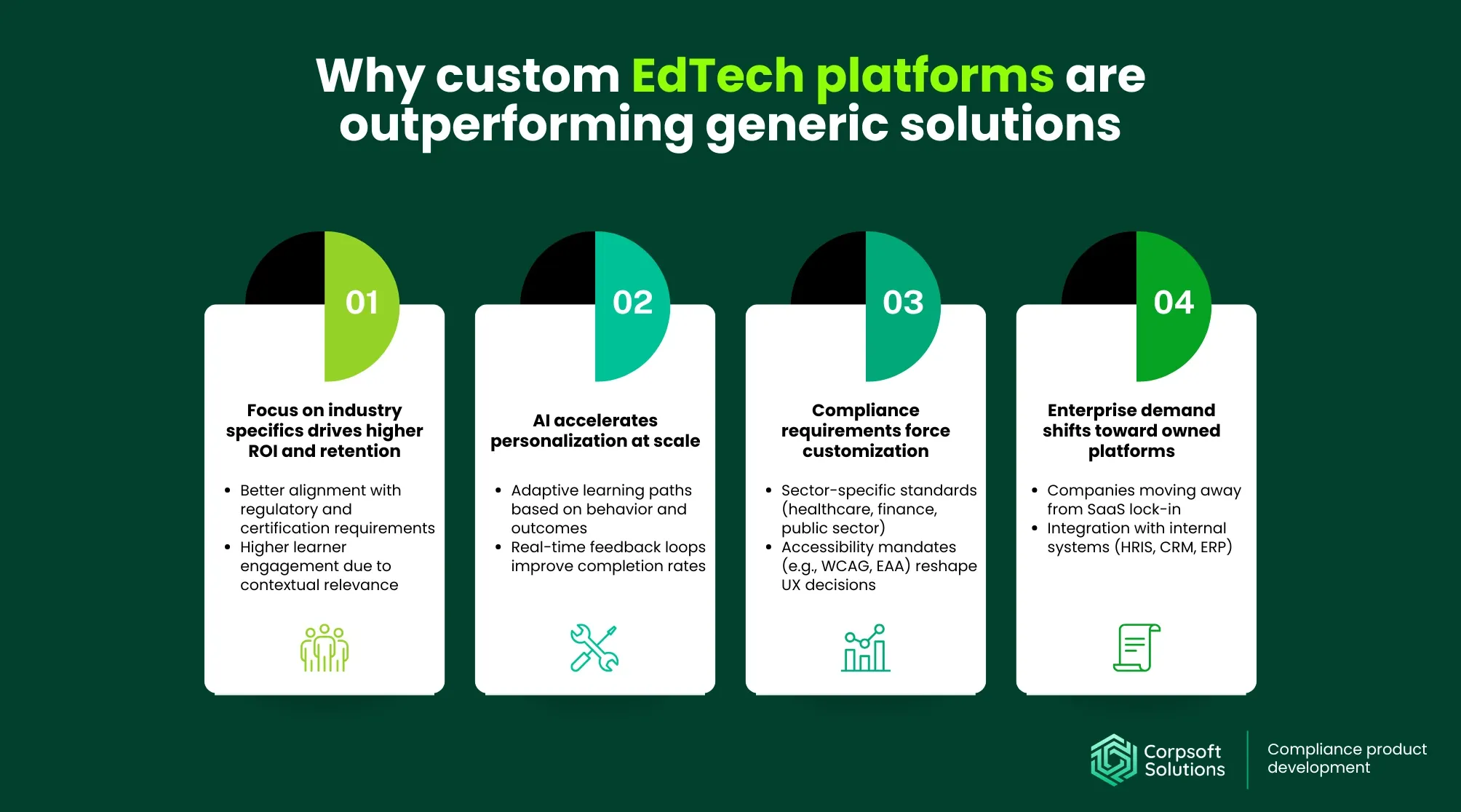
Focus on industry specifics drives higher ROI and retention
Custom EdTech platforms outperform because they are built around real-world use cases rather than abstract learning models. This alignment directly impacts engagement, completion rates, and business outcomes.
- Industry-specific learning paths outperform generic LMS platforms. When content and workflows reflect real job scenarios, users engage more deeply and retain information better. This leads to higher completion rates and more practical application of skills, which is what organizations ultimately pay for.
- Better alignment with regulatory and certification requirements. Many industries require structured, trackable learning tied to compliance or accreditation. Industry-specific elearning solutions embed these requirements directly into the product, reducing manual oversight and minimizing risk.
- Higher learner engagement due to contextual relevance. Users of custom elearning solutions are more likely to stay engaged when the material clearly applies to their day-to-day responsibilities. Relevance reduces cognitive friction and increases motivation, especially in professional or mandatory training environments.
Case in point: Explore how we worked with Asian market requirements and developed a custom knowledge exchange platform
AI accelerates personalization at scale
AI is a key enabler of elearning software solutions, allowing them to deliver tailored experiences without exponentially increasing operational complexity.
- Adaptive learning paths based on behavior and outcomes. AI can adjust content difficulty, pacing, and sequencing based on user performance. This ensures learners are neither overwhelmed nor under-challenged, improving both efficiency and outcomes.
- AI tutoring is becoming a standard expectation. With 67% of educational institutions already integrating AI-assisted learning tools, users expect immediate feedback and support. E-learning platforms that provide this capability gain a clear advantage in both usability and perceived value.
- Real-time feedback loops improve completion rates. Immediate feedback helps users correct mistakes early and stay on track. Over time, this creates a more responsive and effective learning experience, reducing dropout rates.
Compliance requirements force customization
In many sectors, LMS compliance is a constraint that shapes the entire platform. Generic tools rarely meet these needs without significant adaptation.
- Sector-specific standards influence platform design. Industries like healthcare, finance, and public services operate under strict regulations. These rules affect everything from content structure to data handling, requiring purpose-built LMS development.
- Accessibility mandates reshape UX decisions. Regulations such as WCAG and the European Accessibility Act require inclusive design. This impacts navigation, content formats, and interaction patterns, making accessibility a core architectural concern.
- Data sovereignty requirements drive infrastructure choices. Educational organizations must often store and process data within specific regions. This affects cloud strategy, vendor selection, and system architecture from the earliest stages.
Further reading: How embedding ADA and WCAG compliance into your e-learning software can boost reach and revenue
Enterprise demand shifts toward owned platforms
More organizations are moving away from off-the-shelf tools toward platforms they control. This shift is driven by the need for flexibility, data ownership, and long-term scalability.
- Companies are moving away from SaaS lock-in. Generic platforms limit customization and create dependency on external roadmaps. Owning the platform allows businesses to evolve faster and align technology with strategy.
- Need for proprietary data and analytics control. Learning data is increasingly valuable for decision-making. Custom platforms enable deeper insights and better integration with internal analytics systems.
- Integration with internal systems becomes critical. EdTech platforms rarely operate in isolation. Seamless integration with HR, CRM, and operational tools ensures data consistency and improves overall efficiency.
To sum up, custom elearning development solutions win because they align with real-world constraints and turn customization into a core requirement.
Defining your platform scope: the do’s and don’ts of elearning software development
Poor planning and project scoping can easily lead to failure for many companies and can result in up to 10% of financial losses during implementation. When teams try to replicate known EdTech software development products or chase feature parity, they dilute their value proposition and slow down delivery.
Below, you’ll find our key recommendations on how to avoid scope dilution and stay aligned with your goals.
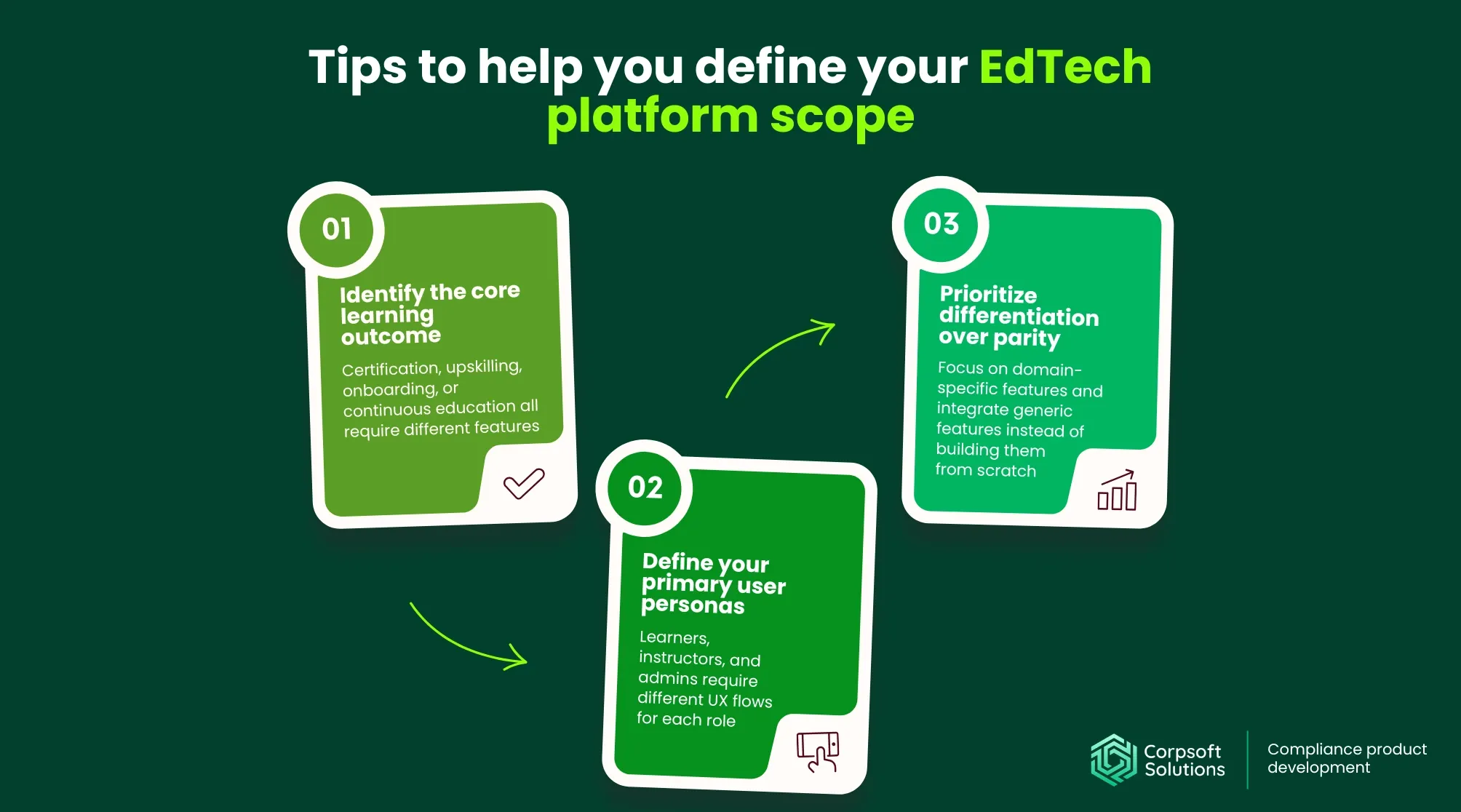
Identify the core learning outcome
Before defining features, you need to be clear on what success looks like for your users and your business. This helps design an e-learning platform around measurable outcomes rather than assumptions.
- Define whether the goal of enterprise LMS software is certification, upskilling, onboarding, or continuous education. Each of these outcomes requires a different structure, content format, and user journey. Without this clarity, teams often build generic flows that don’t effectively support any specific use case.
- Map features directly to measurable outcomes. Every feature should serve a clear purpose, such as improving completion rates, reducing onboarding time, or ensuring compliance. This keeps the product focused and makes it easier to demonstrate ROI to stakeholders.
- Avoid feature-first product thinking. Starting with a list of features leads to bloated products. Instead, define the problem first, then build only what is necessary to solve it.
Further reading: Not all EdTech innovations are created equal. Learn which things to avoid when building custom products.
Define your primary user personas
Different users interact with the educational software in fundamentally different ways. Treating them as a single group creates friction and limits usability.
- Separate learners, instructors, and administrators early. Each role has distinct goals and workflows, from consuming content to managing programs or analyzing performance. Designing for these differences improves usability and reduces confusion.
- Account for enterprise, academic, or hybrid audiences. The expectations of a corporate training program differ from those of a university or certification body. Understanding your audience ensures the platform fits their operational reality.
- Design tailored UX flows for each role. Personalized dashboards, permissions, and navigation paths make the platform more intuitive. This reduces onboarding time and increases overall engagement.
Case in point: Learn how we embedded these differences into the learning platform for the client in the construction industry.
Prioritize differentiation over parity
Trying to match existing platforms feature-for-feature is a common mistake that can cost you big time. Real value comes from focusing on a few things and delivering them with high quality.
- Skip generic LMS features unless they are essential. Features like basic course management or content hosting are often expected, but they shouldn’t consume the majority of your resources. You can reuse generic components via third-party integrations or ready-to-use modules, but the main focus should remain on what sets your platform apart.
- Build proprietary value layers. Unique elements such as analytics, AI-driven personalization, or specialized simulations create defensibility. These are the features that competitors can’t easily replicate.
- Focus on domain-specific workflows. Your platform should reflect how work actually happens in your target industry. Include real case scenarios, industry benchmarks for learner performance evaluation, simulations, and measurable KPIs. These features, embedded during e-learning software development, help platforms to gain their competitive edge.
A well-defined scope is one of the strongest predictors of success in e learning software development. Teams that focus on outcomes, prioritize differentiation, and make early architectural decisions are far more likely to deliver a platform that is both effective and scalable.
AI as a core layer of educational software development
At this stage of education software development services, AI has become part of the infrastructure itself. Ignoring this reality means falling behind competitors who are already leveraging it to build smarter, more responsive products.
Here are several ways AI makes niche EdTech platforms more customizable and differentiated.
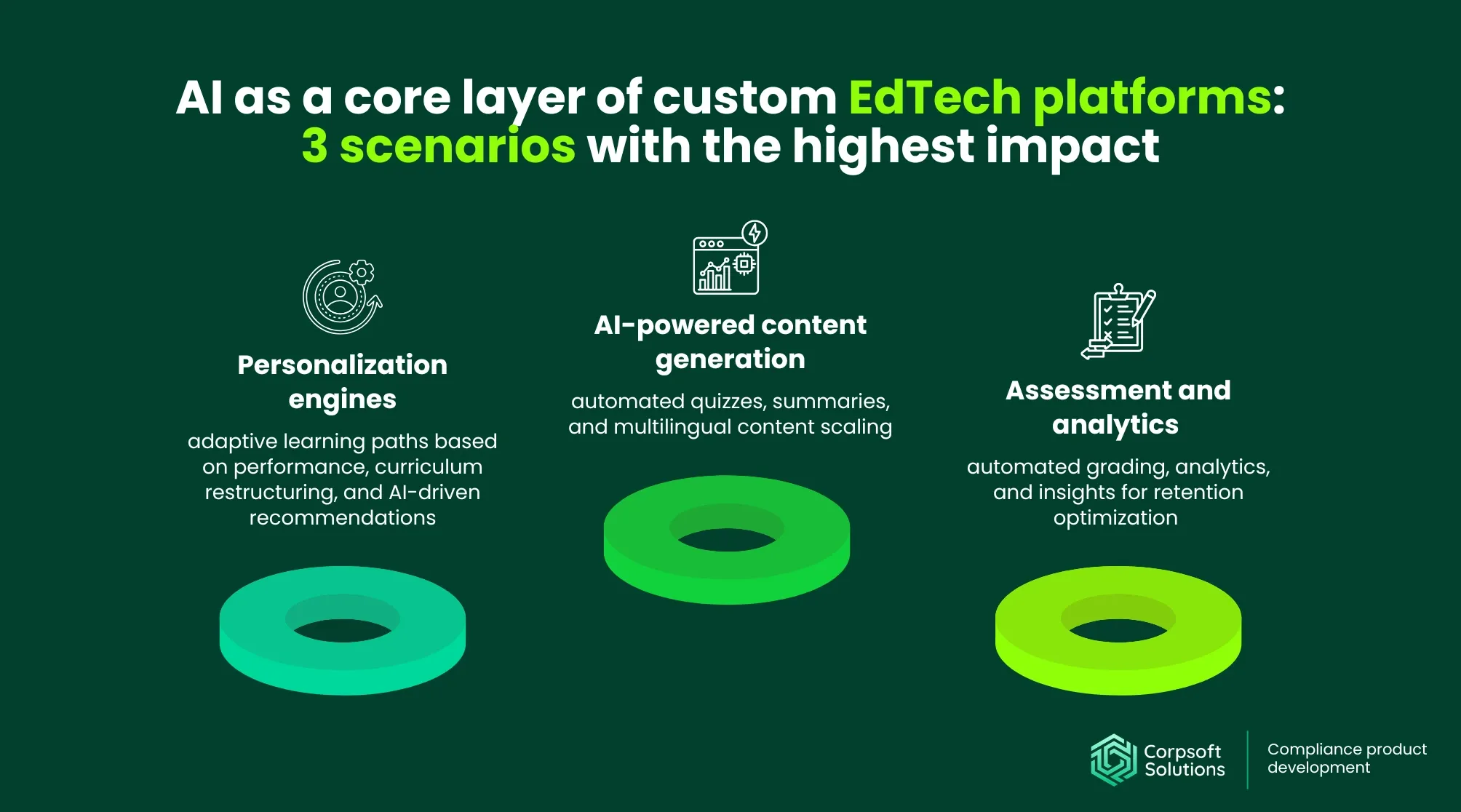
Personalization engines
Personalization is where AI development services deliver their most visible impact, by turning one-size-fits-all courses into learning experiences that adapt to each student in real time.
- Adaptive learning paths based on performance. The system tracks how a learner performs on exercises and assessments, then adjusts difficulty, sequencing, or topic focus accordingly. A student struggling with fractions gets more practice problems before moving to algebra, while an advanced learner skips ahead.
- AI-driven recommendations for content and pacing. Beyond adjusting difficulty, AI suggests supplementary materials and content based on individual learning patterns. It also recommends when to take breaks or revisit earlier material, optimizing retention rather than just completion.
- Dynamic curriculum restructuring. Instead of static course outlines, the curriculum itself can reorganize based on aggregate learner data. If most students struggle with a particular module, the system can automatically reorder prerequisites or insert bridging content.
Further reading: Explore the potential of AI in transforming SaaS solutions.
AI-powered content generation
Creating educational content for elearning software solutions is time-intensive and expensive. AI accelerates this process while improving quality and relevance.
- Automated quizzes, summaries, and explanations. AI generates assessments, condensed summaries, and clarifying explanations tailored to each learner’s progress and performance. A student who missed key concepts gets targeted review materials; one who aced the quiz receives more advanced challenges.
- Localization and multilingual scaling. For platforms serving international students or expanding globally, AI-powered translation and localization reduce the cost and time required to launch in new markets. Content stays consistent across languages without maintaining separate editorial teams for each region.
- Instructor productivity gains. Businesses can use AI in EdTech to show course creators which sections students breeze through and where they drop off or struggle. This feedback helps instructors cut unnecessary content, expand confusing sections, or restructure the flow without waiting for end-of-course surveys.
Assessment and analytics
Progress measurement and grading are where EdTech platforms prove their value. AI solutions transform assessment from a bottleneck into a continuous feedback loop for students, instructors, and platform operators alike.
- Automated grading. AI can save 60-80% of the time compared to manual evaluation, especially for open-ended responses, essays, and code submissions. Instructors spend less time on repetitive marking and more on meaningful student interaction.
- Predictive analytics. By analyzing engagement patterns, assessment results, and behavioral signals, AI can forecast which students are at risk of falling behind or dropping out. Early intervention becomes possible before problems compound.
- Behavioral insights. Tracking how students interact with content reveals what’s working and what isn’t. These insights help optimize material for better comprehension and higher course completion rates.
When you’re collecting detailed behavioral and performance data, you need to establish clear AI data governance policies for storage, access, and consent, especially for younger learners or users in jurisdictions with strict privacy regulations such as the GDPR.
Further reading: Explore our guide on how AI data governance works for enterprises — you might borrow some useful insights from it!
Risks and limitations of AI in EdTech
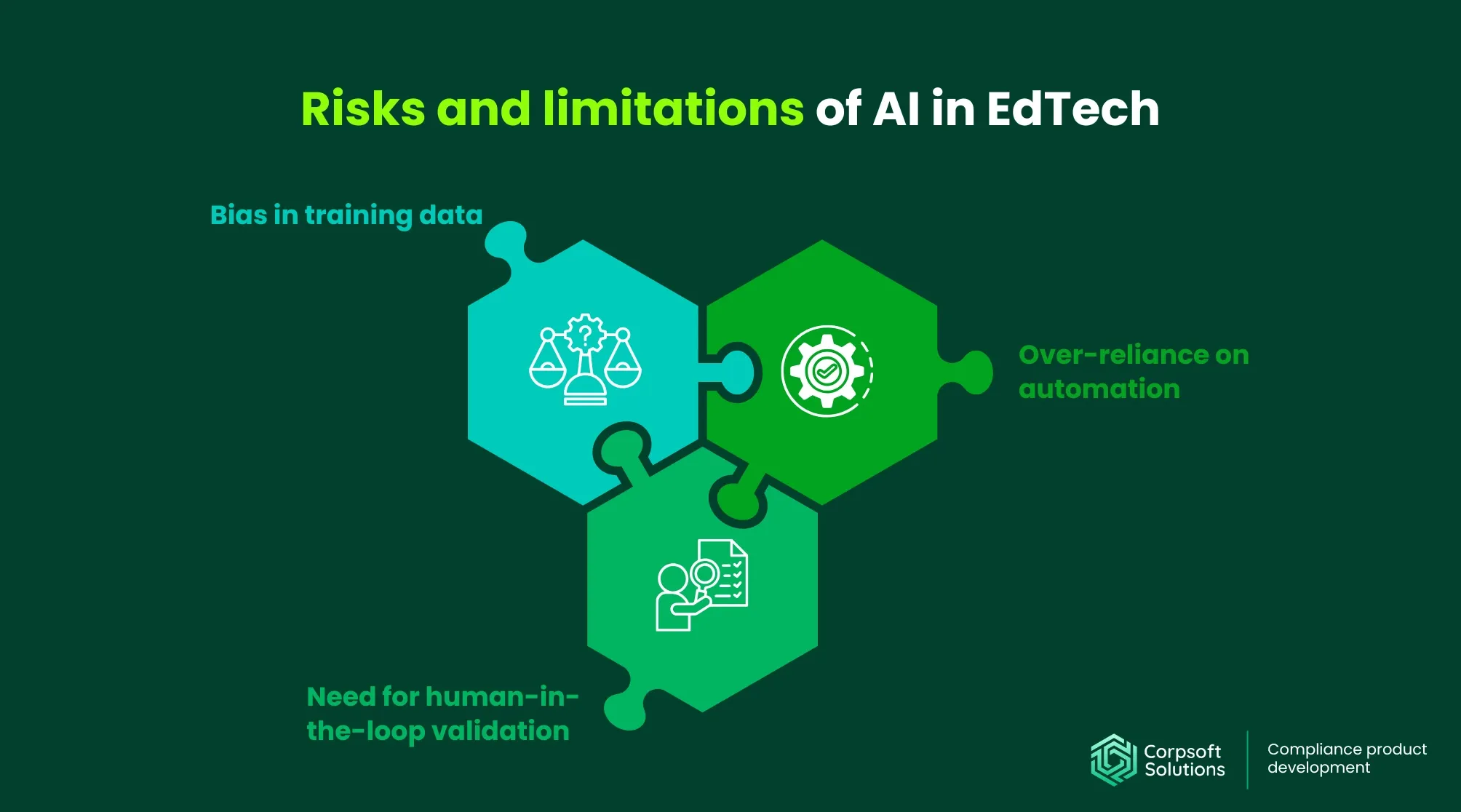
AI isn’t a silver bullet. Understanding its constraints is essential for custom elearning development services and products that deliver on their promises without creating new problems.
- Bias in training data. AI models learn from historical data, which often reflects existing inequities. A grading algorithm trained on biased samples may unfairly penalize certain demographics or writing styles. Audit your training data regularly and test outputs across diverse student populations.
- Over-reliance on automation. Automating everything sounds efficient until it fails silently. Students may receive incorrect feedback, or a flawed recommendation engine may push learners down unproductive paths. Build monitoring systems that flag anomalies and set thresholds for when human review kicks in.
- Need for human-in-the-loop validation. AI should augment educators, not replace them. Critical decisions, such as final grades, student interventions, and curriculum changes, benefit from human judgment. Design workflows in which AI handles the heavy lifting, but humans retain oversight of consequential actions.
To minimize these risks, invest in transparent model documentation, conduct regular bias audits, and establish clear escalation paths for unexpected results from automated systems. Treat AI as a tool your team controls, not a black box you trust blindly.
The non-negotiable features of EdTech platforms: Compliance, accessibility, and data governance
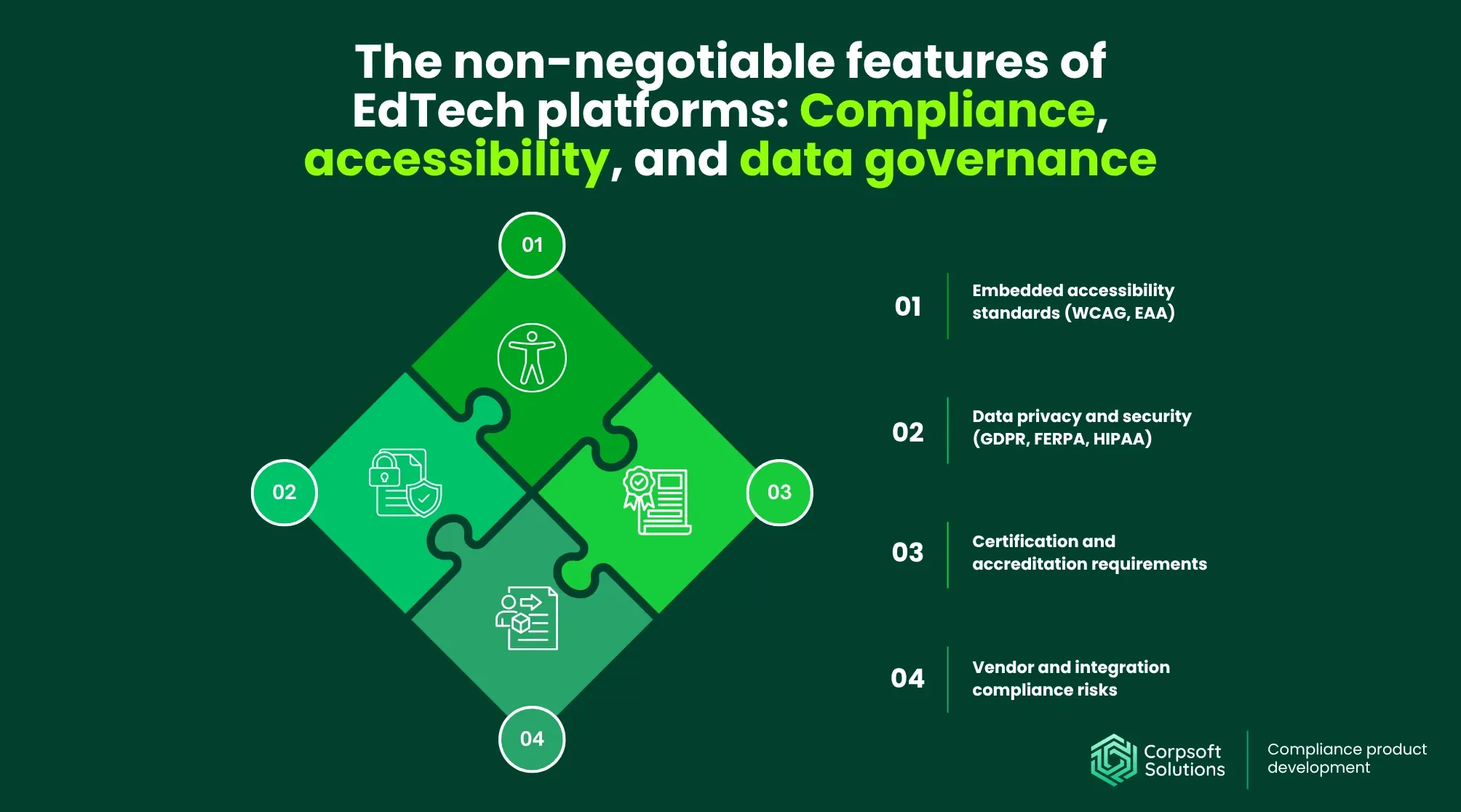
Compliance defines system features and dictates the parameters for architectural, UX, and market strategy. Treating it as a last-minute checkbox is a poor approach. The elements below will genuinely make your EdTech platform competitive.
Embedded accessibility standards (WCAG, EAA)
The Web Content Accessibility Guidelines (WCAG) guidelines, along with the European Accessibility Act (EAA), shape how users with disabilities experience digital learning environments.
- Legal UX frameworks. Accessibility regulations determine crucial interface design guidelines: contrast ratios, keyboard navigation, text alternatives, and screen reader compatibility. These are non-optional if you plan to serve public institutions or international students.
- Frontend implementation impact. Accessibility drives many frontend decisions, from semantic HTML to responsive layouts and ARIA labeling. Designing with accessibility in mind early in development saves massive rework later and broadens your potential user base.
Further reading: Dive into our detailed guide on EAA website compliance — a must-read if you’re planning your launch on the European market!
Data privacy and security (GDPR, FERPA, HIPAA)
Privacy laws go beyond legal compliance: they define how your system stores, processes, and transmits sensitive learner information across jurisdictions.
- Regulation-driven architecture. Frameworks like GDPR (Europe), FERPA (U.S. education), and HIPAA (U.S. health data) directly influence system architecture and tech stack choices. They mandate encryption standards, define data ownership, and restrict cross-border transfers, all of which are vital considerations when handling minors or international learners.
- Cross-market scalability. Building with e learning compliance baked in allows faster entry into new markets. A platform architected for compliance from day one avoids costly retrofits when expanding to regions with stricter privacy laws or localized student protections.
Certification and accreditation requirements
Accreditation connects educational platform development outcomes with real-world recognition, which is a must-have for professional and academic programs.
- Tracking outcomes and credentials. The platform should automatically capture and verify learning milestones, linking assessments and completed modules to traceable credentials such as badges, microdegrees, or formal certifications.
- Integration with certification bodies. Seamless data exchange with external accrediting organizations or LMS APIs simplifies validation processes, ensuring learners’ achievements remain verifiable and portable.
- Audit-ready reporting. Accreditation often requires transparent data trails. Having built-in audit logs, completion analytics, and historical records makes compliance verification straightforward during external reviews.
Vendor and integration compliance risks
Compliance breaches can emerge from unexpected sources, usually in vendor dependencies or integrations. That’s why vetting every third-party component in advance is essential.
- Third-party tools affecting compliance. External analytics or AI models that process personal data can introduce exposure risks if they violate data residency or consent rules. Always review their privacy policies and data storage practices before integration.
- High-risk integrations. Messaging, proctoring, or payment gateways often handle sensitive information. Ensure these vendors meet your region’s specific compliance standards and maintain adequate certifications (e.g., ISO 27001, SOC 2).
- Shared responsibility model. E-learning compliance accountability doesn’t end at your firewall. Define clear contracts outlining which party is responsible for securing and maintaining compliance controls. Regular reviews and audits reduce long-term risk.
List of required features for fully-functional custom EdTech platforms
A fully functional custom EdTech platform requires a robust technical and pedagogical foundation. The table below outlines the essential features that ensure scalability, compliance, and a high-quality learning experience for both educators and students.
| Feature | Value |
| Adaptive learning engine | Uses AI to personalize learning paths based on each student’s performance, improving engagement and learning outcomes. |
| Assessment and analytics suite | Provides automated grading, performance dashboards, and predictive insights to track learner progress and course effectiveness. |
| Content management system (CMS) | Enables instructors and admins to efficiently create, update, and organize digital course materials. |
| User management and roles | Controls permissions and access levels for students, teachers, admins, and external partners—essential for platform security and structure. |
| Interactive learning tools | Includes quizzes, simulations, polls, and gamified elements that promote active participation and retention. |
| Video and multimedia support | Allows seamless integration of live sessions, recorded lectures, and visual content to diversify the learning experience. |
| Mobile responsiveness | Ensures the platform functions smoothly across devices, a critical requirement for today’s mobile-first learners. |
| Compliance and data privacy | Aligns with GDPR, FERPA, and similar regulations to protect student data and meet institutional and legal standards. |
| Accessibility (WCAG/EAA standards) | Guarantees that users with disabilities can navigate and use the platform, expanding inclusivity and meeting legal requirements. |
| Integration APIs | Supports connections with LMS, CRM, and HR systems for seamless data exchange and scalability. |
| Gamification and motivation tools | Adds badges, progress tracking, and reward systems that encourage learner persistence and completion. |
| Collaboration features | Offers discussion boards, chat, and group projects to foster peer learning and community engagement. |
| Report generation and insights | Provides administrators with real-time, exportable reports for decision-making and accreditation compliance. |
| Secure cloud hosting and backups | Protects against data loss and ensures continuity, uptime, and scalability as the user base grows. |
| Localization and multilingual support | Enables cross-market expansion by delivering content in multiple languages and cultural contexts. |
How to design an EdTech platform architecture that supports scale, flexibility, and integration

Modern elearning software development services focus on creating a digital ecosystem that is easily adaptable, seamlessly integrates, and supports a fast-growing user base. Scalability and interoperability then become foundational elements of any successful education product.
#1 Modular and microservices architecture
Designing your platform with modular and microservice principles allows each part of the system to evolve independently.
Why it works:
- Independent scaling of components. Each module — video streaming, analytics, or content delivery can scale independently without overloading the entire system.
- Faster iteration cycles. Teams can deploy updates to one service without taking the whole platform offline, improving agility and release speed.
- Reduced system-wide risk. If one module fails, it doesn’t compromise the platform as a whole, increasing stability and uptime.
Further reading: Find out whether your product is ready for a scalable architecture!
#2 API-first and integration-ready design
An API-first approach to custom EdTech software development services positions the platform for future integrations from day one, making it easy to connect with other systems or tools.
Why it works:
- Seamless system integrations. Your platform can communicate effortlessly with LMS, CRM tools, and analytics platforms.
- Ecosystem expansion. Open APIs let partners build plugins or add-ons, extending your platform’s capabilities.
- Support for third-party innovation. Developers and clients can create new functionalities on top of your core system, keeping your product ecosystem dynamic.
#3 Cloud vs hybrid infrastructure decisions
Selecting between a fully cloud-based or hybrid infrastructure affects cost, flexibility, and compliance alignment.
What to consider:
- Trade-offs between flexibility and control. Cloud offers speed and scalability, while hybrid models balance customization and data ownership.
- Data sovereignty considerations. Educational data may be subject to regional storage rules, especially in the EU and APAC.
- Adoption trends across institutions. Many universities and EdTech startups prefer hybrid setups to retain control over sensitive data while leveraging cloud elasticity.
#4 Performance and scalability planning
A platform must anticipate growth from hundreds to thousands of users across time zones and devices.
What to consider:
- Handling concurrent users. Load balancing, caching, and autoscaling ensure smooth user experiences even under heavy traffic.
- Content delivery optimization. Using CDNs shortens latency and boosts global accessibility.
- Monitoring and observability. Real-time metrics and alerting systems help detect issues early and maintain performance at scale.
How to build a custom EdTech platform: from concept to implementation
Launching an AI-based e-learning platform doesn’t have to be slow, costly, or complicated. With a clear strategy and experienced technical partner, you can move from idea validation to launch quickly: starting lean, iterating fast, and scaling confidently once product–market fit is proven.
Here’s what Corpsoft Solutions’ roadmap looks like from concept to implementation:
- Discovery & strategy alignment. We’ll help you define your platform’s core user personas, value proposition, and product vision. This stage clarifies business goals, compliance needs, and integration expectations.
- Architecture design & prototyping. Our team maps technical requirements to a modular, API-driven architecture, enabling us to develop clickable prototypes or minimal viable features to test user flows and experience early.
- MVP development. After that, we begin developing the essential learning, assessment, and admin modules, focusing on rapid deployment and data protection.
- Integration & scalability setup. Our delivery engineers connect LMS, CRM, or analytics tools through APIs. Implement cloud or hybrid infrastructure and performance-monitoring tools to support growth.
- Launch & continuous improvement. We release the final elearning platform to a pilot audience, gather feedback, and iterate in short development cycles. Gathering data insights shapes future releases and monetization models.
Corpsoft Solutions’ experience in EdTech design and delivery helps clients avoid common pitfalls, such as compliance e learning providers gaps, vendor lock-in, or bottlenecks during scale-up, and ensures a faster path from concept to measurable impact.
What most teams miss: Corpsoft Solutions’ insights into custom EdTech development
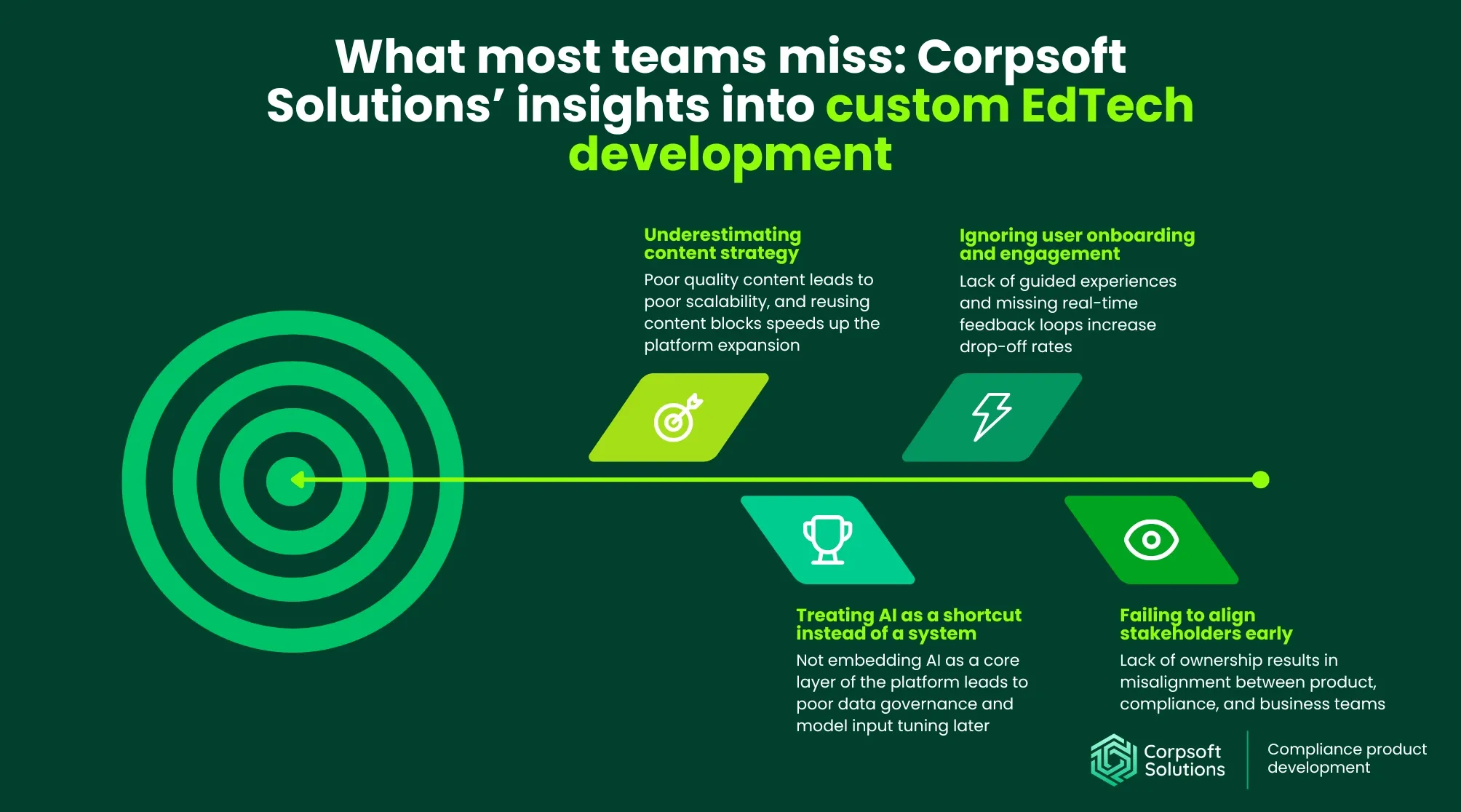
Often, details that seem minor in the early stages of educational software development later reveal significant issues. Below are examples of such overlooked areas, along with our recommendations for anticipating them and building for maximum effectiveness from the start.
#1 Underestimating content strategy
Many teams focus heavily on platform mechanics but neglect the strategic layer of content design and delivery. Even the most advanced system struggles if its learning materials aren’t structured for engagement and growth.
| What it leads to: | How to fix it: |
| Content quality over platform features. Strong tech can’t compensate for weak or inconsistent content; users disengage quickly. | Treat content creation and platform design as equally critical components of product strategy. |
| Lack of instructional design. Without a clear pedagogy, courses become fragmented and fail to drive measurable outcomes. | Embrace content reuse through modular templates, microlearning formats, and localization-ready assets. |
| Poor scalability. Manually built materials slow down localization and content expansion as the platform grows. | Align your content roadmap with key KPIs, such as learner retention, engagement, and completion rates. |
#2 Ignoring user onboarding and engagement
A learner’s first experience defines whether they stay or leave. Overlooking onboarding design often results in poor adoption and low retention, even when the course itself is excellent.
| What it leads to: | How to fix it: |
| High early drop-off rates. Users fail to see immediate value or clarity in navigation. | Design guided onboarding flows that explain platform value and next steps early. |
| Lack of guided experiences. Without direction, learners feel lost and unmotivated. | Add progression and gamification elements: milestones, levels, and smart reminders to sustain motivation. |
| Missing feedback loops. Platforms miss chances to optimize and improve based on user behavior. | Continuously collect and analyze feedback, adjusting user journeys and engagement triggers over time. |
#3 Treating AI as a shortcut instead of a system
E learning AI should be an architectural pillar, not a quick add-on. When used thoughtlessly, it leads to inconsistent results, weak recommendations, and frustrated users.
| What it leads to: | How to fix it: |
| Overpromising capabilities. Users lose trust when AI doesn’t deliver on exaggerated claims. | Make AI a core layer, interwoven with architecture, design, and frontend. |
| Poor model evaluation. Undocumented or unmonitored models degrade accuracy over time. | Ensure a human-in-the-loop model for oversight, continuous retraining, and accountability. |
| Weak data infrastructure. Without strategic data collection, the AI layer can’t learn effectively. | Focus on high-impact (personalization or automated assessment), then expand gradually. |
#4 Failing to align stakeholders early
Alignment issues often surface late, when they’re expensive to fix. Early clarity around ownership, strategy, and decision-making drives efficient execution.
| What it leads to: | How to fix it: |
| Misalignment across teams. Developers, product owners, and educators work toward conflicting goals. | Identify key decision-makers and ownership structures from the outset. |
| Scope creep. Undefined priorities lead to wasted time and bloated features. | Use an iterative delivery model (MVP >> pilot >> scale) to maintain focus and flexibility. |
| Delayed decisions. Without clear leadership, delivery cycles stretch indefinitely. | Align on success metrics and constraints early—covering compliance, budget, and timelines—to ensure all teams move in sync. |
Reasons to choose Corpsoft Solutions as your technology partner for developing custom EdTech solutions
Building a successful EdTech platform demands deep domain expertise, architectural foresight, and the ability to align innovation with compliance and scalability. Here’s why Corpsoft Solutions stands out as a trusted development partner:
- AI integration experience. We design and implement AI in e learning that enhances learning outcomes: adaptive learning engines, automated assessment, and analytics-driven personalization, while keeping data governance at the forefront.
- Compliance-driven development. Our solutions are built in strict alignment with global standards such as GDPR, FERPA, and WCAG, ensuring that every feature meets industry and legal requirements.
- Custom scalable architecture. We design modular, cloud-based systems that can evolve with your product’s user growth, feature roadmap, and market expansion, ensuring stability without sacrificing performance.
- Portfolio of real products. Our proven track record features various products built for EdTech, including custom LMS platforms, AI-assisted content delivery tools, hybrid learning ecosystems, and credentialing systems used in both enterprise and academic settings.
- User experience and pedagogy alignment. We bridge technology with learning strategy by creating intuitive, learner-centered interfaces that improve engagement, retention, and measurable impact.
Choosing Corpsoft Solutions means aligning with a team that understands how to turn educational vision into sustainable, scalable technology.
Share this post: