



TL;DR
- A healthcare website is now a primary patient acquisition channel, not a secondary asset.
- Compliance goes beyond HIPAA: WCAG/ADA are baselines in the U.S., while GDPR and EAA become mandatory when handling EU patient data or entering EU markets.
- Five core principles drive healthcare website performance: accessibility, patient-centric UX, usability, responsiveness, and security.
- Mobile-first UX and fast performance directly impact conversions and SEO visibility.
Today, it’s not necessary to be present at a healthcare facility to assess professionalism, credibility, and even the quality of care. Skimming an organization’s website in a few seconds allows patients to make judgments fast, and if your clinic doesn’t have a proper medical website design, that becomes a red flag in itself.
In 2026, millions of users search for healthcare services directly from mobile devices, while many hospital and clinic websites still struggle with outdated interfaces, poor navigation, and weak accessibility.
A modern healthcare website must balance trust, usability, security, accessibility, and conversion-focused UX — all while complying with regulations such as HIPAA, GDPR, ADA, WCAG, and EAA. In this guide, we explore the most important healthcare website design best practices that help clinics, hospitals, and healthcare brands improve both compliance and business performance.
Why should medical website design be taken seriously in 2026?
Healthcare organizations can no longer treat their websites as secondary marketing assets. In 2026, a healthcare website directly influences patient trust, appointment rates, operational efficiency, and even long-term business growth.
- The demand for medical services is constantly increasing. Aging populations, remote patient monitoring and chronic disease management, adoption of telemedicine platforms, and growing health awareness continue to increase demand for healthcare services worldwide. A professionally designed website helps healthcare organizations stand out and communicate their expertise and credibility from the very first interaction.
- 65% of adults search symptoms online before even contacting a healthcare provider. Healthcare-related queries remain one of the largest search categories globally, covering everything from symptom research to provider comparisons and appointment booking. Patients expect immediate access to trustworthy medical information, intuitive navigation, and seamless online experiences.
- Many users search for healthcare services from mobile devices. Mobile search has become the default behavior for patients looking for urgent care, nearby clinics, specialist consultations, or healthcare advice. Poor mobile usability not only frustrates patients but also negatively affects SEO visibility, accessibility, and conversion rates.
- The website is often the only touchpoint between clinics and patients. For many patients, a healthcare website creates the entire first impression of a provider before any direct communication occurs. Features such as appointment scheduling, patient portals, doctor profiles, and accessible navigation can directly influence whether a patient chooses one provider over another.
- Hospitals with strong digital presence see 28% more new patient acquisitions
Modern healthcare websites are no longer limited to informational purposes — they function as full-scale patient acquisition and retention platforms. Clinics that invest in responsive UX, accessible design, SEO optimization, and secure patient interactions consistently achieve stronger conversion performance.

The globalization of medical compliance: not just HIPAA
A common misconception is that compliance begins and ends with HIPAA-compliant website development. In reality, the regulatory landscape governing website design for healthcare has expanded significantly. Whether you need to change healthcare website architecture to meet new requirements or build from scratch, compliance must be embedded in design from day one — not retrofitted after launch.
Here is what modern healthcare website development must account for from day one:
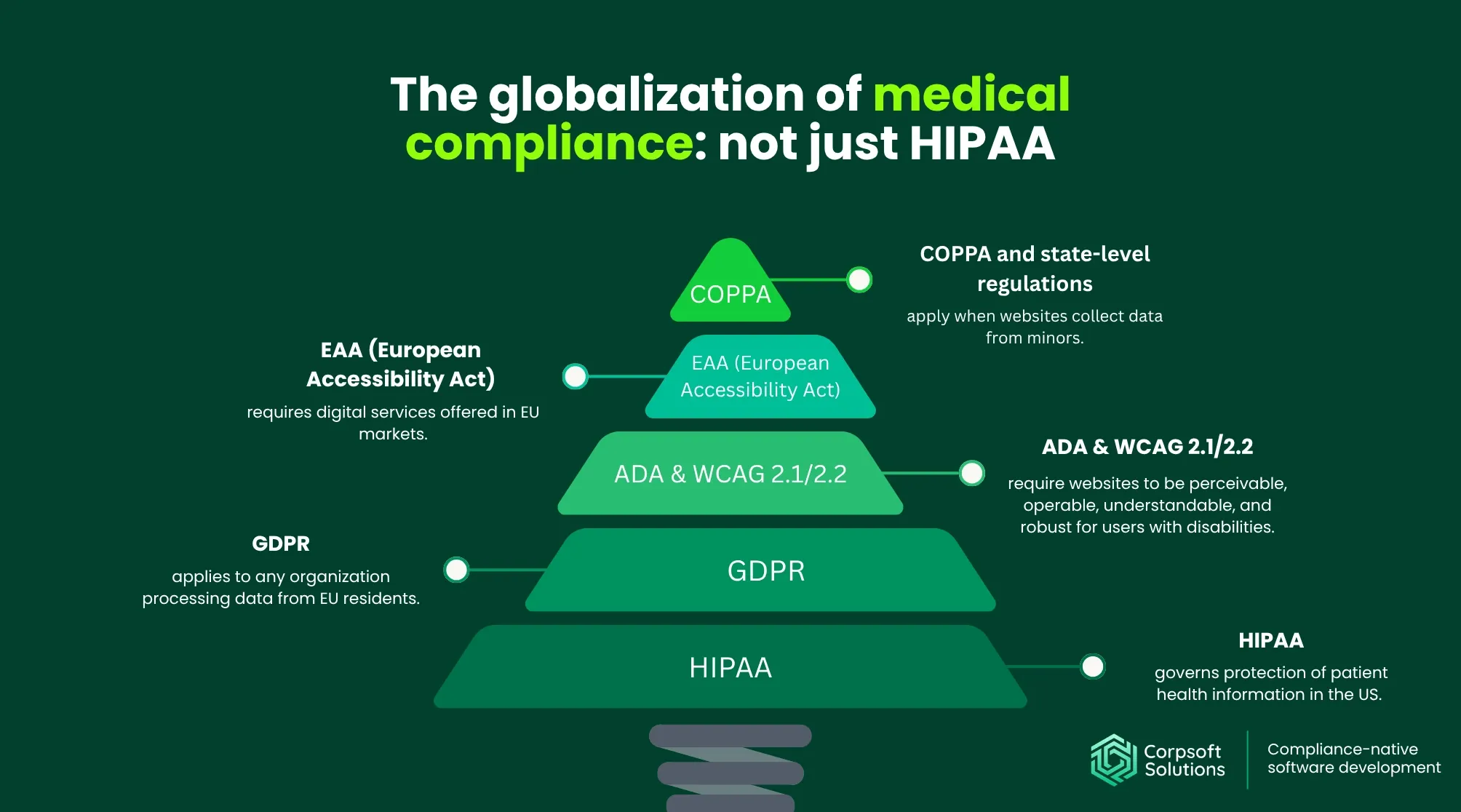
- HIPAA governs the protection of patient health information in the US. Any website that collects, stores, or transmits PHI through contact forms, appointment systems, or patient portals must implement encryption, access controls, audit logs, and business associate agreements. See our full HIPAA compliance assessment guide.
- GDPR applies to any organization processing data from EU residents — explicit consent mechanisms, a clear privacy policy, and documented data processing procedures. Our GDPR website compliance guide covers what clinics operating across borders need to do to comply.
- ADA & WCAG 2.1/2.2 require websites to be perceivable, operable, understandable, and robust for users with disabilities. ADA website compliance enforcement has increased sharply; WCAG 2.1 AA is the widely accepted standard.
- The EAA (European Accessibility Act), in force since 2025, requires digital services offered in EU markets — including healthcare websites — to meet accessibility standards and includes its own enforcement mechanisms.
- COPPA and state-level regulations apply when websites collect data from minors or process payments, adding complexity for pediatric practices or platforms targeting younger patients.
A HIPAA-compliant website that ignores WCAG is still a liability. A GDPR-aligned platform lacking ADA-compliant navigation creates both legal exposure and a poor patient experience. Compliance must be embedded in architecture, design system choices, and vendor selection from the outset — any healthcare website development company worth engaging will enforce this from discovery onward.
5 essential healthcare website design principles
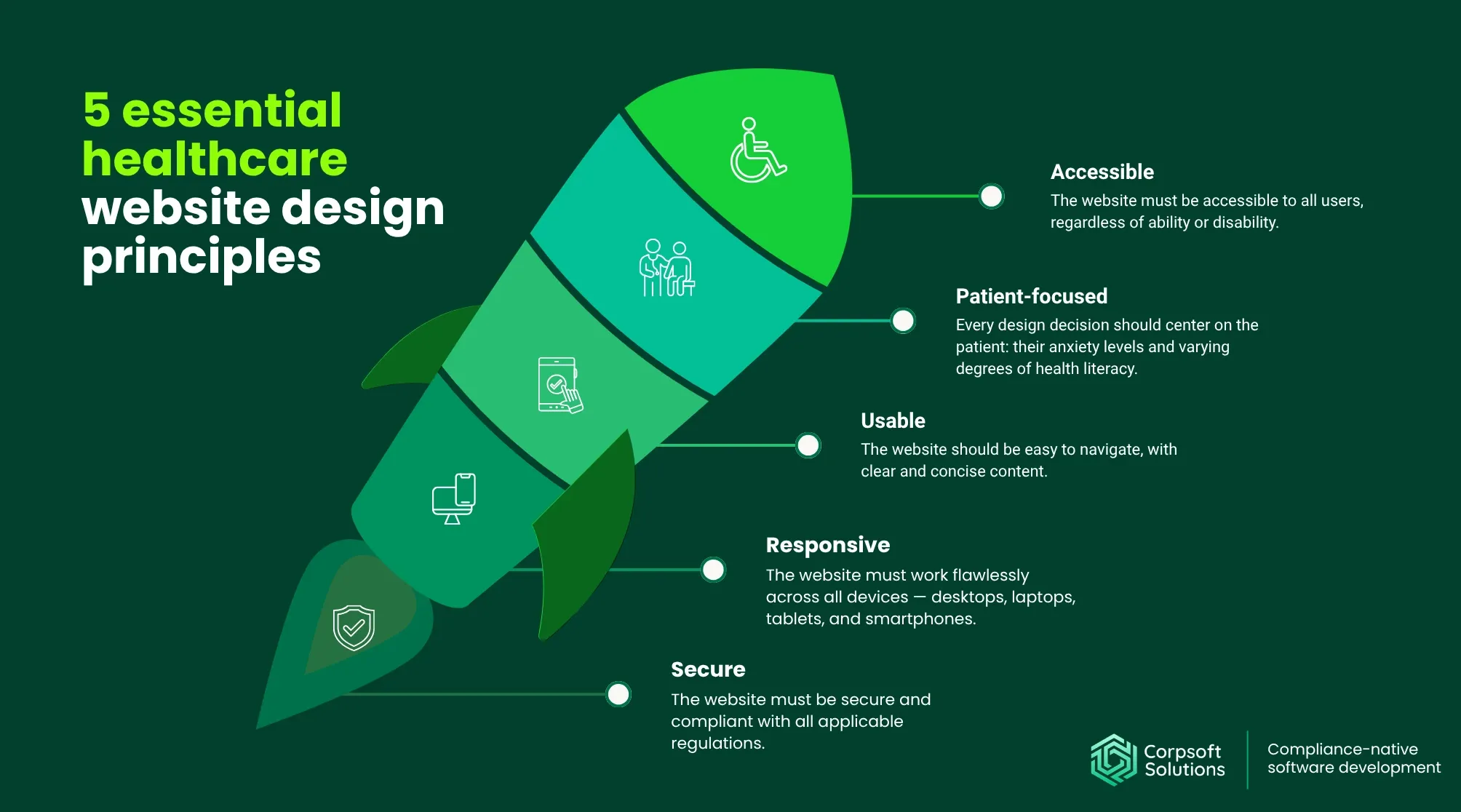
Effective website design for healthcare is built on five interdependent principles, each addressing a different dimension of patient experience and organizational risk.
- Accessible. The website must be accessible to all users, regardless of ability or disability. Accessibility is not a feature — it is a baseline that affects your legal standing, SEO performance, and the breadth of patients you can serve.
- Patient-focused. Every design decision should center on the patient: their anxiety levels when seeking care, their varying degrees of health literacy, their need for clarity over cleverness. Patient-focused design means writing at an appropriate reading level, organizing information around patient journeys rather than organizational hierarchies, and surfacing what patients actually need — contact information, services offered, how to book — without friction.
- Usable. The website should be easy to navigate, with clear, concise content, a logical information architecture, and obvious calls to action. Usability is what converts a visitor into a booked appointment.
- Responsive. The website must work flawlessly across all devices — desktops, laptops, tablets, and smartphones. Given that most healthcare searches now begin on mobile, responsive design is inseparable from performance.
- Secure. The website must be secure and compliant with all applicable regulations. This extends beyond HIPAA — especially when payments are processed, minors’ data is collected, or the platform is intended for global markets. A HIPAA-compliant website design is a minimum; full security posture requires layered controls across infrastructure, application, and third-party integrations.
Why applying healthcare website design best practices boosts revenue and patient loyalty
These five principles map directly onto the patient acquisition funnel. Here is how each stage connects to specific design principles and tactical implementations:
| Funnel stage | Goal | Essential design principles | Examples |
| Awareness | Attract and keep attention | Responsive, Usable, Accessible | Fast mobile pages, clear homepage messaging, readable typography, accessible navigation, SEO-friendly structure |
| Consideration | Help patients evaluate providers and services | Patient-focused, Usable, Secure | Clear treatment explanations, doctor bios, FAQ sections, testimonials, HIPAA/privacy messaging, clear contact info |
| Conversion | Turn visitors into booked appointments or leads | Usable, Responsive, Secure | Simple appointment forms, click-to-call buttons, sticky CTAs on mobile, secure patient forms, minimal-step scheduling |
| Loyalty | Maintain patient relationships and repeat engagement | Patient-focused, Accessible, Secure | Patient portals, educational resources, secure messaging, prescription refill UX, accessible follow-up communications |
Understanding this funnel is also central to healthcare interoperability — when back-end systems communicate effectively, patient experiences become seamless across the entire care journey. See also what makes a fully HIPAA-compliant website perform at each stage.
Implementing principles of good healthcare website design in practice
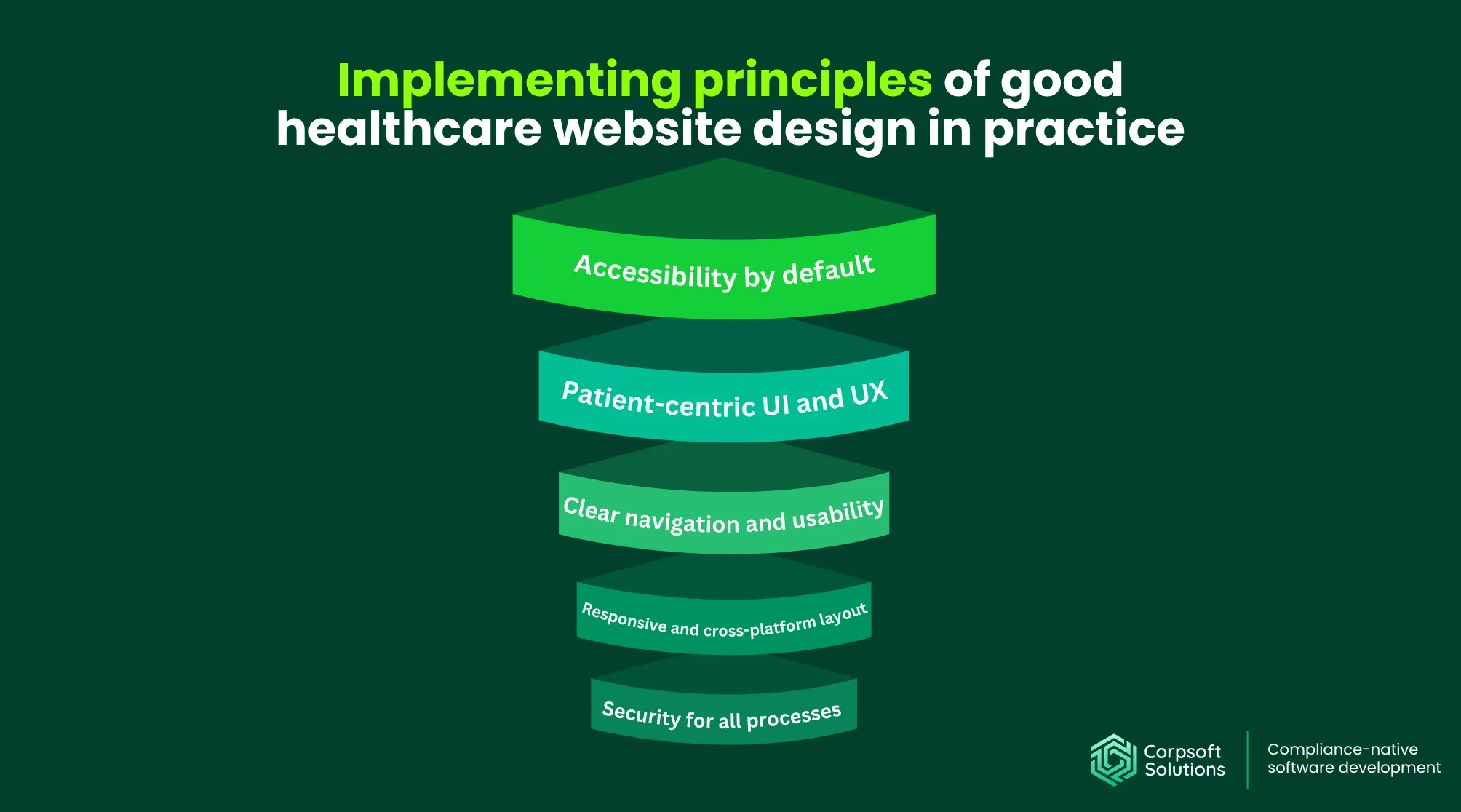
Principles are only as useful as their implementation. Here is how each of the five principles translates into concrete design decisions and measurable outcomes.
#1 Accessibility by default
Website accessibility is determined by whether users with visual, auditory, motor, or cognitive impairments can perceive, navigate, and interact with all content. In healthcare, this matters more than in almost any other sector — patients seeking care are disproportionately likely to have accessibility needs. What must be in place: sufficient color contrast (minimum 4.5:1 per WCAG 2.1 AA), descriptive alt text on all meaningful images, full keyboard navigability, and screen reader compatibility via semantic HTML and ARIA labels. Integrate automated scanning (axe, Lighthouse) into your CI/CD pipeline so regressions are caught before deployment — building accessibly from the start costs a fraction of retrofitting.
#2 Patient-centric UI and UX
Patient-centric design organizes information architecture around what a patient needs at each moment, not what is convenient for the organization to publish. A patient arriving in pain or anxiety wants to find the right specialist, understand what to expect, and book quickly — not navigate a corporate org chart. Key requirements: symptom-to-service navigation that avoids medical jargon, doctor profiles with credentials and languages spoken, transparent pricing or insurance information where permitted, and patient portal access surfaced prominently. Test with real patients across age groups and target a sixth-grade reading level; research confirms this maximizes comprehension across the general population.
#3 Clear navigation and usability
For website design for healthcare, clear navigation governed by WCAG, ADA, and EAA requirements means a system optimized for assistive technologies — structured so any user can orient themselves, find what they need, and complete an action without confusion. A flat information hierarchy (no more than three levels deep), persistent navigation with consistent placement, a search function that handles medical terminology, and skip-to-content links for keyboard users are all non-negotiable. Label navigation by patient intent — “Book an Appointment,” not “Intake Portal” — and ensure every interactive element has a descriptive label, not “click here.”
#4 Responsive and cross-platform layout
Responsive design is table stakes in 2026, yet many medical practice website design projects still treat mobile as secondary. Urgent care searches and appointment bookings happen predominantly on smartphones — a site that degrades on mobile loses patients in real time. Mandatory requirements: a mobile-first layout approach, Core Web Vitals targets met across all device types (LCP <2.5s, CLS <0.1, INP <200ms), touch-optimized components with minimum 44×44px tap targets, and cross-browser QA across Chrome, Safari, Firefox, and Edge. Use modern image formats (WebP, AVIF) and lazy-load content below the fold.
#5 Security for all processes
Security must protect patients submitting personal and medical information, clinicians accessing clinical tools, and administrative staff managing records. A HIPAA-compliant website addresses the patient layer; a comprehensive posture covers all three. Non-negotiables: TLS 1.2+ with HSTS headers, end-to-end encryption for any PHI-collecting form, role-based access controls in staff-facing portals, and a documented vetting process for all third-party integrations — every analytics tag and scheduling plugin is a potential point of data exposure.
If a HIPAA-compliant website builder or CMS is used, verify it offers a signed BAA. For organizations expanding globally or processing pediatric data, engage HITECH compliance development specialists before finalizing architecture.
Top 7 healthcare website design mistakes to avoid
Even well-resourced healthcare organizations make predictable errors when building or redesigning their digital presence. These seven are entirely avoidable.
#1 Treating compliance as a launch checklist
Compliance requirements baked in from day one cost a fraction of what retrofitting would. The healthcare website classification criteria that regulators apply don’t distinguish between “we didn’t know” and “we chose not to prioritize it.”
#2 Designing for the organization, not the patient
Navigation built around internal departments and content written in clinical jargon are symptoms of inside-out design. The best healthcare website designs are built from patient journey maps, not org charts.
#3 Neglecting mobile performance
A site that looks polished on desktop but loads slowly on mobile loses the majority of potential patients. Website design for medical practice must treat mobile performance — not just mobile layout — as a primary success metric.
#4 Using generic health care website templates without customization
Off-the-shelf health website templates accelerate initial build but carry accessibility gaps, performance bottlenecks, and limited integration options. They typically cannot meet enterprise-grade HIPAA requirements without significant custom engineering — which often costs more than building properly from the start.
#5 Weak or absent calls to action
Patients who cannot immediately identify how to book or make contact will leave. CTAs must be prominent, action-oriented, and present at every logical decision point — not confined to a single “Contact Us” page.
#6 No strategy for trusted content
Publishing unreviewed health content or letting it go stale erodes patient trust and damages SEO. With up to 92% of health-related searches now producing AI overviews, content without clear clinical authorship is increasingly invisible.
#7 Ignoring post-launch maintenance
Regulations, browser standards, and security vulnerabilities evolve continuously. Organizations that skip structured maintenance — including dependency updates, accessibility audits, and content reviews — accumulate technical and legal debt quietly until a crisis forces their hand.

Essential features of good healthcare website development
| Website element | Why it matters |
| UI/UX design | Sets the tone for patient trust in under 3 seconds. Clean, calm visual design signals professionalism and reduces anxiety for users in distress. Directly affects bounce rate and time-on-site. |
| Navigation | Determines whether patients can find what they need — or leave in frustration. Accessible, logically structured navigation is also a core requirement for WCAG and ADA compliance. |
| Content | Educates patients, supports SEO and AI overview visibility, and builds clinical credibility. Must be accurate, attributed to qualified authors, and written at an appropriate reading level. |
| Accessibility | Ensures all patients — including those with disabilities — can use the site effectively. Required by ADA, WCAG, and EAA. Also improves SEO through semantic HTML and structured content. |
| Conversion tools | Appointment booking, click-to-call, secure contact forms, and live chat are the mechanisms that turn website traffic into actual patients. Must be frictionless, mobile-optimized, and compliant. |
The importance of trusted content for website design for healthcare
Up to 92% of health-related searches now produce AI overviews, according to the Stanford HAI 2026 AI Index. This means that for a growing share of healthcare queries, patients never reach your website at all unless your content is authoritative enough to be cited or featured by AI systems. Trusted content is no longer a nice-to-have — it is a prerequisite for visibility.
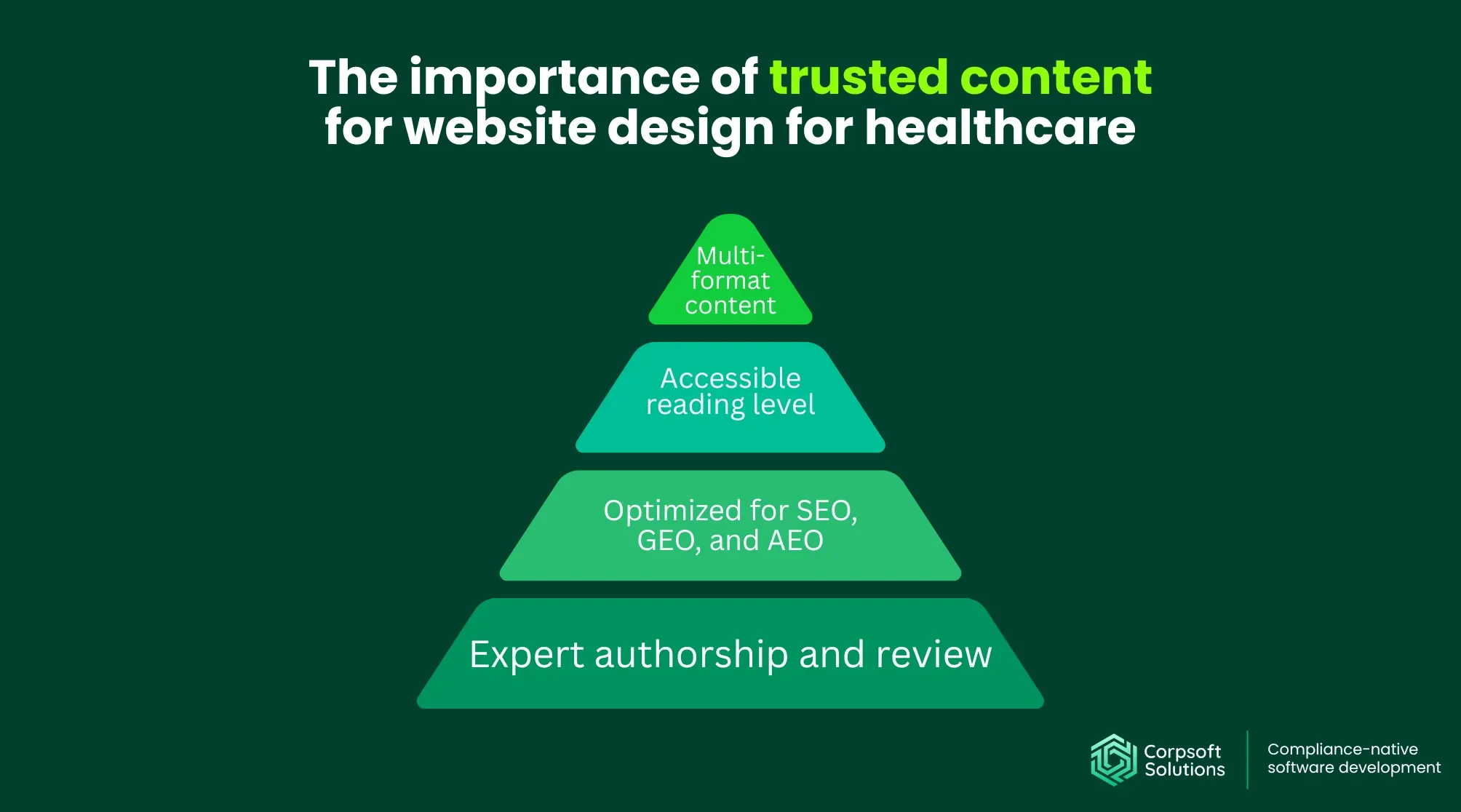
What trusted healthcare content looks like in practice:
- Expert authorship and review. Opinion pieces and clinical guides should be written or reviewed by credentialed professionals at your organization. Author bios, credentials, and review dates must be visible.
- Optimized for SEO, GEO, and AEO. Traditional search engine optimization remains important, but Generative Engine Optimization (GEO) and Answer Engine Optimization (AEO) are now equally relevant — particularly at the awareness stage, where AI overviews intercept patient queries before they ever see a results page.
- Accessible reading level. Research recommends that health information be written at a sixth-grade reading level to maximize comprehension across the general population. Complex clinical terminology should be explained, not assumed.
- Multi-format content. Text alone is insufficient. Videos, infographics, interactive symptom guides, and illustrated procedure explanations serve patients with different learning preferences and accessibility needs, while also improving dwell time and engagement signals.
Using AI in healthcare web development: where, why, and how not to harm
AI is already embedded in medical website design and development workflows — from automated accessibility scanning to AI-assisted content generation and intelligent appointment routing. The question is no longer whether to use AI, but how to use it responsibly in a regulated environment.
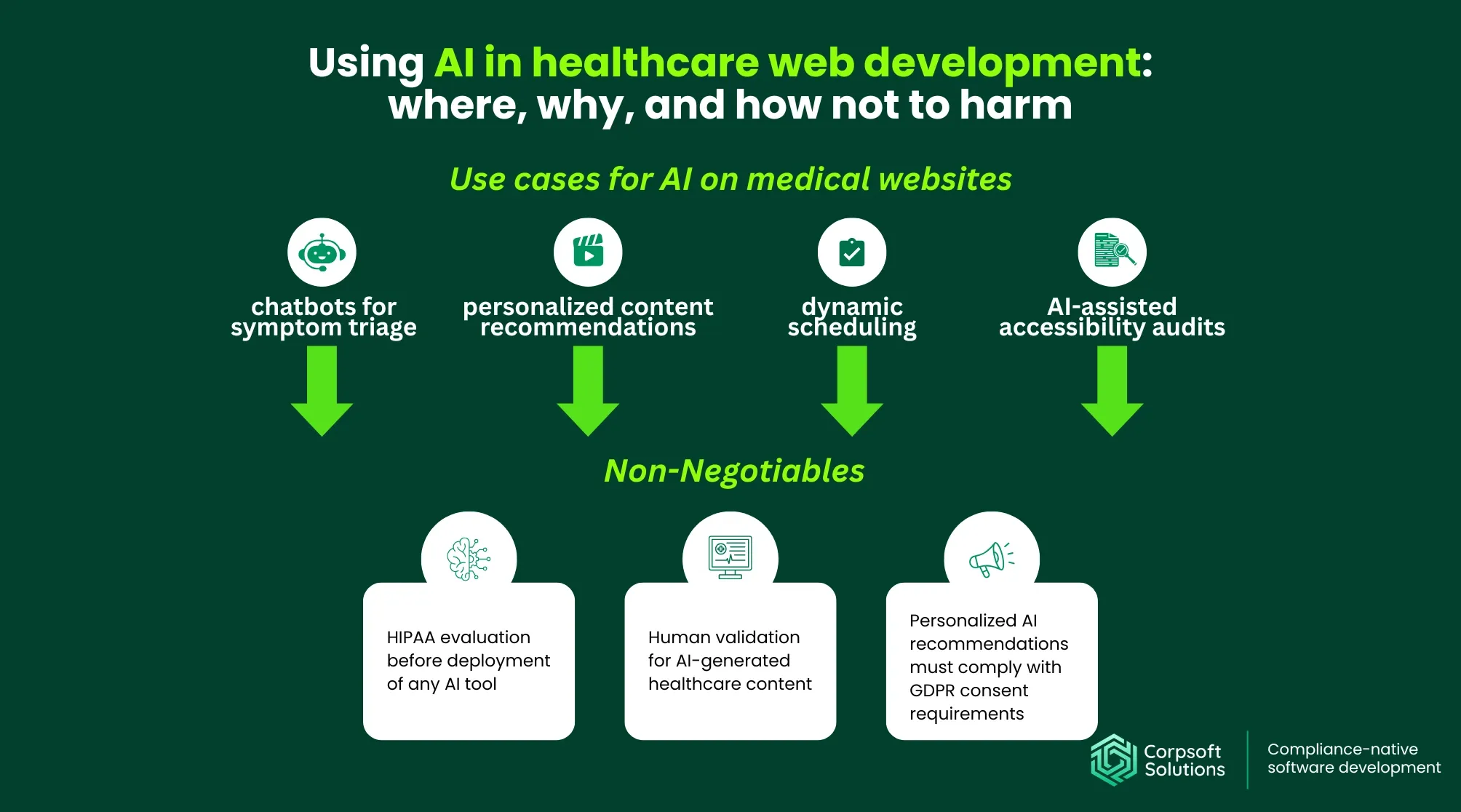
Healthcare organizations are deploying AI across both patient-facing and back-end layers:
- chatbots for symptom triage
- personalized content recommendations
- dynamic scheduling
- AI-assisted accessibility audits.
The non-negotiables:
- Any AI tool processing PHI must undergo HIPAA evaluation before deployment.
- AI-generated health content must be reviewed by qualified clinical staff.
- AI-driven personalization must comply with GDPR consent requirements.
For organizations building autonomous AI features, our industry-specific AI governance guide and resources on AI agents and healthcare compliance outline the framework required. Teams exploring AI automation in healthcare operations should map data flows and audit-trail requirements before finalizing any architecture decisions.
To build or not to build: custom healthcare website development vs ready-to-use website builders
One of the most consequential decisions a healthcare organization makes is whether to build a custom website or use a healthcare website builder platform. Both approaches have legitimate use cases — the right choice depends on organizational scale, compliance requirements, integration needs, and growth ambitions.
| Custom development | Website builder/template | |
| Compliance | Full control over architecture, data flows, and BAA coverage across all components | Compliance depends entirely on the platform vendor; BAA availability varies significantly |
| Accessibility | Accessibility built to spec from the ground up; easier to achieve and maintain WCAG AA | Template accessibility quality is inconsistent; remediation can be costly |
| Performance | Optimized component libraries, no unnecessary dependencies, full control over Core Web Vitals | Performance constrained by platform architecture; bloated templates common |
| Integrations | Custom EHR, scheduling, and patient portal integrations possible; full API flexibility | Limited to native integrations and marketplace plugins; complex integrations often impossible |
| SEO & GEO | Full technical SEO control; optimizable for AI overview citation and structured data | SEO capabilities limited by platform; schema markup and technical optimization constrained |
| Time to launch | Longer initial timeline | Faster initial launch |
| Long-term cost | Higher upfront; lower cost of change and compliance maintenance over time | Lower upfront; platform fees, customization costs, and compliance gaps accumulate |
For small practices with limited budgets and straightforward needs, a well-chosen template with careful accessibility remediation can be a pragmatic starting point. For multi-specialty clinics, hospital networks, or any organization processing significant volumes of PHI, a healthcare website design agency or a dedicated development team will consistently outperform builder platforms in compliance depth, performance, integration capabilities, and long-term adaptability.
A capable healthcare website development company offers more than just engineering. Experienced teams arrive with libraries of pre-optimized, compliance-tested components, established patterns for HIPAA-compliant healthcare web development, and the ability to advise on positioning, content strategy, and marketing architecture — capabilities no website builder can replicate.
Corpsoft Solutions’ approach to medical website design and development that impresses stakeholders and patients alike
At Corpsoft Solutions, we treat every web development for healthcare engagement as a compliance, performance, and conversion challenge simultaneously — because in practice, they are inseparable. Our process begins with a discovery phase that maps all applicable regulatory requirements to architecture decisions before a single line of code is written. We maintain component libraries pre-validated against HIPAA, WCAG, ADA, and EAA requirements, which accelerates delivery without compromising quality.
We have delivered platforms ranging from AI-powered diagnostic tools to full-scale telehealth platforms. Whether your organization needs a ground-up build, a healthcare website redesign, or a compliance audit of an existing platform, our team brings the domain expertise to execute without shortcuts — including strategy on SEO, GEO, and the emerging landscape of AI agents in healthcare.
Conclusion
Today, a healthcare website is not a marketing brochure — it is a clinical front door. Patients judge provider credibility and decide whether to book based on what they encounter in the first few seconds. Organizations that invest in best healthcare website design — accessible, patient-focused, secure, responsive, and compliant — consistently outperform those that treat their digital presence as an afterthought.
The five principles in this guide are not aspirational; they are the minimum viable standard for any healthcare organization that wants to compete for patient trust in an AI-dominated search environment. Whether you are planning a healthcare website redesign or building from scratch, the investment in doing it right is always less expensive than doing it twice.
Share this post: