



Corporate learning management systems (LMS) are undergoing a structural shift from static, one-size-fits-all training programs to adaptive, AI-driven solutions that respond to individual employees’ needs in real time. This transition is driven by urgent business pressures.
Organizations are facing widening skill gaps and increasing demand to prove ROI from learning initiatives, while talent retention is becoming a critical priority. According to LinkedIn’s 2024 Workplace Learning Report, 90% of organizations are concerned about employee retention, and e-learning is one of the primary strategies to address it.
This article will guide you through the key benefits of AI-supported learning management systems for businesses backed up by real-world use cases and our first-hand expertise. By the end, you’ll have a clear framework for evaluating corporate e learning solutions and understanding how AI can directly impact employee performance, engagement, and business outcomes.
Why traditional corporate e-learning solutions are no longer effective
Traditional e-learning platforms were designed for a different era, where job roles and skill requirements changed slowly, and standardized training could reasonably meet most organizational needs. Today, that assumption no longer holds. Rapid digital transformation, hybrid work environments, and increasingly specialized roles have made workforce development far more dynamic and context-dependent.
As a result, traditional LMS for corporate training is outdated and actively limiting the impact of corporate learning initiatives.

One-size-fits-all learning fails modern workforces
A unified e-learning approach, which most traditional organizations treat as a standard for talent growth, assumes that all employees share a uniform baseline of knowledge and learning needs, a premise that rarely reflects reality:
- Static courses don’t adapt to skill levels or roles. Traditional corporate elearning delivers the same content to all employees, regardless of their experience, responsibilities, or current capabilities. As a result, large portions of the material become irrelevant, reducing effectiveness and leaving real skill gaps unaddressed.
- Low engagement and completion rates. When content feels too generic or disconnected from day-to-day work, employees are far less motivated to engage with it. This leads to low completion rates and situations where courses are technically finished but rarely translated into practical application. Research supports this, showing that only 12% of employees can apply what they learn from the training program in the workplace.
Ultimately, standardized learning models fail because modern workforces are not standardized. Effective corporate e-learning solutions require adaptability, relevance, and alignment with individual and organizational goals.
Limited insight into skills and performance
Traditional employee training software solutions provide a very limited view of learning outcomes, focusing primarily on course completion rather than actual knowledge acquisition or skill development. While completion rates are easy to track and report, they offer little insight into whether employees have truly understood the material or can apply it in real-world scenarios.
This creates a significant visibility gap for organizations, leading learning and development teams to often make decisions based on incomplete or misleading data.
The lack of measurable outcomes from an e learning platform also makes it difficult to align training with business goals, turning learning activities into a cost center rather than a strategic investment.
Scaling training across teams is operationally inefficient
As organizations grow, scaling employee training software solutions across teams becomes more complex, especially in global and hybrid environments. Employees operate across different time zones, roles, and business contexts, each requiring distinct knowledge and skill sets. This leads to two scalability challenges for that are difficult to address with traditional e-learning tools.
- Global, hybrid teams increase operational complexity. What works for one team or region may be irrelevant or impractical for another. Without the ability to adapt content dynamically, organizations struggle to maintain both consistency and relevance at scale.
- Scaling without personalization further amplifies inefficiency. Instead of personalizing learning paths and improving outcomes, companies end up distributing the same generic content to a larger audience. As a result, more employees spend time on training that does not align with their roles or immediate responsibilities.
Rather than closing skill gaps, these challenges often reinforce them. Organizations invest more resources into training delivery but see little to no improvement in performance. The drastic change in outcomes appears from utilizing adaptive learning tools, such as AI in elearning.
Ways in which the use of AI in elearning can transform corporate talent growth

AI in e-learning shifts the approach to corporate learning by analyzing real-time data and behavioral insights. Such AI solutions for business enable companies to move beyond traditional training models and build scalable learning ecosystems that directly impact performance and business outcomes.
Adaptive learning paths replace static content
Elearning AI fundamentally shifts corporate learning from static, standardized courses to adaptive learning paths tailored to each employee.
- Learning speed and content complexity are determined by user behavior. Instead of assigning identical content to everyone, an AI-assisted platform for corporate learning analyzes user behavior, performance data, and interaction patterns to dynamically adjust what learners see next. High-performing employees can skip redundant material and move directly to advanced topics, while others receive additional reinforcement where needed.
- Positive impact on time-to-competency. Time-to-competency is one of the most critical L&D metrics, and by eliminating unnecessary content and focusing only on what each employee needs to learn, AI for e-learning reduces the time required to reach proficiency in a role or skill.
- Better responsiveness to evolving business priorities. Learning paths can be updated dynamically without requiring full course redesigns, as new tools, processes, or market demands emerge. This makes training programs more agile and aligned with real-time organizational needs.
Check out how Corpsoft Solutions delivered a unique learning academy solution for content creators that allows for easy knowledge sharing and makes education more accessible for everyone.
Real-time skill assessment and feedback
Traditional learning models rely heavily on periodic testing: assessments that occur at fixed intervals, often at the end of a course. This episodic approach, while being useful for measuring short-term retention, provides limited visibility into skills growth over time.
An AI-based enterprise learning management system enables a shift toward continuous evaluation, where learner performance is assessed in real time through interactions, task completion, and behavioral signals. The system continuously collects data on how employees engage with content, solve problems, and apply knowledge in context, rather than relying solely on completion data.
This creates continuous feedback loops, allowing both employees and organizations to identify gaps as they emerge rather than after the fact. Continuous feedback is immediate, contextual, and actionable, which means more precise guidance on what to improve and how to progress. For organizations, software to track employee training provides a granular view of workforce capabilities and learning effectiveness.
As a result, learning becomes an ongoing process embedded into daily workflows, rather than a series of isolated training events. This significantly improves both knowledge retention and real-world application.
Predictive learning and workforce planning
AI in e-learning extends beyond reactive learning optimization to proactively anticipate future skill needs and address them:
- Prediction of potential skill gaps. By analyzing historical learning data, performance trends, role requirements, and even external market signals, AI agents in e-learning systems can identify emerging skill gaps before they impact business outcomes.
- Skills forecasting. Predictive learning allows organizations to move from a reactive to a proactive L&D strategy. Now, companies can forecast which skills will be needed and prepare employees in advance, rather than haphazardly closing skill gaps as they arise.
- Personalized learning paths. Predictive models can recommend personalized learning paths not only based on current performance but also on future role trajectories. This supports internal mobility and career development while ensuring the organization builds the skills it will need next.
This capability transforms the corporate learning management system from a content delivery platform into a strategic workforce planning tool. Learning data becomes a key input for talent development and organizational design.
Core AI capabilities in modern e-learning platforms
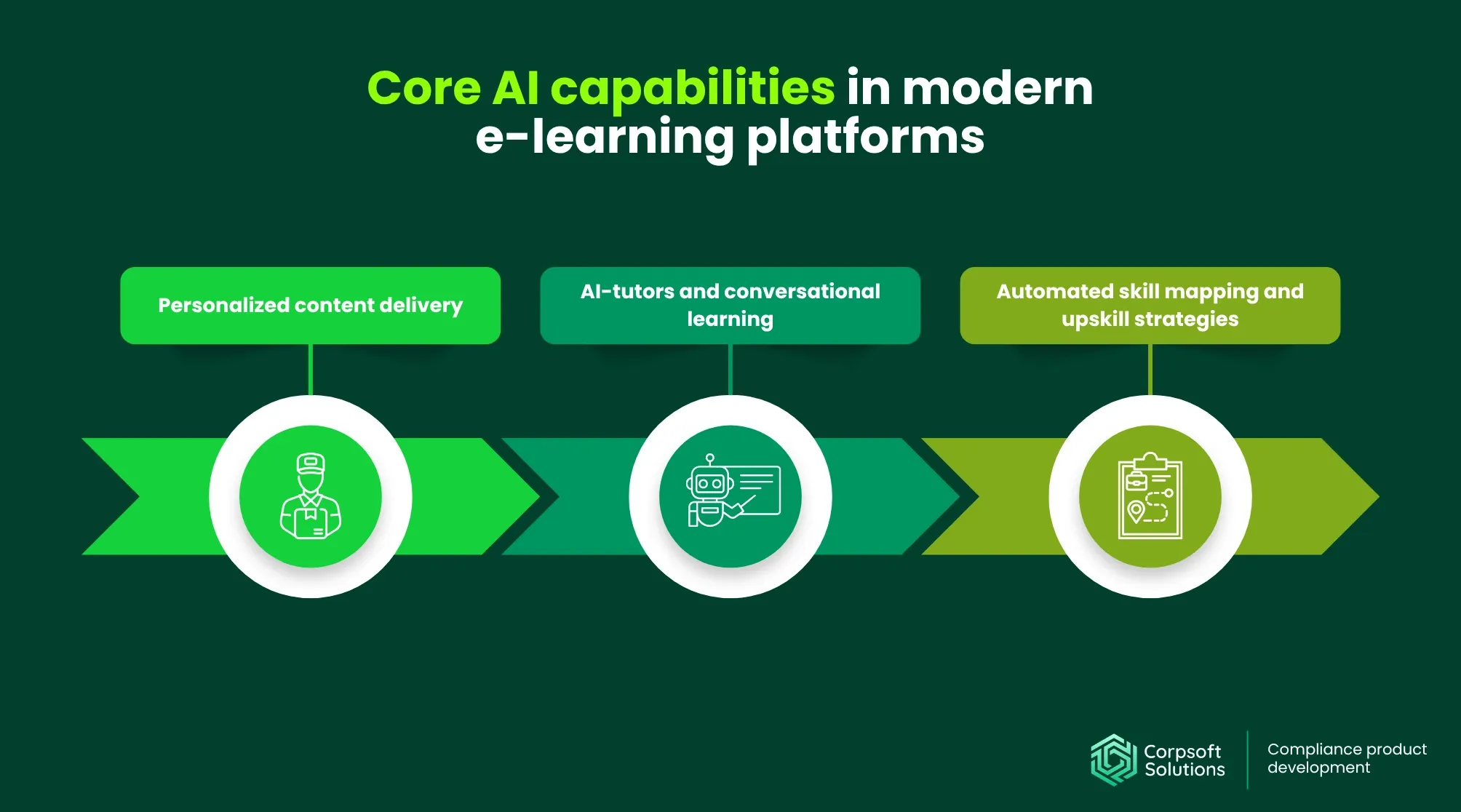
AI-powered e-learning platforms are redefining how learning systems operate at a foundational level. The era of static course repositories is over; modern corporate training LMS employs AI to continuously analyze user data and align learning with both individual and organizational goals.
#1 Personalized content delivery
AI in e learning enables fully personalized learning experiences by building dynamic learning paths tailored to each user.
The system continuously analyzes user interactions: completed modules, assessment results, and engagement patterns, and recommends the most relevant courses, materials, or microlearning units. These recommendations are also informed by the employee’s role, career goals, and historical activity within the platform.
This approach works not only for the humanities but for complex technical disciplines.
Case in point: our LMS administration app for a leading construction industry provider.
The learning content is also not static. It adapts in real time depending on user responses and performance. If a learner struggles with a concept, the system can provide additional explanations or simpler materials; if they perform well, it can accelerate their progress or suggest more advanced topics. This can boost employee performance by 15% to 25%, compared to traditional methods.
#2 AI-tutors and conversational learning
Custom elearning solutions, enhanced by AI, offer a more interactive and intuitive way to learn through conversational interfaces and virtual tutors. Users can interact with the system using natural language, asking questions, requesting clarification, or exploring topics more flexibly.
AI tutors analyze user behavior and context to provide guidance exactly when it is needed. For example, if a learner makes a mistake, the system can immediately offer hints, explanations, or relevant examples.
At the same time, the employee training software continuously generates feedback on progress and performance. AI enables ongoing, contextual responses that help learners correct mistakes and reinforce understanding as they go.
#3 Automated skill mapping and upskill strategies
AI-driven personalization plays a critical role in translating learning data into talent development strategies. By analyzing learners’ performance and behavior, it can automatically map employee skills and identify gaps that need to be addressed.
This enables several high-impact use cases:
- Skill gap analysis. Elearning AI identifies discrepancies between current employee capabilities and required competencies, providing a clear view of where development is needed.
- Role-based learning alignment. Employees’ learning paths are directly tied to specific roles, ensuring they acquire skills immediately relevant to their responsibilities.
- Personalized upskilling recommendations. AI suggests targeted learning activities to support growth and internal mobility, based on individual profiles and career trajectories.
- Workforce planning insights. Learning and skill data, aggregated by AI agents, provide leadership with visibility into organizational capabilities, helping inform hiring, reskilling, and long-term talent strategies.
Business impact of AI-driven corporate e-learning
AI-powered personalization in corporate learning directly impacts key business metrics by making training more relevant, efficient, and aligned with performance outcomes. Instead of treating learning as a support function, organizations can integrate AI into existing employee training system and turn it into a measurable driver of productivity, retention, and cost optimization.
- Higher employee engagement & knowledge retention. AI-driven learning uses gamification, microlearning, quizzes, and interactive formats to keep employees actively engaged. According to the Research Institute of America, this can increase retention rates to 25–60%, compared to 8–10% for traditional training.
- Faster employee onboarding (time to productivity). AI personalizes onboarding journeys based on role, experience, and progress, helping employees reach full productivity faster. By eliminating irrelevant content and focusing on essential skills with AI-powered employee onboarding and training software, companies can reduce ramp-up time.
- Training programs as a high-ROI investment. Integrating AI into corporate e learning solutions ensures that learning is targeted and outcome-driven, reducing wasted time and increasing impact. According to Deloitte, companies with strong learning cultures are 92% more likely to innovate,highlighting the direct link between effective training and business performance.
- Training cost reduction. AI reduces costs by automating delivery, minimizing instructor dependency, and eliminating inefficient training. Even small gains scale significantly: an IBM assessment at an energy company with 1,000 employees found that improving productivity by just 3 minutes per day resulted in savings of at least $240,000 annually.
AI in LMS platforms: what organizations should evaluate

AI capabilities in learning management systems for businesses can vary from basic automation layers to fully adaptive, data-driven systems. For organizations, especially at enterprise scale, selecting the right platform requires evaluating the core features, selecting underlying architecture, data strategy, and ability to receive actionable outcomes.
Below are the key dimensions that determine whether an AI-powered LMS can truly support scalable, high-impact learning.
Agentic AI vs rule-based automation
Not all “AI-powered” corporate learning platforms are genuinely intelligent. Many rely on rule-based automation: predefined logic such as “if user completes X, assign Y.” While useful, this approach is inherently static and cannot adapt beyond what has been explicitly programmed.
Agentic AI, by contrast, operates with adaptive logic. It analyzes user behavior, performance, and context to make decisions about what content to deliver, when, and in what format. Instead of following fixed rules, it learns and optimizes over time.
Why does this matter? Rule-based systems scale operationally but not cognitively — they automate processes without improving outcomes. Agentic systems, however, can dynamically optimize learning paths, making them far more effective in closing skill gaps and improving performance.
Data integration and ecosystem fit
Even a customly developed AI solution will only be as effective as the data it can access. In isolation, an LMS has limited visibility into employee performance, role requirements, and business context.
To deliver meaningful personalization for e learning corporate training, the platform must integrate with systems such as HRIS, performance management tools, project management platforms, and even communication tools.
Why does this matter? Integrated AI solutions create a unified data layer that reflects how employees actually work and perform. This way AI can align learning with performance metrics, career progression, and organizational priorities.
Analytics and reporting depth
Traditional employee training and development software fetches reports based on surface-level metrics: course completion, time spent, and assessment scores. Modern AI-driven platforms must go further, offering deep analytics that connect learning activity to performance outcomes. This includes:
- Identifying existing and emerging skill gaps across teams
- Tracking competency development over time at both individual and organizational levels
- Correlating learning activity with performance metrics and business KPIs
- Evaluating the effectiveness of specific programs or content formats
Why does this matter? Deep analytics and insights gathered with AI agents allow L&D and business leaders to clearly understand which skills are missing, which initiatives are delivering impact, and which of the EdTech innovations to invest into next.
Customization and white-label capabilities
For enterprise organizations, flexibility in user experience is a critical requirement. White-label LMS capabilities allow companies to fully customize the platform’s interface, branding, and user journeys to match internal standards and workflows.
This goes beyond visual customization. Enterprises often require tailored learning environments for different departments, regions, or roles. The ability to configure UX, navigation, and content structures ensures that learning feels integrated into the organization rather than imposed by an external system.
Why does this matter? Having a white label e learning platform directly impacts adoption and usability: employees are more likely to engage with a platform that fits seamlessly into their workflows and reflects the organization’s structure and brand.
Scalability and performance of AI models
At enterprise scale, the performance of corporate elearning solutions is the process of maintaining the quality of personalization as the number of users grows.
To avoid downtimes and lags, LMS platforms must support scalable AI architectures, including efficient data pipelines, real-time processing, and robust model training mechanisms. Features such as distributed computing, incremental learning, and model optimization help ensure that personalization remains precise even as user volume increases.
Why does this matter? Many systems degrade under scale: recommendations become less accurate, response times increase, and personalization becomes more generic. This undermines the core value of AI personalization in learning.
Content intelligence and lifecycle management
AI in modern learning management systems for businesses should extend beyond content delivery to actively managing the content lifecycle. In large organizations, learning libraries tend to grow quickly, leading to duplication, outdated materials, and declining relevance over time.
AI personalization addresses this by continuously analyzing how content is used and how it performs. It can automatically tag and categorize materials, detect low-performing or obsolete content, and suggest updates or replacements. In more advanced cases, AI can also assist in generating or refining content based on identified gaps. This creates a self-optimizing content ecosystem where learning materials remain relevant, structured, and aligned with current business needs.
Why does this matter? Outdated or irrelevant content directly reduces learning effectiveness and engagement, while intelligent content management ensures that training stays aligned with real business needs without increasing operational overhead.
Another way to create adaptive learning programs for educational businesses is using IEP software. Check our guide on what it is, how it works, and how you can get the most benefits from using it!
Security, compliance, and data governance
Enterprise-grade employee onboarding training software operate with sensitive data, including employee performance metrics, learning behavior, and potentially proprietary business information. This makes security and AI data governance a core evaluation factor, not a secondary feature.
Data quality is another foundational feature of secure and accurate e-learning tools. Poor quality data can compromise learning recommendations and introduce bias to learning insights, which reduces the effectiveness of the training process.
AI-powered systems must support robust security and compliance frameworks, including:
- Data encryption and secure storage across all environments
- Role-based access controls to limit exposure of sensitive information
- Compliance with regulations such as GDPR and internal data policies
- Transparent data handling for AI models (storage, usage, and training)
Beyond technical safeguards, organizations should assess how transparently the LMS for corporate training handles data and whether governance mechanisms are scalable as AI usage grows.
Why does this matter? Weak data governance creates legal, security, and reputational risks, making it critical to ensure that AI-driven learning systems handle sensitive employee data responsibly and compliantly at scale.
Transparency and ethics of AI decisions
As AI becomes more central to learning decisions, managing its transparency becomes critical. Organizations need to understand how and why employee training management software makes certain recommendations. Black-box models can create challenges in trust, compliance, and adoption.
One of the situations where the lack of transparency may surface, is AI decision ethics. Ethical AI and bias mitigation are critical considerations in AI-enabled corporate learning, particularly in the U.S. market where regulatory and reputational risks are high.
Organizations must ensure that AI systems used for career pathing do not introduce or reinforce discrimination based on factors such as age, gender, ethnicity, or other protected characteristics. This requires transparent model design and regular bias based on the use of diverse, representative training data. Additionally, explainability features and human oversight should be embedded to validate AI-driven decisions and maintain fairness across the employee lifecycle.
Why does this matter? Lack of transparency reduces trust and adoption, while explainable AI ensures that learning decisions are credible, non-biased, and aligned with business objectives.
Implementation complexity and change management
Even the most advanced employee training software will fail without proper implementation and adoption. AI-driven systems often require changes in workflows, data integration, and user behavior. A successful implementation balances technical capability with organizational readiness, ensuring that the system delivers value quickly and sustainably.
Organizations should evaluate how easily the platform can be deployed, how well it integrates into existing processes, and what level of change management is required. This includes onboarding, training for administrators, and ongoing support.
Why does this matter? Even strong technology fails without adoption. Effective implementation and change management determine how quickly the organization realizes ROI from the platform.
Choosing the right corporate learning platform: build vs buy approach
When evaluating a LMS for corporate training, the build vs buy decision comes down to trade-offs between control, speed, cost, and long-term scalability. While building offers maximum flexibility, buying typically delivers faster time-to-value and lower operational complexity.
Below is a structured comparison across key decision parameters:
|
Parameter |
Custom-builtLMS |
Off-the-shelf LMS |
| Time to launch | 400–500+ development hours (2.5–3 months) | Weeks to deploy with vendor support |
| Total cost of ownership (5-year period) | Significantly higher due to engineering + maintenance | Lower due to use of off-the-shelf or no-code solutions |
| Customization level | Full control, fully tailored to business needs | Limited to vendor capabilities (with some configuration/white-label) |
| Maintenance & updates | Fully internal responsibility (engineering, infrastructure, security) | Included in vendor offering (updates, support, hosting) |
| Scalability | Requires additional engineering effort and infrastructure scaling | Built-in scalability depending on vendor architecture |
| Integration complexity | Fully flexible but requires custom development | Pre-built integrations with common HRIS/tools |
| Time-to-value (ROI) | Slower — delayed until system is fully built | Faster — immediate impact after deployment |
As you can see, buying off-the-shelf systems is the default for small and medium-sized organizations, especially those aiming for faster deployment and predictable costs without building them from scratch.
On the contrary, custom software development makes sense when you have highly specific requirements, strong internal engineering resources, and a long-term strategy directed at talent retention and upskilling your employees.
The role of cloud in AI-powered learning
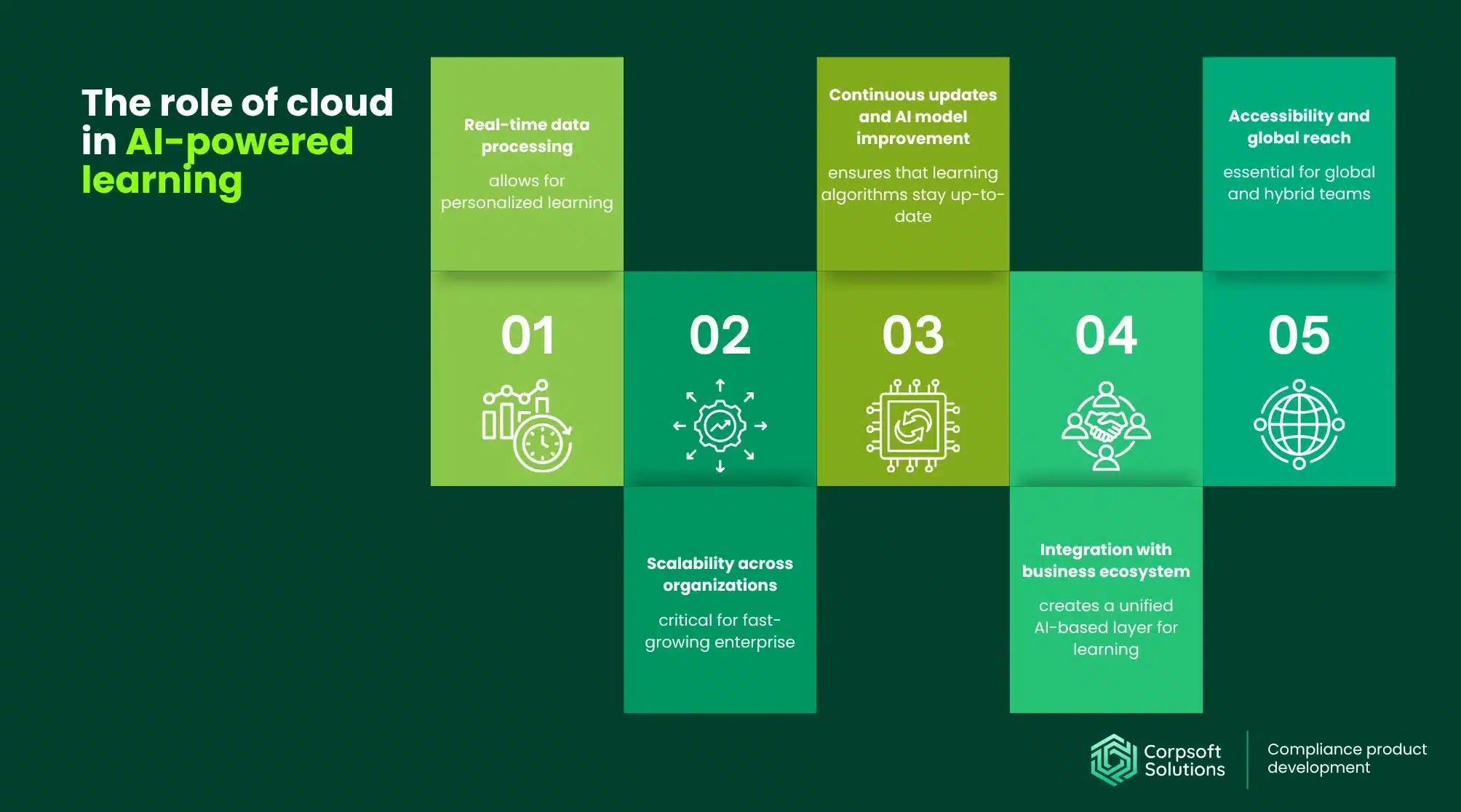
Cloud infrastructure is a foundational layer for most AI-driven personalization in corporate learning. Without cloud capabilities, most advanced AI features in LMS platforms would be either limited or impossible to implement at scale.
Real-time data processing
AI-powered learning relies on processing large volumes of data in real time: user interactions, performance metrics, and behavioral patterns. This data is essential for delivering personalized content and adapting learning paths dynamically.
Cloud-based learning management system provides the computational power and low-latency infrastructure required to handle this workload. They enable continuous data ingestion and processing, ensuring that recommendations, feedback, and content adjustments happen instantly rather than with delays.
Scalability across organizations
Cloud infrastructure allows organizations to scale learning programs seamlessly across thousands of users without compromising performance. This is especially critical for corporate e-learning solutions and fast-growing companies.
Cloud systems can dynamically allocate resources to handle increasing user count and maintain system responsiveness and personalization quality. This eliminates the need for costly infrastructure upgrades and ensures consistent performance regardless of scale.
Continuous updates and AI model improvement
AI models require continuous training, optimization, and updates to remain effective. Cloud environments enable these updates to be deployed without interrupting the user experience.
This means organizations can improve recommendation engines, personalization logic, and analytics capabilities in real time, without system downtime.
Integration with business ecosystem
Cloud-based learning management platforms are inherently more flexible when it comes to integrations. They can easily connect with HR systems, EdTech CRM platforms, performance management tools, and other business applications.
This creates a unified data layer that allows AI systems to operate with full context and connect learning activity to employee performance, career progression, and organizational goals.
Accessibility and global reach
Cloud-based e-learning platforms provide access to training from any location and device, making them ideal for distributed and hybrid teams.
Employees can engage with learning content regardless of geography, time zone, or device, ensuring consistent access to development opportunities. This is particularly important for global organizations aiming to maintain alignment and skill development across diverse teams.
How AI changes the operating model of corporate e-learning

AI is fundamentally redirecting the approach to corporate e-learning from a static, course-based system to a continuous and data-driven process. Learning is no longer a separate activity but becomes integrated into daily workflows, personalized to each employee, and directly aligned with business performance.
This shift introduces several key changes:
- Microlearning as a new standard. AI enables short, focused learning units delivered at the moment of need. This improves retention, reduces friction, and fits naturally into busy work schedules.
- AI-driven recommendations for skill development. Learning paths are no longer predefined. Elearning AI analyzes user behavior, performance, and role requirements to recommend what to learn next, ensuring continuous and relevant skill development.
- Work tools integration (Slack, Teams, Zoom). The process of learning is embedded directly into collaboration tools employees already use. This allows training, feedback, and knowledge sharing to happen within existing workflows, reducing context switching.
- Agentic AI as a learning assistant. AI tools and personalization evolve from a passive system into an active assistant that guides users, answers questions, suggests content, and supports learning in real time based on context and needs.
- Learning in the flow of work. Custom elearning solutions that are enriched with AI tools enable learning experiences that are triggered by tasks, projects, or performance signals, making training immediately applicable and actionable.
- Continuous feedback and adaptive learning loops. Rather than maintaining periodic training cycles, AI creates ongoing feedback loops that continuously assess skills, adjust learning paths, and refine development strategies.
Corpsoft Solutions’ approach to developing learning management systems
At Corpsoft Solutions, we approach e-learning management system development as a strategic capability. We focus on building systems that are scalable, adaptive, and devoid of common shortcomings of traditional LMS. This approach allows us to create tailored and AI-driven learning management systems for small businesses, as well as enterprise-grade solutions with complex system integrations and architectures.
Our approach to building the best corporate e learning platforms is structured around several key principles:
- AI-first architecture. We design LMS platforms with AI at the core, not as an add-on. This enables adaptive learning paths, real-time personalization, and continuous skill assessment from day one.
- Deep integration with business systems. At its core lies seamless connectivity with HRIS, performance management tools, and collaboration platforms. This creates a unified data layer that allows learning to be directly linked to performance and workforce planning.
- Personalization at scale. Our systems are built to deliver individualized learning experiences across large organizations without loss of quality. This includes dynamic content delivery, AI-driven recommendations, and role-based learning paths.
- Scalable and cloud-native infrastructure. Cloud technologies are one of the pillars of our e-learning solutions development. We use them to support real-time data processing, global accessibility, and high-performance AI models that remain effective as organizations grow.
- Advanced analytics and decision support. Beyond standard reporting, we provide actionable insights into skill gaps, learning effectiveness, and business impact, enabling data-driven decision-making.
- Flexible UX and white-label capabilities. We design customizable interfaces that align with internal workflows, branding, and organizational structure, ensuring high adoption and seamless user experience.
- Continuous improvement and evolution. We design our systems to evolve over time, with ongoing AI model optimization, content intelligence, and performance monitoring.
This approach ensures that the LMS becomes the core component of your talent development strategy and organizational growth.
Conclusion
Modern corporate e-learning is undergoing a fundamental shift driven by advances in AI and cloud technologies. Traditional models based on static content and standardized delivery are no longer sufficient to meet the needs of modern, dynamic workforces.
AI enables personalization and predictive insights, while cloud infrastructure provides the scalability and integration required to support these capabilities at an enterprise level. For organizations, this evolution presents both an opportunity and a challenge: selecting and implementing the right LMS development approach requires careful evaluation of technology, data, and operational fit. Those that succeed can turn learning into a strategic advantage, improving workforce capability, accelerating growth, and driving measurable business outcomes.
Share this post: