
Software Security Testing
Your last scan came back clean. That doesn’t mean your app is secure.
Automated scanners catch what they’re trained to catch. They don’t catch a broken authorization check, a business-logic flaw or the workaround a real attacker would try first. Your codebase and APIs get SAST, DAST and manual penetration testing, mapped to OWASP Top 10 and the compliance framework you’re audited against.
 SAST + DAST + Manual Penetration Testing
 OWASP Top 10 mapped
 AWS Select Tier Partner
 6 compliance frameworks
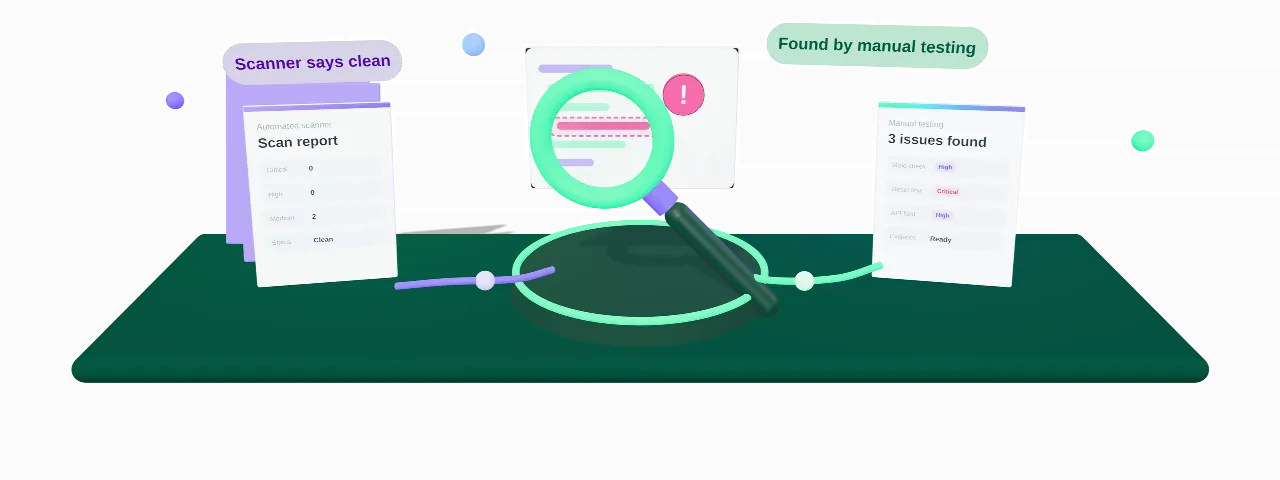
A clean scanner report isn't the same as a secure application.
Most teams run an automated scanner, get a report with no critical findings, and call it tested. Scanners are good at pattern matching — a known CVE, an outdated dependency, an obvious injection point. They miss what requires actually thinking like an attacker: a role check that works everywhere except one endpoint, a password reset flow with a logic gap, an API that trusts a client-supplied field it shouldn't.
Missed by the scanner
Our scanner says we're clean. Our last enterprise prospect's security team found three issues it missed.
Untested APIs
We don't know if our APIs leak more data than the UI shows, because nobody's actually tried.
No manual evidence
Our auditor wants evidence of manual testing, not just a tool's PDF export.
What software security testing actually covers here
Each testing method catches what the others miss, so your product gets all three. Every finding is mapped to OWASP Top 10 and the compliance framework you’re audited against.
Static Application Security Testing (SAST)
Your source code reviewed for insecure patterns — injection points, hardcoded secrets, broken cryptography — before it ever reaches a build, mapped against OWASP Top 10.
Dynamic Application Security Testing (DAST)
Your running application tested the way an attacker actually approaches it — authentication, session handling, input validation — from the outside, with no access to source code.
Manual Penetration Testing & Code Review
A security engineer manually probing business logic, authorization boundaries, and workflow edge cases that automated tools are structurally unable to catch.
API & Mobile Application Testing
The same three methods applied to your APIs and mobile apps specifically, including object-level authorization checks and client-side data exposure, not just your main web surface.
What working with Corpsoft Solutions looks like in numbers
100%
Audit readiness
Every finding comes with documented evidence of manual and automated testing, so your product is ready for HIPAA, SOC 2 Type II or ISO 27001 review.
Related case study:
Comprehensive Remote Patient Monitoring Platform for Chronic Care Management
5.0
Rating on Clutch
Across 20+ verified client reviews in healthcare, AI and enterprise SaaS.
Related case study:
Clutch profile6
Core regulations and standards
HIPAA, SOC 2 Type II, ISO 27001, GDPR, EU AI Act and NIS2. Every test result is mapped to the frameworks your product is audited against.
7 days
Free risk assessment
A prioritized view of where your code, APIs and running application are most exposed, with what to test and fix first.
Related case study:
Read more about this Risk Assessment of yoursFind out what your last scan didn't catch.
A short scoping call covers what's in your codebase and APIs today, which testing methods actually fit your risk profile, and what a findings report ready for an auditor looks like.
Book a 30-Min Scoping CallHow a testing engagement actually runs
- 01
Scoping
We map what's in scope — codebase, APIs, mobile apps — and which compliance framework the findings need to satisfy, before any testing starts.
- 02
Static Analysis
SAST runs against your source code, surfacing insecure patterns early, before anything reaches a build or a live environment.
- 03
Dynamic Analysis
DAST runs against your application while it's live, probing it the way a real attacker would from the outside.
- 04
Manual Testing
A security engineer works through business logic, authorization boundaries, and API/mobile-specific edge cases that automated tools structurally can't reach.
- 05
Findings Report & Remediation Guidance
Every finding is prioritized by real risk, mapped to OWASP Top 10 and your compliance framework, with concrete fix guidance, not just a severity label.
What you have once testing is complete
Every deliverable is something you can hand to an engineer to fix or an auditor to review, not a scanner export nobody can act on.
Prioritized Findings Report
Every issue ranked by real exploitability, not a flat severity score, with the reasoning a developer needs to fix it.
Coverage Across Three Methods
Insecure patterns caught in source code, runtime behavior tested under attack conditions, and logic flaws found by a person, not just a tool.
OWASP Top 10 Mapping
Every finding tied to the specific OWASP category it falls under, the format an auditor and a security questionnaire both expect.
Audit-Ready Evidence
Documentation of what was tested, how, and what was found, ready to hand to a CPA auditor or an enterprise security review.
A Clear Remediation Path
Findings prioritized so your team fixes what actually matters first, not whatever's listed first in a report.
Confidence Beyond the Scanner
Knowing your application has been tested by a method automated tools can't replicate, not just scanned and assumed clean.
Trusted by growing companies, past the MVP stage

Check out what they have to say about working with us.
"They respond to everything in a practical manner and in a quick time."
Thanks to Corpsoft.io's engagement, they have successfully created a functional app installed with extra features according to what they have agreed with the clients. The team has established effective communication to respond quickly and provide progress updates. They're prompt and structured.

Check out what they have to say about working with us.
"They respond to everything in a practical manner and in a quick time."
Thanks to Corpsoft.io's engagement, they have successfully created a functional app installed with extra features according to what they have agreed with the clients. The team has established effective communication to respond quickly and provide progress updates. They're prompt and structured.
See it in production
See how one startup shipped HIPAA-compliant AI diagnostics 3 weeks ahead of schedule. And another one scaled to 10,000+ patients while meeting HIPAA and SOC 2 requirements.
AI-powered dermatology platform built to handle sensitive patient data securely
Handling sensitive patient images without data leakage
Ensuring HIPAA-compliant AI diagnostics
Fragmented dermatology workflows across tools
Slow diagnosis and long patient wait times
Secure image processing with encryption and audit trails
HIPAA-aligned architecture with governed AI models
Unified platform for end-to-end dermatology workflows
AI-assisted diagnostics to accelerate doctor decisions
- Secure, compliant AI diagnostics (HIPAA-aligned)
- End-to-end dermatology workflow in one platform
- 1.5x faster diagnosis & 1–2 minute review time
- Up to 4x reduction in patient wait times

Consulting marketplace reached 10,000+ users and 5,000+ consultations in 3 months
Complicated booking with unclear availability
Secure video calls inside the platform
Experts managing profiles and schedules by hand
Scaling to more users and mobile access
Real-time availability and one-click slot booking
Encrypted WebRTC video calls for booked sessions
Expert dashboard for profiles and live availability
Scalable architecture and PWA for mobile access
- 10,000+ registered users in the first 3 months
- 5,000+ consultations completed with a 4.9/5 average rating
- 80% expert booking rate within the first month
Find out what your scanner isn't telling you.
Tell Andrii what needs testing (your codebase, APIs or mobile app) and what’s driving it: an audit, a security questionnaire or a release you need to trust. He’ll outline the right mix of SAST, DAST and manual testing for your product.
Book a call with AndriiFind out what your scanner isn't telling you.
Tell Andrii what needs testing (your codebase, APIs or mobile app) and what’s driving it: an audit, a security questionnaire or a release you need to trust. He’ll outline the right mix of SAST, DAST and manual testing for your product.
Book a call with Andrii
Andrii Svyrydov
Founder & CEO of Corpsoft Solutions · ex-Head of Tech at a software company with 1,500+ delivered projects
Further reading on this topic
 September 4, 202613 min read
Enterprise AI Security: What Buyers Actually Ask Before They Sign
Your SOC 2 report covers most of the vendor questionnaire, but not its AI section. What enterprise buyers ask about your model, data path and retention, and which artifacts close the review.
View more
 June 23, 202626 min read
Exposed API Keys in Frontend Code: A Cybersecurity Risk Assessment Guide for CTOs
Most API key leaks start with a credential nobody knew was there. Here's what a proper cybersecurity risk assessment of your API key infrastructure actually looks like.
View more September 17, 202612 min read
Third-Party Software Security Assessment: What to Check and Why Most Teams Skip It
Why third-party software security assessment gets skipped, and the process that makes it repeatable instead of accidental.
View more


Questions clients ask before we start
SAST, static application security testing, reads your source code without running it, catching insecure patterns like hardcoded secrets or injection points before anything ships. DAST, dynamic application security testing, attacks your application while it's actually running, the way a real attacker would, catching issues that only show up at runtime. Neither replaces the other. A thorough engagement uses both.
Yes. API testing covers authentication, authorization, and object-level access checks, the kind of flaw that lets one user's token return another user's data. Mobile testing applies the same three methods to your app specifically, including client-side data exposure that a web-only test wouldn't catch.
Manual testing is a core part of this service, not an add-on. Automated SAST and DAST catch a lot, but a skilled engineer is still the only way to find a broken authorization check or a business-logic flaw that technically passes every automated test. If a vendor is only offering you a scanner's output, that's not the same service.
Software security testing is the practice of finding security weaknesses in an application before an attacker does, through a combination of automated analysis (SAST and DAST) and manual testing by a security engineer. Corpsoft Solutions runs all three, mapped to OWASP Top 10 and whatever compliance framework your audit actually requires.
Yes, Corpsoft Solutions is an AWS Select Tier Partner, with AWS Certified Solutions Architects on the team, so testing accounts for how your application actually interacts with its cloud environment, not just the application code in isolation.
Every finding is tagged against the OWASP Top 10 category it falls under, which maps directly onto the technical safeguard requirements most frameworks already reference, SOC 2's Common Criteria, HIPAA's Security Rule, ISO 27001's Annex A. The report is built to be handed straight to an auditor, not translated after the fact.
Ready to discuss your project with us?Not sure where to start?
Drop us a line about your project or challenge — we'll take it from there.
 Typical response time1 hour on business days