
HIPAA-Compliant Software Development
Healthcare software ready for a HIPAA audit from the first release.
Your healthcare product and AI features get encryption, access controls and audit logging built in from day one.
 100% audit readiness
 6 frameworks built in
 BAA signed with every client
 Security Rule safeguards built in
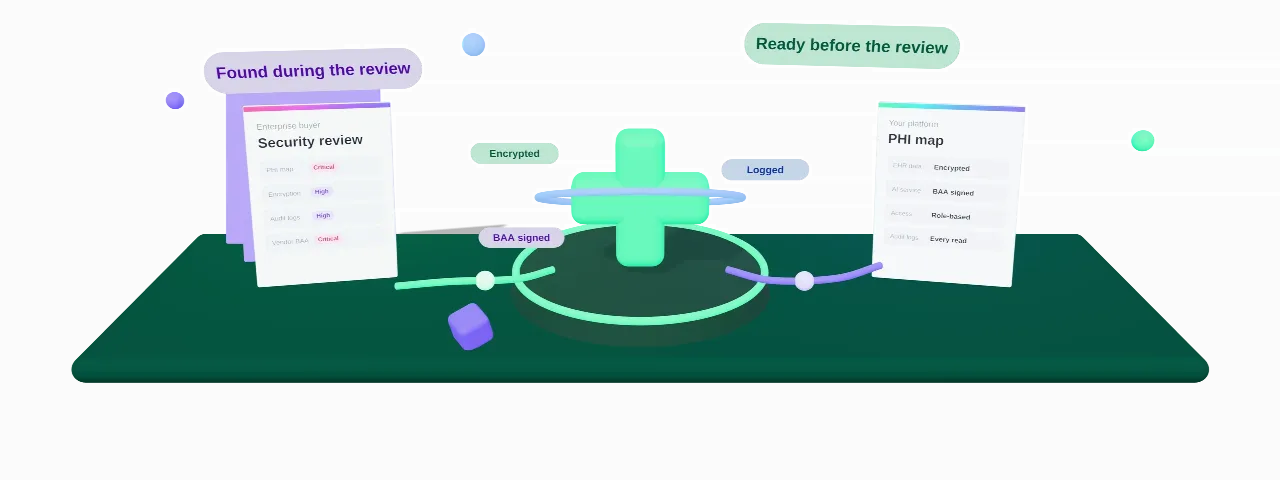
Most HIPAA gaps surface during an audit, not before.
A HIPAA policy describes what should happen to Protected Health Information. The software determines what actually happens. Many healthcare and health-tech teams find the gap during a security review or an enterprise buyer's questionnaire, after the fix already costs more than building it right would have.
Unmapped PHI
No one can show which systems actually touch patient data.
Safeguards added late
Encryption and logging were added late, and it shows.
AI without a BAA
AI features touch patient data without a signed BAA.
Starting over every time
Every new deal or framework means starting over.
What standards do we build to
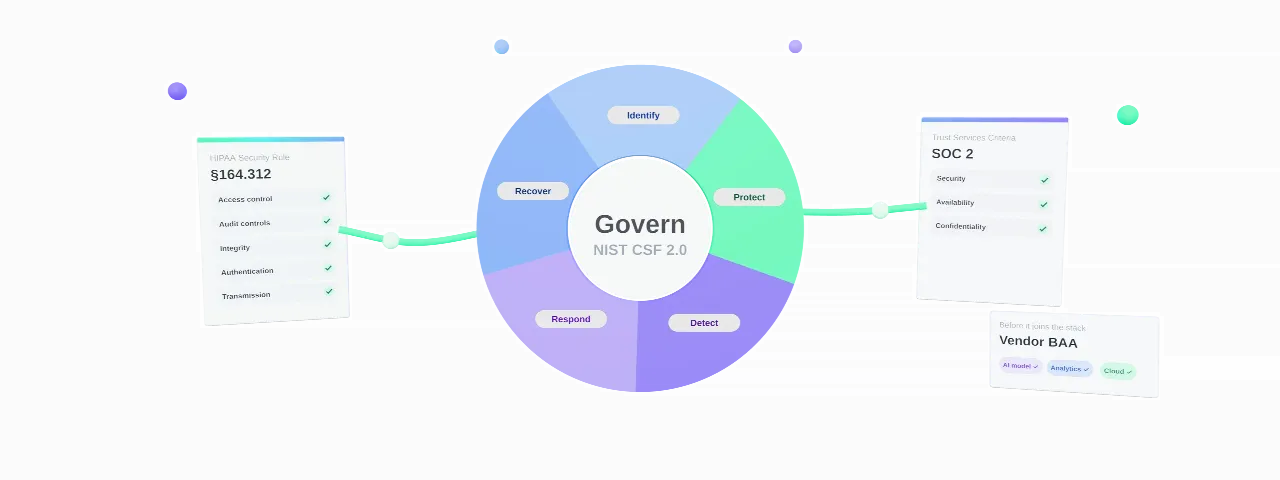
Corpsoft Solutions builds HIPAA-compliant software to the standards auditors and enterprise buyers actually check, not a proprietary checklist, but a structured implementation of the HIPAA Security Rule and the frameworks it is most often paired with: SOC 2, GDPR, ISO 27001, EU AI Act, and NIS2.
01
HIPAA Security Rule §164.312
Technical safeguard requirements for access control, audit controls, integrity, and transmission security, implemented at the architecture level for any product handling Protected Health Information.
02
NIST Cybersecurity Framework 2.0
Used to map control coverage — Govern → Identify → Protect → Detect → Respond → Recover — into the architecture from the first sprint, not as a post-launch checklist.
03
SOC 2 Trust Service Criteria
Security, availability, and confidentiality controls built in from day one, so audit evidence exists from production launch, not from a pre-audit scramble.
04
Vendor BAA Coverage
Every third-party integration, including AI vendors and analytics tools, is reviewed against HIPAA's Business Associate Agreement requirement before it's added to the stack.
What HIPAA-compliant software development actually means
HIPAA-compliant software development means building healthcare software, including AI features, so the required safeguards are structural decisions, not documentation added afterward. We map which parts of the HIPAA Security Rule apply to your system before writing architecture decisions, then design data flows, access controls, and audit logging so the software holds up under an audit or a vendor questionnaire.
HIPAA-Compliant Web Development
Websites, patient portals, and web applications that collect or handle Protected Health Information, built and audited to the same Security Rule standard as custom backend systems.
HIPAA-Compliant AI Features
Model lineage, a signed BAA with the AI vendor, and decision logging, built into any AI feature that touches Protected Health Information.
What we find in software built without HIPAA in mind
Shared access to PHI
Admin and support staff share broad access to systems holding Protected Health Information — one compromised account or a departing employee reaches every patient record in the database.
PHI outside the BAA
PHI shows up in application logs, error trackers, or analytics tools that were never covered by a Business Associate Agreement, a violation that exists before the first regulated customer signs on.
Patchy encryption
Encryption is applied to some data flows and not others, usually patched in after a security review flags the gap, not designed in from the first architecture decision.
AI without governance
AI features process patient data without a signed BAA with the AI vendor, model lineage, or a record of what data the model was trained on.
Logs without answers
Access logs record that something happened, but not who did it or why, turning "who viewed this patient's record" from a query into a weeks-long investigation.
What working with Corpsoft Solutions looks like in numbers
100%
Audit readiness
Across our HIPAA engagements. If our architecture contributes to a failed audit, we fix it as part of the engagement.
5.0
Rating on Clutch
Across 20+ verified client reviews in healthcare, AI and enterprise SaaS.
6
Compliance frameworks
Built into your product’s architecture as needed: HIPAA, SOC 2 Type II, ISO 27001, GDPR, EU AI Act and NIS2.
60 days
To notify patients of a breach
HIPAA’s outer limit for breach notification. Breach detection and audit logs are built so your team can meet it.
See what a HIPAA-compliant architecture looks like for you.
A discovery call maps your PHI data flows, checks which BAAs you already need, and outlines what a HIPAA-compliant architecture looks like for your system before the first design decision is made.
Book a Discovery CallHow We Build
Every HIPAA-compliant engagement runs through six phases. Nothing skips a step, and nothing reaches production without the evidence to prove it's compliant.
- 01
Discovery
We map your HIPAA environment: what Protected Health Information you handle, which BAAs are already in place, and where your current system creates exposure.
- 02
Design
Architecture decisions are made against the Security Rule's requirements: access model, encryption boundaries, PHI data flows, and logging design — before infrastructure is provisioned.
- 03
Implementation
The architecture is built as Infrastructure as Code, with access controls, encryption, and audit logging implemented exactly as designed, not approximated during a sprint.
- 04
Validation
We test the system against HIPAA Security Rule requirements: access reviews, control verification, and gap analysis before it reaches production traffic.
- 05
Documentation
Architecture diagrams, control mappings, and a signed Business Associate Agreement are delivered as part of the build, not assembled for an auditor's request later.
- 06
Support
As HIPAA guidance and enterprise buyers' security expectations evolve, we extend the architecture instead of rebuilding it from scratch.
What you have when the engagement is complete
Every deliverable is something you can hand to an auditor, a security reviewer, or your own engineering team — not a slide deck.
HIPAA Architecture Blueprint
System architecture diagrams mapped to the Security Rule requirements they satisfy, ready for engineering handoff or an auditor's review.
Infrastructure as Code
The architecture as deployable, version-controlled code, reproducible and free of manual configuration drift.
Access & Encryption Baseline
IAM policies, encryption configuration, and network rules documented as the enforced baseline for every environment handling PHI.
Signed Business Associate Agreement
A BAA covering every system and vendor that processes Protected Health Information on your behalf.
Audit Evidence Trail
Logs and control-implementation records generated from day one of production, not assembled before a review deadline.
HIPAA Gap Assessment
An honest account of what's covered and what remains open, so nothing surfaces as a surprise mid-audit or mid-deal.
Trusted by growing companies, past the MVP stage

Check out what they have to say about working with us.
"The team is very professional and pleasant to work with, and their attentiveness is very noticeable and present."
Corpsoft.io consistently updates their task list, prepares for sprints, and checks and marks the feedback document daily. Moreover, the team manages the project well without micromanagement, proactively informs the client about the project's status, and promptly addresses all their requests.
"It is a pleasure working with them."
Corpsoft.io team is professional and highly knowledgeable. They deliver on time after extensive QA process.
Check out what they have to say about working with us.
"The team is very professional and pleasant to work with, and their attentiveness is very noticeable and present."
Corpsoft.io consistently updates their task list, prepares for sprints, and checks and marks the feedback document daily. Moreover, the team manages the project well without micromanagement, proactively informs the client about the project's status, and promptly addresses all their requests.
"It is a pleasure working with them."
Corpsoft.io team is professional and highly knowledgeable. They deliver on time after extensive QA process.
See HIPAA-compliant systems in production
See how one startup shipped HIPAA-compliant AI diagnostics 3 weeks ahead of schedule. And another one scaled to 10,000+ patients while meeting HIPAA and SOC 2 requirements.
Comprehensive Remote Patient Monitoring Platform for Chronic Care Management
Manual follow-ups and referrals overloading care teams
Tracking cognitive health remotely between visits
Securing patient data across four user roles
Automated patient journeys and provider scheduling
Built-in cognitive assessments with scheduled retests
HIPAA-compliant SSO with RBAC and audit logging
- 60% reduction in administrative workload
- Continuous remote monitoring of chronic conditions
- Role-based access for patients, providers, therapists, and admins

A Revolutionizing Platform For Pediatric with AI-Powered Workflow Optimization
Paperwork and slow access to patient data
Protecting patient data processed by AI
AI summaries and two-click access to patient records
Encrypted PHI storage with role-based access controls
- Treatment summary reports cut from 45 to 5 minutes
- Fully digital patient registration and records
- More time for patient care and higher daily capacity
- Real-time dashboard tracking time saved

Build it HIPAA-compliant once. Stay audit-ready as you grow.
Tell us what PHI your system handles. We’ll outline the architecture and BAA path in a 30-minute call.
Book a Discovery Call with AndriiBuild it HIPAA-compliant once. Stay audit-ready as you grow.
Tell us what PHI your system handles. We’ll outline the architecture and BAA path in a 30-minute call.
Book a Discovery Call with Andrii
Andrii Svyrydov
Founder & CEO of Corpsoft Solutions · ex-Head of Tech at a software company with 1,500+ delivered projects
Further reading on this topic
 June 19, 202613 min read
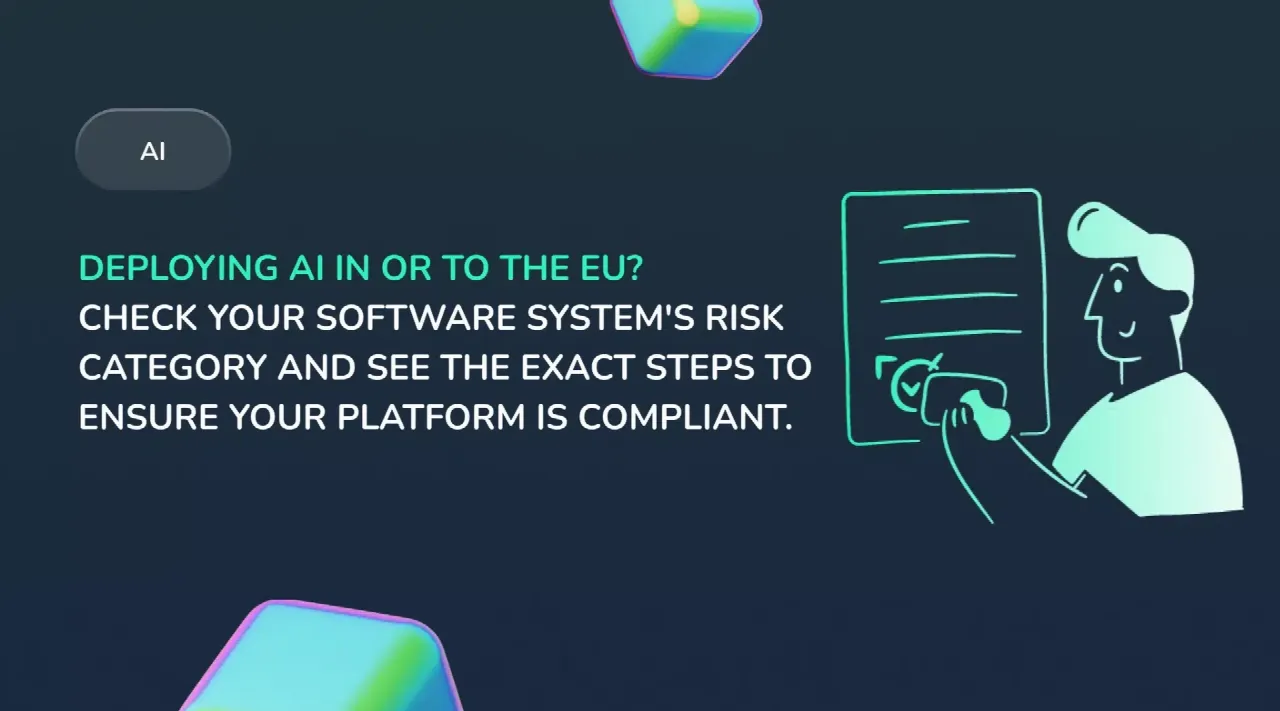
EU AI Act Explained: What Your System Must Actually Do
EU AI Act compliance deadlines hit in 2026 and 2027. Learn which risk tier your AI falls into and what AI systems must actually do.
View more
 June 15, 202624 min read
AI Governance and Compliance: The Hidden Cost of Waiting Until Your First Enterprise Deal
Your AI system works. It may not survive an enterprise security review. Here's what procurement actually checks — and why most AI teams discover the gap at the worst possible moment.
View more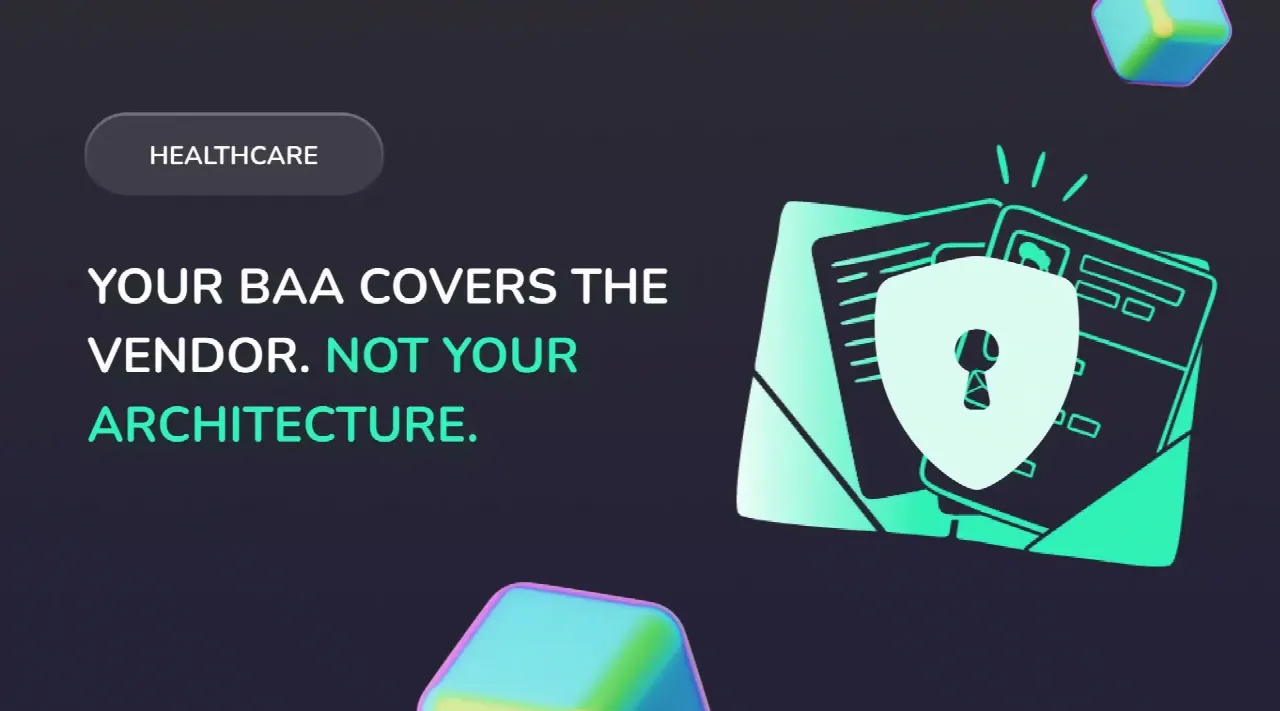 September 30, 202610 min read
HIPAA-Compliant LLM Features: What Has to Be True Before You Ship
What a HIPAA-compliant LLM feature has to satisfy before a hospital review, across all three governance layers at once.
View more


Questions clients ask before we start
Common questions about HIPAA-compliant software development
Common questions about HIPAA-compliant software development
Yes, every engagement includes a signed Business Associate Agreement covering Corpsoft Solutions and any subcontractor with access to Protected Health Information. The BAA is delivered as part of the build itself, alongside the architecture and documentation, not requested separately or added as a legal step once the software is already in production.
The HIPAA Security Rule requires administrative, physical, and technical safeguards: risk analysis, access controls, encryption, audit logging, and a signed BAA with any vendor that touches Protected Health Information. We map every requirement to your specific system before writing architecture decisions, so the safeguards are built in rather than checked off after the software is already live.
Yes, model lineage, a signed BAA with the AI vendor, and decision logging are built into any AI feature that processes Protected Health Information. This applies whether the AI is a feature we build for you or a third-party tool you integrate, using the same governance approach behind our AI governance services.
Hosting covers where your data lives — a data center or cloud environment configured to Security Rule standards. Development covers how your software is built to use that environment correctly: encryption, access controls, and audit logging designed into the application itself, not just the infrastructure underneath it. A HIPAA-compliant host doesn't make software that ignores those safeguards HIPAA-compliant on its own.
Yes, but both frameworks apply at once, not one after the other. GDPR governs how personal data is processed and what individuals can request about it; HIPAA governs Protected Health Information specifically. An AI feature handling health data from EU users needs a signed BAA and GDPR-compliant data handling in the same architecture.
The core requirements are risk analysis, access controls, encryption, audit logging, and a signed BAA with any vendor that touches Protected Health Information. For software specifically, that also means secure code practices, tested backups, and documentation that proves the safeguards are actually in place, not just described in a policy.
Ready to discuss your project with us?Not sure where to start?
Drop us a line about your project or challenge — we'll take it from there.
 Typical response time1 hour on business days