



TL;DR:
Generative AI security in 2026 is a compliance problem before it’s a hacking problem. Here’s what this guide covers:
- 10 production AI risks that block enterprise deals and EU market entry
- Which regulation each risk violates
- How auditors detect them in your system
- The architectural control that prevents each one
Enterprise procurement doesn’t ask whether your model is accurate. It asks whether you can explain how it works, where its data flows, and who remains accountable for its decisions. That’s why the security risks of generative AI in 2026 are, first and foremost, a compliance problem — and why a standard security checklist won’t get your AI system through an enterprise deal or into the EU market.
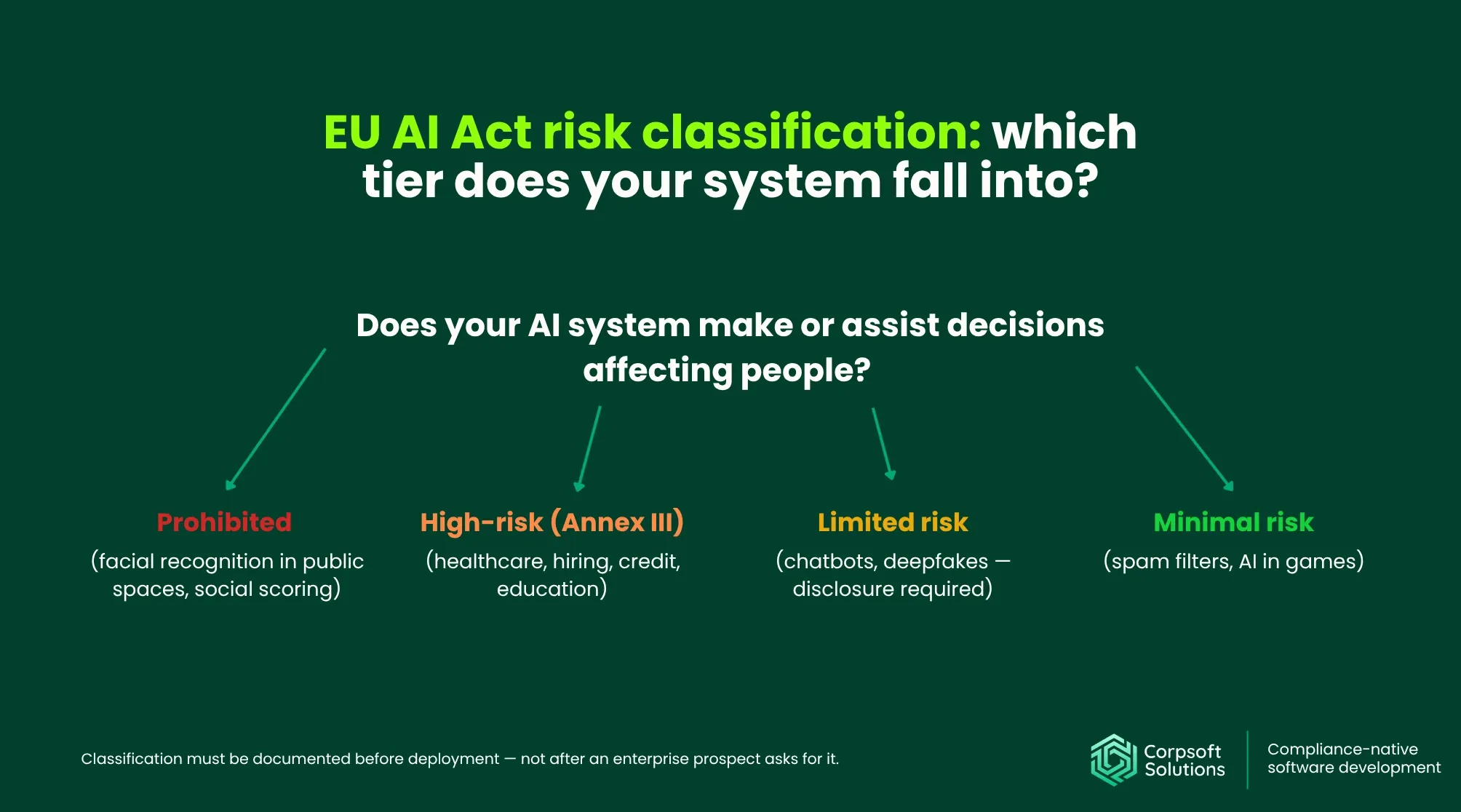
Two dates make this more urgent this year than last. GPAI model obligations under the EU AI Act took effect in August 2025, and obligations for high-risk systems follow in August 2026 — which means any AI feature touching hiring, credit, healthcare, or another Annex III category needs a classification decision on file well before that date, not after an enterprise prospect asks for one.
If your AI system just moved from pilot to production and you’re preparing for an enterprise contract or a European launch, the risks below are the ones that actually stop that path — not the ones that make headlines.
Reality check: if you cannot answer all five questions below in under five minutes, your AI system is probably not audit-ready:
- Where are prompts stored?
- Which model version produced this output?
- Can a reviewer override the decision?
- Which jurisdiction processes inference?
- Which vendor contract covers this data?
Why generative AI security risk is a compliance problem, not just an IT problem
Every risk on this list connects the same way: how to tell it’s already in your system, what it costs you in business terms, which law or standard it touches, and the architectural control that closes it — not a training session or a policy binder written after the fact. That logic is the same one behind AI Governance in Practice: governance that survives an audit is built into the system, not layered on top of it once someone asks.
That maps directly onto the AI Compliance Stack, Corpsoft Solutions’ framework — three layers, all required simultaneously:
| Layer | Owner | Audit question |
Evidence expected |
| Data Governance | Platform/data engineering | Where does data go before, during, and after the model sees it? | Data flow map, DPA coverage, redaction logs |
| Model Governance | ML engineering | Can you explain why the model made this decision? | Decision lineage, model version log, override records |
| Regulatory Compliance | Legal + engineering | Can you prove the system meets its regulatory obligations? | Risk classification, technical documentation, conformity assessment |
The order matters. A system with airtight regulatory documentation but no data governance still fails because the paperwork won’t align with what the system actually does under inspection. A system with clean data handling but no audit trail still fails, because no one can reconstruct what happened when a reviewer asks. Each layer below assumes the ones before it hold.
![Top Generative AI Security Risks to Monitor in 2026 — diagram of the three-layer AI Compliance Stack: Data Governance, Model Governance, Regulatory Compliance]](https://corpsoft.io/wp-content/uploads/2026/08/ai-compliance-stack-three-layers.webp)
Layer 1 — Data governance
Fails because: input handling was built for speed, not for a paper trail — teams optimize for getting a feature shipped, and data handling gets whatever structure survives the sprint. Get this wrong, and nothing above it matters — see AI Data Governance: Why Your AI Is Only as Good as the Data Governance Behind It.
Risk 1: Prompt logs leak PHI and PII before anyone notices
This is generative AI data security in its most literal form: what happens to a prompt after it’s sent.
Signs you already have this problem:
- Prompt and response logs aren’t separated from any training or fine-tuning data store, so anything logged today could end up shaping tomorrow’s model
- You can’t say which of the last 90 days of prompts contained customer or patient data, because no one tagged or classified them at the time.
Business impact: A single flagged prompt log turns a routine enterprise security review into a stalled procurement cycle — the reviewer stops scoring your product and pulls legal in.
Regulatory consequence: GDPR Art. 5 & 32; HIPAA (unauthorized PHI disclosure).
Architectural control: Redact PII/PHI at ingestion; isolate prompt/output logs from any training corpus, encrypted separately.
Severity: Critical
On Corpsoft Solutions’ pediatric telemedicine platform, patient health information is de-identified before it ever reaches the ML model — this exact control is in place in a production system that processes real clinical data.
Risk 2: Shadow AI routes regulated data through tools you never approved
Signs you already have this problem:
- Engineers or product features call public AI APIs directly, outside any approved vendor list, because it was faster than waiting for procurement sign-off
- No one can produce a current list of which third-party AI endpoints touch production data if asked for one this afternoon.
Business impact: One unapproved AI integration found during vendor review is enough for procurement to freeze the deal until every other AI touchpoint gets re-audited — not just the one they found.
Regulatory consequence: HIPAA (BAA requirement); GDPR Art. 28.
Architectural control: Allowlist compliant vendor endpoints only; block unapproved AI API domains at the network egress layer — see HIPAA Compliance Development.
Severity: High
Typical scenario: a product team wires a consumer AI API into a support feature to hit a deadline. Real user data — some of it personal — flows through it, with no DPA in place. An enterprise prospect’s security team finds this during procurement and pauses the deal until every AI touchpoint gets re-reviewed, not just the one they caught.
Risk 3: Cross-border inference breaks your data residency promises
Signs you already have this problem:
- You don’t know which region your model provider physically processes inference in, or whether that’s changed since you last checked
- No documented data flow map exists for your AI subprocessors, so no one can answer a residency question without asking the vendor first.
Business impact: An undocumented data route outside the EU adds weeks to a European enterprise’s legal review, even when the actual risk is minor — because no one can quickly confirm it isn’t a problem, and legal defaults to caution when they can’t confirm either way.
Regulatory consequence: GDPR Chapter V (international transfers); NIS2 for in-scope entities.
Architectural control: Use region-pinned inference endpoints; maintain a documented subprocessor data-flow map covered by a DPA.
Severity: Medium
What enterprise security questionnaires typically ask at this stage:
- Do you use customer data to train or fine-tune AI models, and is consent documented?
- Where, geographically, is data processed by your AI systems?
- Do you have a signed DPA or BAA with every AI subprocessor?
- Can you provide a data flow diagram showing how data enters and leaves your AI systems?

Layer 2 — Model governance
Fails because: model behavior can’t be reproduced or explained after the fact — the same input can produce a different output next week, and unless every version, prompt, and response is captured, there’s no way to say why.
Risk 4: Prompt injection turns your AI agent against you
As AI agents get more autonomy, agentic AI security risks in 2026 increasingly come down to one design question: how much can this agent do without a human checking first?
Signs you already have this problem:
- Your AI agent calls tools or APIs without a permission boundary separate from the user’s own access, so a compromised prompt inherits whatever access the user has
- You’ve never tested the system against hidden instructions embedded in retrieved content — what security teams track under the OWASP Top 10 for LLM Applications (LLM01: Prompt Injection).
Business impact: An agent that takes an unapproved action — a refund, a data export — turns a technical bug into an incident report that legal and the client’s security team both have to sign off on before the relationship continues.
Regulatory consequence: EU AI Act Art. 15 (robustness and cybersecurity for high-risk systems).
Architectural control: Sanitize and validate inputs before they reach the model; scope agent tool access to least privilege; validate outputs before any action executes.
Severity: Critical
Risk 5: No audit trail means you can’t defend an AI decision
Signs you already have this problem:
- You can’t reproduce a model’s output from three months ago because the version isn’t logged anywhere you can query
- A request to “show the last 10 AI-assisted decisions” takes longer than two days to answer, because the data lives in scattered application logs, not one record.
Business impact: When a client asks why the AI made a specific call and you can’t answer inside the review window, the deal doesn’t die — it goes back to security review from the start, with a new reviewer. If you can’t reproduce an AI decision six months later, you don’t have an AI system you can defend — you have one you can only hope behaves correctly.
Regulatory consequence: GDPR Art. 22; EU AI Act Art. 12 (record-keeping).
Architectural control: Persist model version, prompt, and output together in an immutable decision-lineage store for every automated decision.
Severity: High

Risk 6: A Human-in-the-Loop who can’t actually override the model
Signs you already have this problem:
- The designated “reviewer” has neither the time nor the system access to actually override an AI-generated decision before it takes effect
- No documented process exists for what happens when a human disagrees with the model — the disagreement just isn’t captured anywhere.
Business impact: A reviewer who can’t actually override the model isn’t a safeguard an auditor will accept — it’s a finding that reopens the entire review, and the second review usually goes to a more senior reviewer who asks harder questions.
Regulatory consequence: GDPR Art. 22(3); EU AI Act Art. 14 (human oversight).
Architectural control: Give the reviewer real override authority and direct access to the underlying data behind the AI output.
Severity: Critical
Risk 7: An unverified model checkpoint can backdoor your entire product
Signs you already have this problem:
- You can’t verify the provenance of every fine-tuned checkpoint or LoRA adapter running in production, including ones pulled from public registries
- Your model registry accepts new versions without a signature or hash check, so a swapped file would go live unnoticed.
Business impact: An unverified checkpoint discovered during due diligence doesn’t just flag one risk — it makes the reviewer question every other component in your stack, extending the review indefinitely.
Regulatory consequence: EU AI Act Art. 15; NIST AI RMF (Govern/Manage functions).
Architectural control: Require signed, hash-verified checkpoints only; restrict the production registry to an allowlisted source; maintain an artifact inventory for every model in production.
Severity: High
Traditional AppSec vs. generative AI security
Security teams evaluating an AI system for the first time tend to look for the controls they already know, mapped onto unfamiliar territory. The table below is the fastest way to have that conversation:
|
Traditional AppSec |
Generative AI security equivalent |
| SQL injection | Prompt injection |
| IAM / access control | Tool permissions for AI agents |
| Audit logs | Decision lineage |
| Data residency | Inference residency |
The controls aren’t new categories of engineering — they’re the same discipline, applied to a system that talks back. A security reviewer who already understands IAM already understands why tool permissions matter; the vocabulary is just newer than the underlying discipline.
Layer 3 — Regulatory compliance
Fails because: the system works, but nothing about it is written down — the engineering is sound, but the evidence an auditor or enterprise reviewer needs to confirm that doesn’t exist anywhere they can find it.
Risk 8: Shipping an unclassified high-risk system can delay EU market entry
Signs you already have this problem:
- No documented classification decision exists for any AI feature you’ve shipped, minimal or otherwise
- Your healthcare, hiring, or credit-scoring feature has never been checked against Annex III, even informally.
Business impact: Without a documented classification decision, EU market entry can stall indefinitely — many enterprise buyers and distributors require proof of classification before they’ll continue evaluating the product.
Regulatory consequence: EU AI Act Art. 6 + Annex III.
Architectural control: Make risk classification a mandatory, documented artifact at design phase — before deployment, not after. See AI Business-Specific Governance for how classification plays out by industry.
Severity: Critical
Risk 9: No technical documentation means no way to prove compliance
Signs you already have this problem:
- No maintained technical file exists — architecture, training data provenance, risk assessment — that anyone could hand over today
- Every evidence request lands on an engineer’s desk instead of pulling from an existing record, and takes them off product work to answer.
Business impact: Engineering time gets drained one manual evidence request at a time — the same document gets assembled from scratch for every new reviewer who asks, because nothing was kept from the last time.
Regulatory consequence: EU AI Act Art. 11 (technical documentation).
Architectural control: Generate the model card and data lineage documentation as part of the CI/CD release pipeline, not as a one-off exercise before an audit.
Severity: High
Typical scenario: an enterprise customer requests technical documentation on a Friday. The system is secure. No model card exists. No data lineage. By Monday, procurement has restarted from zero.
Risk 10: An unverified AI vendor makes their compliance gap your liability
Signs you already have this problem:
- Your foundation model or AI vendor’s compliance posture has never been checked against your own regulatory obligations, only their marketing page
- No DPA or BAA exists for at least one AI subprocessor touching regulated data, and no one currently owns closing that gap.
Business impact: Finding one AI subprocessor without a signed DPA doesn’t stay a one-line finding — it triggers a review of every AI vendor in the stack, not just the one that got flagged.
Regulatory consequence: GDPR Art. 28; HIPAA BAA chain.
Architectural control: Require a compliance verification gate in procurement before integrating any AI vendor; make a signed DPA/BAA a contractual precondition.
Severity: Medium
Typical evidence requested during enterprise procurement:
- AI risk classification decision (documented)
- Model card
- Data processing agreement (DPA) or BAA
- Subprocessor list with data flow coverage
- Audit logs from the last review period
Risk matrix

The ten risks above map cleanly onto layer, regulation, and severity — useful as a working reference on its own, separate from the detail above:
| # | Risk | Layer | Regulation | Control |
Severity |
| 1 | Prompt logs leak PHI/PII | Data | GDPR Art. 5/32; HIPAA | Redact at ingestion; isolate logs | Critical |
| 2 | Shadow AI | Data | HIPAA BAA; GDPR Art. 28 | Vendor allowlist; egress control | High |
| 3 | Cross-border inference | Data | GDPR Ch. V; NIS2 | Region-pinned endpoints; DPA flow map | Medium |
| 4 | Prompt injection/ agent actions | Model | EU AI Act Art. 15 | Input sanitization; least privilege | Critical |
| 5 | No audit trail | Model | GDPR Art. 22; EU AI Act Art. 12 | Immutable decision-lineage log | High |
| 6 | Human-in-the-loop can’t override | Model | GDPR Art. 22(3); EU AI Act Art. 14 | Override authority + data access | Critical |
| 7 | Unverified model checkpoint | Model | EU AI Act Art. 15; NIST AI RMF | Signed checkpoints; registry allowlist | High |
| 8 | Unclassified high-risk system | Regulatory | EU AI Act Art. 6 + Annex III | Mandatory pre-deployment artifact | Critical |
| 9 | No audit-ready documentation | Regulatory | EU AI Act Art. 11 | Auto-generated model card in CI/CD | High |
| 10 | Unverified vendor compliance | Regulatory | GDPR Art. 28; HIPAA BAA | Vendor compliance gate | Medium |
If you only remember one thing: AI systems fail enterprise reviews because of missing evidence, missing logging, and missing classification — not because attackers are smarter.
What these ten risks have in common
None of these are generative AI security best practices in the generic sense — they’re the top gen AI security risks to monitor in any production system, and every one is prevented by a design choice made before the system ships, not a policy written after an audit finding. None of these GenAI risks are solved by writing another document. The pattern holds across all three layers: the fix is never a new hire dedicated to watching for the problem — it’s a constraint built into the system that makes the problem structurally harder to cause in the first place.
Which risk to fix first
If you’re preparing for a European launch, start with Layer 3 — an unclassified high-risk system can delay EU market entry regardless of how well-built Layers 1 and 2 are. If you’re closing an enterprise deal, start with Layer 2 — audit trail and human oversight are what security questionnaires ask for first, before anyone checks your regulatory classification. If you’re doing neither yet but scaling toward either, start with Layer 1 — data governance is the layer every other layer’s evidence depends on, and it’s the cheapest one to fix before the system is handling production volume.
Quick self-check:
- [ ] Are prompt/output logs isolated from training data?
- [ ] Is every automated decision traceable to a model version?
- [ ] Does your human reviewer have real override authority?
- [ ] Has your AI feature been checked against EU AI Act Annex III?
- [ ] Is there a signed DPA/BAA for every AI vendor touching regulated data?
The takeaway
Every risk in this list traces back to the same root cause: governance treated as paperwork instead of architecture. A policy document doesn’t stop a prompt injection attack, redact a PHI-laden log, or produce a decision trail six months after the fact — only a system built to do that can. That’s the point of Corpsoft Solutions’ AI Compliance Stack: Data Governance, Model Governance, and Regulatory Compliance aren’t three teams handing off a checklist. They’re three layers of the same system, and each one either holds under audit or doesn’t.
Generative AI security risk isn’t going away in 2026 — it’s becoming the default lens enterprise buyers and EU regulators use to judge whether an AI system is production-grade at all. The systems that pass aren’t the ones with the best intentions. They’re the ones where compliance was a design decision, checked into the same pipeline as everything else, not a document written after the fact.
Share this post: