


TL;DR:
No single AI compliance consulting firm fits every organization — the right pick depends on what you actually need:
- An enterprise-scale program backed by a dedicated compliance platform
- Compliance engineered directly into your system’s architecture as you build — the approach Corpsoft Solutions takes for growth-stage AI companies
- Independent third-party audit to verify what’s already in place
This guide compares 10 firms across the full spectrum — advisory-only, hybrid, and implementation-focused — so you can match the type of consulting to what you’re actually trying to solve.
Who this guide is for
This guide is for CTOs, Heads of AI, engineering leaders, and compliance managers evaluating AI governance consulting firms — whether for enterprise AI compliance consulting, regulatory readiness, or hands-on implementation.
Read it if you’re:
- Deploying an AI system that’s approaching production or already live
- Preparing for enterprise procurement that requires proof of AI governance
- Expanding into regulated markets under the EU AI Act, NIST AI RMF, or ISO 42001
- Building an AI governance program from scratch
Your AI system just moved from pilot to production, and the first enterprise procurement questionnaire landed with a question your team can’t fully answer: who has reviewed your model’s decision logic, and can you prove it? A generic AI vendor doesn’t have that answer. Neither does a policy document written before the system shipped.
This is the point where most engineering teams start looking for outside help — and where the search gets confusing fast. Some firms will hand you a governance framework and a slide deck. Others will actually touch your codebase. The distinction affects what actually changes inside your AI system, and it’s the first thing to sort out before you pick a name off a list.
How we evaluated these firms
Not all AI compliance companies offer the same thing. The best fit for your situation depends on whether you need advisory work or hands-on implementation.
This guide evaluates publicly available information: service descriptions, framework expertise named on each firm’s own site, published case studies, and technical capabilities the company describes for its own delivery. Private delivery practices, internal methodologies, or confidential client engagements were not considered unless publicly documented.
No single consulting firm is the best fit for every organization. Rather than ranking firms by brand recognition alone, this guide evaluates how each provider aligns with specific implementation scenarios, regulatory needs, and organizational maturity — and separates firms that primarily advise from firms that primarily build. The list order below reflects these evaluation criteria rather than an absolute ranking of capability. A higher position doesn’t necessarily mean a better fit for every organization or implementation scenario.
Disclosure: Corpsoft Solutions is the publisher of this article and one of the firms included in the comparison, at position #2. The evaluation criteria were applied consistently to every entry, including our own.
Implementation vs Advisory Consulting
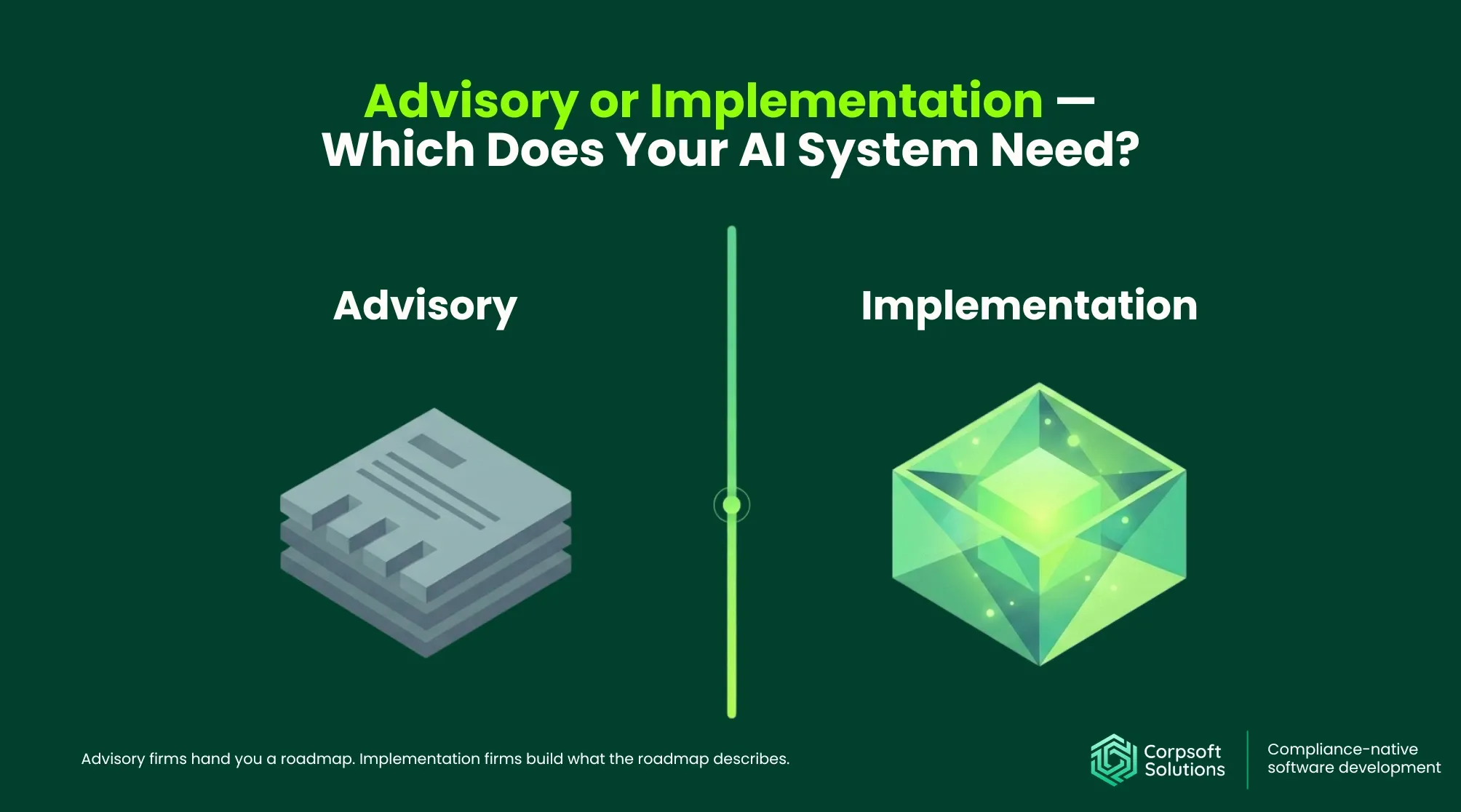
“AI governance consulting” covers two fundamentally different services, and most comparisons blur them together. Advisory-focused engagements typically produce governance design, policies, and risk assessment. Implementation-focused engagements extend into technical controls and engineering execution. Both are legitimate — but only one of them changes what’s actually running in production.
| Advisory produces… | Implementation produces… |
| Governance policies — who approves what | Technical controls — systems that enforce it |
| Risk assessments — where the exposure is | Audit logging — proof the exposure is being tracked |
| Compliance roadmap — what to build, and when | Monitoring implementation — what runs after “when” |
| Documentation — describes the system | Model governance — governs the system directly |
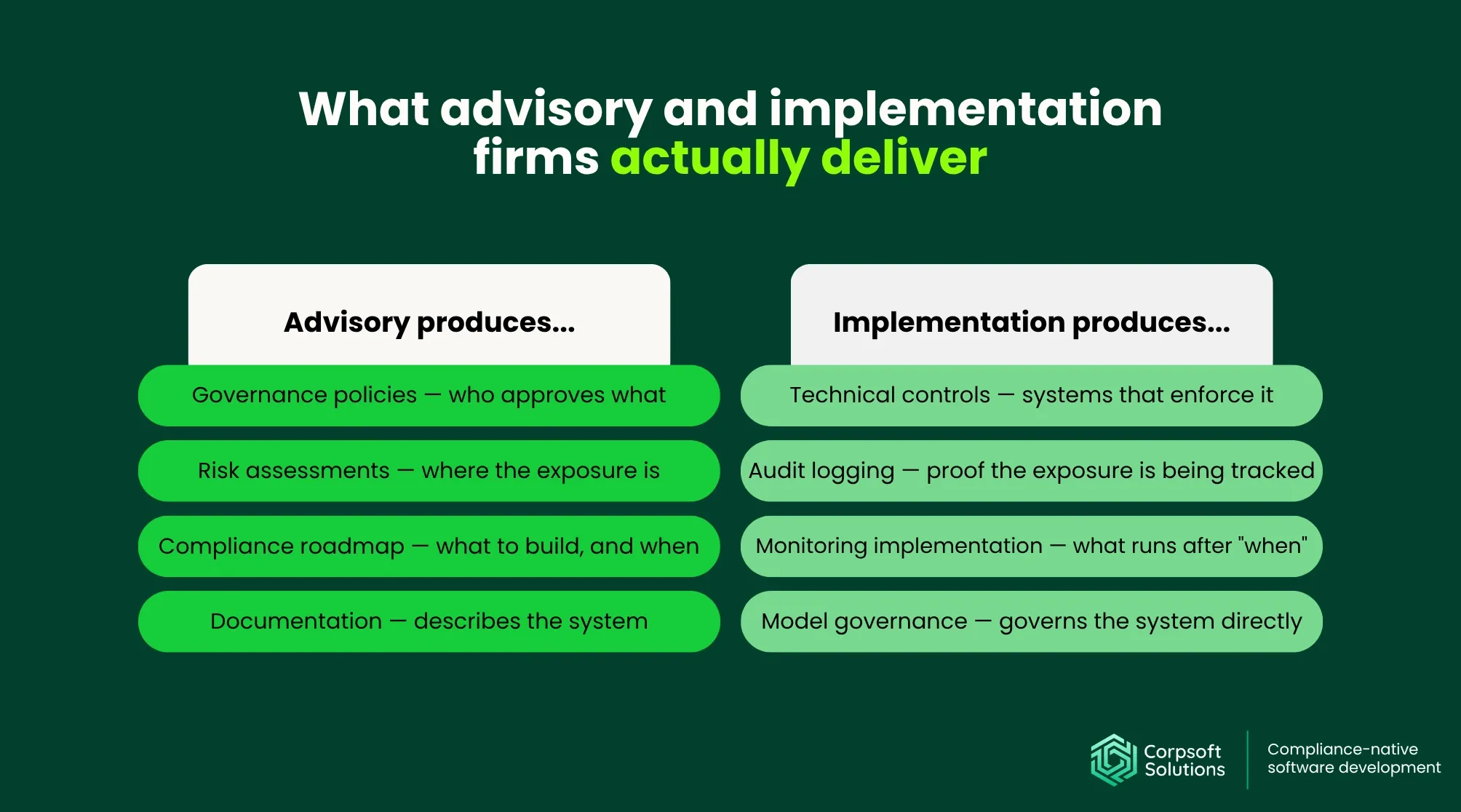
Most firms sit somewhere on this spectrum rather than at either extreme. The comparison table and profiles below flag where each of the 10 firms lands — verified from what each company documents about its own delivery, not assumed from its size or reputation.
Mapping AI governance frameworks to the AI Compliance Stack
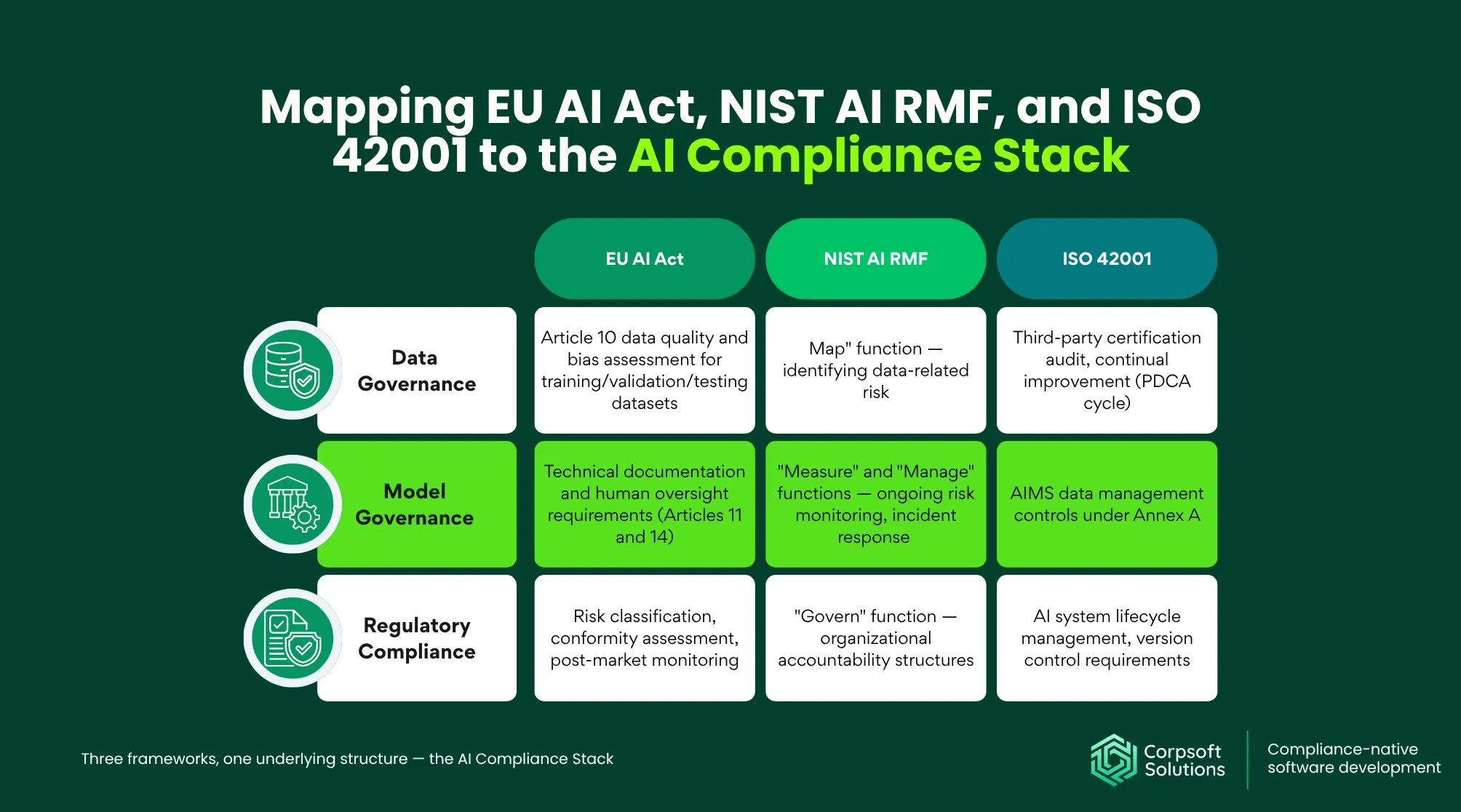
EU AI Act, NIST AI RMF, and ISO 42001 solve overlapping problems from different angles — one is binding law, one is a voluntary risk methodology, one is a certifiable management standard. Comparing them by scope and enforcement, as most guides do, tells you which one applies to you. It doesn’t tell you what to build. Mapped against the AI Compliance Stack — the three-layer model Corpsoft Solutions uses to structure AI compliance work, see how the full model applies across an AI system’s lifecycle — the practical requirements become concrete.
For the purposes of this comparison, the AI Compliance Stack is used as Corpsoft Solutions’ own analytical model for mapping technical work across governance frameworks — not an industry-standard classification.
| AI Compliance Stack layer | EU AI Act | NIST AI RMF |
ISO 42001 |
| Data Governance | Article 10 data quality and bias assessment for training/validation/testing datasets | “Map” function — identifying data-related risk | AIMS data management controls under Annex A |
| Model Governance | Technical documentation and human oversight requirements (Articles 11 and 14) | “Measure” and “Manage” functions — ongoing risk monitoring, incident response | AI system lifecycle management, version control requirements |
| Regulatory Compliance | Risk classification, conformity assessment, post-market monitoring | “Govern” function — organizational accountability structures | Third-party certification audit, continual improvement (PDCA cycle) |
These mappings summarize how each framework treats comparable implementation areas — they are not exhaustive legal interpretations of the underlying regulations.
Data governance failures are usually the first thing that breaks at scale — we’ve covered what that looks like in practice.
What a typical AI compliance engagement should deliver
What “mature” actually means varies by industry — see our implementation guide across sectors if your system spans more than one regulatory context. Whether you engage an advisory firm, an implementation partner, or a mix of both, a mature AI compliance engagement typically produces:
- AI system inventory — every model in production or development, mapped to its risk tier
- Risk register — documented risks per system, not a generic template
- Model documentation — technical documentation sufficient for a formal conformity assessment
- Governance policies — who approves what, and under what conditions
- Technical control mapping — which framework requirement maps to which control in the actual system
- Evidence repository — audit-ready documentation, not scattered across email threads
- Monitoring recommendations — how ongoing compliance gets checked after launch, not just at delivery
- Gap assessment — an honest list of what’s still missing, not a clean bill of health
If a proposal skips more than one or two of these, ask what’s replacing them before signing.
Comparing the top 10 AI compliance consulting firms
The table below compares the best AI compliance companies in this guide by regulatory focus and delivery model.
| Company | Best for | Regulatory Focus | Advisory ↔ Implementation |
| EPAM Systems | Enterprise-scale AI governance + GenAI delivery | EU AI Act | Advisory + Delivery |
| Corpsoft Solutions | Compliance-native AI system development | EU AI Act, GDPR, HIPAA, SOC 2, ISO 27001, NIS2 | Implementation |
| Thoughtworks | Sociotechnical AI governance with delivery | ISO 42001, EU AI Act | Advisory + Delivery |
| Neurons Lab | Financial services AI, pilot to production | EU AI Act | Implementation |
| DataArt | Healthcare/fintech AI under overlapping regulation | EU AI Act, GDPR, MDR | Implementation |
| Capgemini | EU AI Act compliance with dedicated platform | EU AI Act, ISO 42001, NIST AI RMF | Implementation |
| Endava | Governance frameworks for agentic AI | GDPR | Advisory-leaning |
| Persistent Systems | AI governance backed by audited certifications | ISO 42001, ISO 27001, SOC 2, ISO 27701 | Advisory + Delivery |
| Capco | AI governance within FSI regulatory context | EU AI Act, DORA, UK GDPR | Advisory-leaning |
| BABL AI | Independent third-party AI audit | EU AI Act, NIST AI RMF, ISO 42001, NYC LL144, DSA, EEOC | Audit-only |
#1 EPAM Systems — best for enterprise-scale AI governance paired with GenAI
Type: Public global software engineering company (NYSE: EPAM)
Regulatory focus: EU AI Act. EPAM runs dedicated Responsible AI consulting services — assessment and delivery blueprints covering governance, policy, and risk management — combined with hands-on generative AI delivery, including LLM security implementation and AI product development. Its own careers page lists dedicated “AI Security Consultant” and “Data & AI Governance Consultant” roles scoped explicitly to EU AI Act regulatory readiness — real, ongoing internal capacity, not a one-off campaign.
Limitations: Public materials confirm EU AI Act by name but don’t document NIST AI RMF or ISO 42001 alignment — organizations prioritizing certified AI management system credentials should verify current coverage directly. Engagement scale typically suits large enterprise budgets and timelines.
Typical engagement: Enterprise AI governance program design paired with GenAI product delivery.
Implementation focus: Advisory + Delivery — governance consulting plus hands-on AI product engineering.
#2 Corpsoft Solutions — best for compliance-native AI system development
Type: Compliance-native software development company
Regulatory focus: EU AI Act, GDPR, HIPAA, SOC 2, ISO 27001, NIS2. Corpsoft Solutions builds AI compliance directly into system architecture through its AI Compliance Stack — data governance, model governance, and regulatory compliance addressed as one engineering workstream, not separate advisory and delivery phases. This fits companies that need compliance engineered into the product, not just advised on from the outside. Its Audit-to-Fix Gap approach targets the exact handoff failure most compliance projects hit: translating audit findings into actual architecture, logging, and documentation without bringing in a second vendor.
Limitations: Not a certification body — organizations needing formal SOC 2/ISO 27001 attestation still need an accredited third-party auditor for the certification step itself; Corpsoft Solutions prepares the architecture and evidence but doesn’t issue certifications.
Typical engagement: Starts with a free 7-Day Risk Assessment, followed by architecture remediation and ongoing compliance-native development. Scope varies from focused audits to full-cycle product builds. Support continues after launch too — long-term partnership options include adapting to regulatory changes, ongoing monitoring, and integrating new features as compliance requirements evolve.
Implementation focus: Implementation — compliance engineered directly into codebase and data flows.
#3 Thoughtworks — best for sociotechnical AI governance with delivery follow-through
Type: Global technology consultancy
Regulatory focus: ISO 42001, EU AI Act. Thoughtworks anchors its own internal AI governance around an AI Compliance Policy aligned with the ISO 42001 management framework, overseen by its Technology Lifecycle Management (TLM) Group — direct operational experience with the same standard it advises clients to adopt. Delivery runs through its AI/works Agentic Development Platform, carrying clients from readiness assessment through prototype to production.
Limitations: Confirms ISO 42001 and mentions EU AI Act, but doesn’t document NIST AI RMF mapping — US-based organizations prioritizing NIST alignment should confirm current scope. Historically, strategy-first positioning means technical delivery depth can vary by engagement.
Typical engagement: AI governance operating model design, followed by MVP delivery of a compliant AI use case.
Implementation focus: Advisory + Delivery — governance consulting plus platform-based technical delivery.
#4 Neurons Lab — best for financial services AI moving from pilot to production
Type: Boutique AI engineering consultancy
Regulatory focus: EU AI Act Neurons Lab positions itself as execution-first: its own materials state that for most financial services organizations, “the constraint is execution,” not strategy. Engagements follow a four-phase methodology (Discovery → Pilot → Production → Expansion), ending in a fully deployed system integrated into the client’s existing stack, with auditable decision trails built in from the start to support EU AI Act traceability.
Limitations: Scoped exclusively to Financial Services in public materials — no published evidence of comparable depth in healthcare or general SaaS. A 50+-person team is small relative to global systems integrators, which may limit capacity for large multi-region programs.
Typical engagement: Production-grade AI agent deployment for a specific FSI use case, governance built in from Discovery onward.
Implementation focus: Implementation — production deployment is the stated end deliverable .
#5 DataArt — best for Healthcare and Fintech AI under overlapping regulation
Type: IT consultancy (custom software development)
Regulatory focus: EU AI Act, GDPR, MDR. DataArt’s own hosted webinar — presented by named DataArt engineers — walks through validating AI in Software as a Medical Device against MDR, GDPR, and EU AI Act requirements simultaneously, reflecting direct delivery experience at one of the most regulation-dense intersections in health tech. The firm describes its approach as grounded in real project delivery across HL7/FHIR healthcare data and FCA-regulated insurance platforms.
Limitations: Framework evidence centers on healthcare (MDR) and UK financial services (FCA) — public materials don’t demonstrate comparable EU AI Act depth outside those verticals. No independent confirmation of NIST AI RMF or ISO 42001 alignment found.
Typical engagement: Regulated AI/data platform modernization for healthcare or fintech clients, architecture through compliance documentation.
Implementation focus: Implementation — delivery-grounded, vertical-specific engineering.
#6 Capgemini — best for EU AI Act compliance backed by purpose-built tooling
Type: Public global technology and consulting company (EU-headquartered)
Regulatory focus: EU AI Act, ISO 42001, NIST AI RMF. Capgemini runs a dedicated EU AI Act Compliance & Regulations Platform, built on what the company describes as over seven years of regulatory research and platform development — EU AI Act work backed by purpose-built software, not consulting hours alone. Open roles like “Responsible AI Engineer” and “AI Governance Senior Consultant” confirm ongoing internal delivery capacity, not a one-time initiative.
Limitations: As a large multinational SI, engagement model and pricing typically suit enterprise budgets; the platform-based approach may suit teams wanting a structured compliance product less than one wanting a fully custom build.
Typical engagement: EU AI Act readiness assessment and platform-based compliance documentation and monitoring.
Implementation focus: Implementation — proprietary compliance platform, not advisory-only.
#7 Endava — best for governance frameworks ahead of Agentic AI deployment
Type: Public global software engineering company (NYSE: DAVA)
Regulatory focus: GDPR. Endava has published detailed thinking on governance for agentic AI specifically — proposing that AI agents receive unique cryptographically secured identities with defined permissions, structured through its Dava.Flow methodology (Signal, Explore, Govern, Evolve).
Limitations: Endava’s own published content on agentic AI governance offers architectural recommendations without concrete code examples or configuration detail — establishing what compliance should look like more than how to build it. Confirms GDPR by name but not EU AI Act, NIST AI RMF, or ISO 42001 specifically.
Typical engagement: AI governance framework design and readiness advisory, positioned ahead of broader AI delivery work.
Implementation focus: Advisory-leaning — governance thinking well-developed; technical depth not publicly demonstrated to the same degree.
#8 Persistent Systems — best for AI governance backed by audited certifications
Type: Public global IT services company (NSE/BSE)
Regulatory focus: ISO 42001:2023, ISO 27001, SOC 2 Type 2, ISO 27701. Persistent holds ISO 42001:2023 certification for its AI management system alongside ISO 27001, SOC 2 Type 2, and ISO 27701 (per Persistent’s published certifications page) — audited third-party credentials rather than self-declared compliance. The firm builds “digital trust programs” combining governance design with automated tooling and accelerators to scale controls across a client’s systems.
Limitations: Confirms strong ISO/SOC 2 certification depth but doesn’t name EU AI Act or NIST AI RMF specifically — organizations whose primary driver is EU AI Act conformity should confirm current scope directly.
Typical engagement: Enterprise digital trust program design, combining governance work with platform tooling for ongoing monitoring.
Implementation focus: Advisory + Delivery — governance program design plus automated tooling for ongoing enforcement.
#9 Capco — best for AI governance within financial services regulatory context
Type: Financial services-focused consultancy
Regulatory focus: EU AI Act, DORA, UK GDPR/DPA. With over 90% of its portfolio in financial services (per Capco’s published materials), Capco pairs AI strategy advisory with compliance-specific automation — including AI-assisted SAR drafting and automated control testing, which the firm states can reduce compliance effort by 40-80% (per their published data). This gives Capco a narrower but deeper focus than generalist consultancies for FSI work spanning EU AI Act and DORA simultaneously.
Limitations: Public materials focus exclusively on financial services — no comparable published depth for healthcare, general SaaS, or other regulated sectors. Described tooling is presented functionally rather than with technical implementation detail, indicating an advisory-led engagement model.
Typical engagement: AI governance and regulatory compliance advisory for banks, capital markets firms, and insurers.
Implementation focus: Advisory-leaning — strong compliance-specific automation, technical delivery depth not demonstrated to the same degree as engineering-first firms in this list.
#10 BABL AI — best for independent third-party AI system audit
Type: Third-party AI audit and certification firm
Regulatory focus: EU AI Act, NIST AI RMF, ISO 42001, NYC Local Law 144, EU Digital Services Act, EEOC AI and Algorithmic Fairness Initiative. BABL AI is led by a founder with a documented track record of testifying and advising on AI regulation in both the US and EU, and runs an explicitly audit-only model: certified independent auditors review documentation and conduct interviews using assurance-engagement standards comparable to financial auditing, concluding in formal findings and certification. Framework coverage is the broadest and most explicit of any firm on this list.
Limitations: States plainly that audits require “no software downloaded or platform integrations” — the firm identifies gaps and issues certification but does not implement fixes. A separate technical partner is needed to act on findings.
Typical engagement: Independent third-party AI system audit (2-3 weeks post-documentation), concluding in certification or a gap report.
Implementation focus: Audit-only — zero technical implementation, by design.
How to choose the right consulting partner
|
If your priority is… |
Look for firms that… |
| EU market expansion | Have explicit, documented EU AI Act compliance consulting experience — not just “AI governance” in general terms |
| Enterprise procurement / audit-readiness | Offer ISO 42001 consulting grounded in their own audited certifications — not just framework mentions |
| Building compliance into an existing product | Prioritize Implementation-focused firms — advisory alone won’t change what’s running in production |
| Financial services-specific compliance | Choose firms with FSI-specific regulatory depth (DORA, sector frameworks), not generalist advisory |
| Independent verification of an existing system | Choose a dedicated third-party auditor — not a firm that also wants to sell you the fix |
| Multi-region compliance (US + EU simultaneously) | Look for firms citing NIST AI RMF and EU AI Act together, not just one |

Questions to ask before selecting an AI compliance consulting firm
Most AI compliance consultants will answer these confidently — verify the answers against what’s public before signing.
- Do you help implement technical controls, or only document requirements?
- Which specific frameworks do you specialize in — and where is that documented publicly?
- What artifacts does the engagement actually deliver — code changes, audit logs, a policy document, or all three?
- How is evidence collected, and who owns it after the engagement ends?
- How is ongoing compliance supported after the initial engagement, or is monitoring a separate contract?
- Does your team work directly with our engineers, or only with legal and compliance stakeholders?
Choosing an AI compliance consulting partner isn’t about finding the biggest brand. It’s about matching your organization’s regulatory obligations, engineering maturity, and implementation needs with a provider that can deliver the right combination of governance expertise and technical execution. AI compliance obligations apply from the moment your system processes personal data or makes decisions about people, not from the moment a regulator asks.
Share this post: