


TL;DR:
- GDPR compliance is an engineering problem, not a documentation problem — the audit trail, model registry, and explainability endpoint have to exist in code before the first production inference.
- Every AI decision must be reconstructable months later: which model version ran, on what data, under which lawful basis, and what the output was.
- Logging without model versioning isn’t an audit trail — it’s a timestamped black box.
- Many of the engineering controls required by the GDPR also support compliance with the EU AI Act, making it more efficient to design for both requirements from the outset.
GDPR is consistently misread as a documentation problem. But a supervisory authority doesn’t investigate your paperwork first — it asks the system a question: which model version made this decision, on which lawful basis, and whether the individual can understand and contest it? If your audit log can’t answer that, no amount of legal groundwork changes the outcome. That’s not a documentation gap. It’s an engineering failure — and GDPR AI compliance must be built into the system before the first inference runs.

What GDPR actually requires from AI systems
Most teams treat GDPR compliance as a legal checklist: draft the privacy policy, sign the DPA, document the data flows. Those steps are necessary — but they don’t provide the technical controls required by GDPR for AI systems. The gap between legal documentation and working architecture is where most AI compliance failures originate. It’s the same gap we cover in more general terms in AI Governance in Practice — GDPR is one specific, EU-scoped instance of a broader pattern: governance documents that nobody built the system to satisfy.
Five articles create direct engineering obligations:
1. Article 5 establishes six data processing principles with architectural implications. Purpose limitation means your model can’t use data for undisclosed purposes, which requires the purpose to be tracked per processing operation. Data minimization means the logging layer should capture less personal data than it technically could. Storage limitation means the audit trail needs a retention policy enforced at the infrastructure level, not managed by an application-layer cleanup job.
2. Articles 13 and 14 require AI transparency in data collection. For AI systems, this includes disclosure of “the existence of automated decision-making” and “meaningful information about the logic involved, the significance and the envisaged consequences” — language that requires an explainability layer, not just a privacy notice updated to mention that AI is involved.
3. Article 22 governs automated individual decision-making — a subset of AI processing that triggers additional safeguards when a decision is solely automated and significantly affects someone.
→ See: GDPR Automated Decision-Making: What Article 22 Means for Your AI System
For the logging, tracing, and explainability requirements below, what matters is that some of your AI decisions may fall under it — and the technical controls in this guide are what make that determination answerable in the first place.
4. Article 30 requires records of processing activities. Every AI processing operation must be documented — including the model used, the data sources, the lawful basis, the retention period, and the purpose. A ROPA entry is a living document; when the model version changes, it should be reviewed and updated.
5. Article 35 requires a Data Protection Impact Assessment before deploying high-risk AI processing. For most AI systems making consequential decisions about individuals, DPIA is mandatory — and it should be completed before architecture decisions are finalized, not after a system is already in production.
GDPR technical requirements — translation from legal article to engineering artifact:
| GDPR Article | What it says |
What the engineer builds |
| Art. 13/14 | Disclose automated logic at data collection | Explainability API |
| Art. 22 | Right to human review + explanation + contest | Human review queue + per-decision rationale endpoint |
| Art. 30 | Document every processing operation | ROPA integration in model registry |
| Art. 35 | Assess high-risk processing before deployment | DPIA workflow with technical risk mapping |
| Art. 17 | Right to erasure | Deletion pipeline across training data, fine-tuned models, and embeddings |
| Art. 5(1)(e) | Storage limitation | Retention policy enforced at storage level |
Source: EDPB Guidelines on Automated Individual Decision-Making, WP251; ICO Guidance on AI and Data Protection
In practice, most teams have these articles addressed in a privacy policy. What they don’t have is the mapping between those articles and the technical controls that actually satisfy them. The gap typically surfaces when the first subject access request arrives, and the engineering team discovers the audit trail doesn’t contain the fields required to answer it.
What GDPR-compliant AI needs to log
The audit trail for an AI system processing personal data is different in kind from an application log. Application logs capture system events — errors, latency, request traces. A GDPR AI logging layer captures decision accountability: what decision was made, about whom, by which model version, under which lawful basis, at what time, and with what level of human involvement.
The minimization of tension. GDPR imposes two competing obligations on the logging layer simultaneously. Log too little — and you can’t reconstruct accountability for a historical decision, violating Art. 30’s documentation requirement. Log too much — and you’re retaining personal data beyond what the processing purpose requires, violating Art. 5(1)(c)’s data minimization principle. The engineering resolution: log-structured references and identifiers, not raw personal data fields. The audit record should enable reconstruction of accountability — it shouldn’t store the original personal data. This is the same tension we cover at the data-architecture level in AI Data Governance for Enterprise AI — logging is one specific application of a broader consent-and-provenance discipline.
Each audit record needs enough fields to reconstruct accountability months later — without storing more personal data than the processing purpose requires. The table below shows the minimum set and which GDPR obligation each field satisfies.
Example: GDPR AI Audit Log Record
| Field | Example value |
GDPR obligation |
| decision_id | uuid-v4 | Unique identifier per inference — links all records for this decision |
| timestamp | 2026-03-14T09:23:11Z | UTC — moment of inference, not write time |
| model_id | risk-classifier | Identifies the model family |
| model_version | v2.4.1 | Immutable link to model registry entry |
| input_hash | sha256:a3f9b2e1… | Art. 5(1)(c): hash only — no raw personal data in the log |
| lawful_basis | legitimate_interests | Art. 6 basis for this specific processing operation |
| lia_reference | lia-2026-003 | Reference to the LIA (Legitimate Interest Assessment) document on file |
| consent_record_id | null | null when lawful basis is not consent |
| processing_purpose | credit_risk_assessment | Ties to ROPA entry |
| ropa_entry_id | ropa-007 | Art. 30 record this operation belongs to |
| output | declined | Actual decision output |
| confidence_score | 0.87 | Model confidence at time of inference |
| feature_explanation_id | expl-uuid-v4 | Links to per-decision explainability record |
| human_review_required | true | Flagged for mandatory review under automated decision-making safeguards |
| human_review_completed | false | Review not yet completed |
| human_review_requested_at | null | Populated when review is triggered |
| data_subject_id_hash | sha256:f2a9… | Art. 5(1)(c): hashed identifier — minimization principle |
What NOT to log — the minimization constraint
Logging raw personal data fields in the audit trail when a hash or pointer suffices is itself a GDPR violation under Art. 5(1)(c). It extends the retention obligation to data that wasn’t necessary in the audit record, increases the supervisory authority’s investigation surface, and creates additional security exposure. The principle: log the minimum that allows accountability to be reconstructed on demand.
Retention, access controls, and integrity
The audit trail needs a different infrastructure from application logs. Specifically: append-only writes (the inference pipeline writes; no other process modifies the records), strict read access controls (compliance, legal, and authorized reviewers only), and integrity verification that demonstrates records haven’t been tampered with after creation. A hash chain per log partition is the most common implementation.
Retention period should align with the ROPA entry for this processing operation. In most EU member states, this typically corresponds to the statutory limitation period for legal claims — three to five years, depending on jurisdiction and the nature of the processing.
Real-world pitfall: Missing model version
The gap we find most often isn’t missing logs — it’s a missing model_version field. In one insurtech system we assessed, two production rollbacks over 18 months had left thousands of audit records with no reliable way to tell which model version generated which historical decision. Every access request and explanation request from that period became unanswerable — the team had to disclose the gap to their DPO rather than resolve it. Retrofitting model versioning into an existing log schema meant a full audit log migration before a single new request could be answered correctly.
Engineering takeaway: Model version should be an immutable reference to a specific model registry entry — not a deployment name, tag, or alias. When the model changes, the version ID changes. Every historical decision remains permanently linked to the exact artifact that generated it.
What GDPR-compliant AI needs to trace
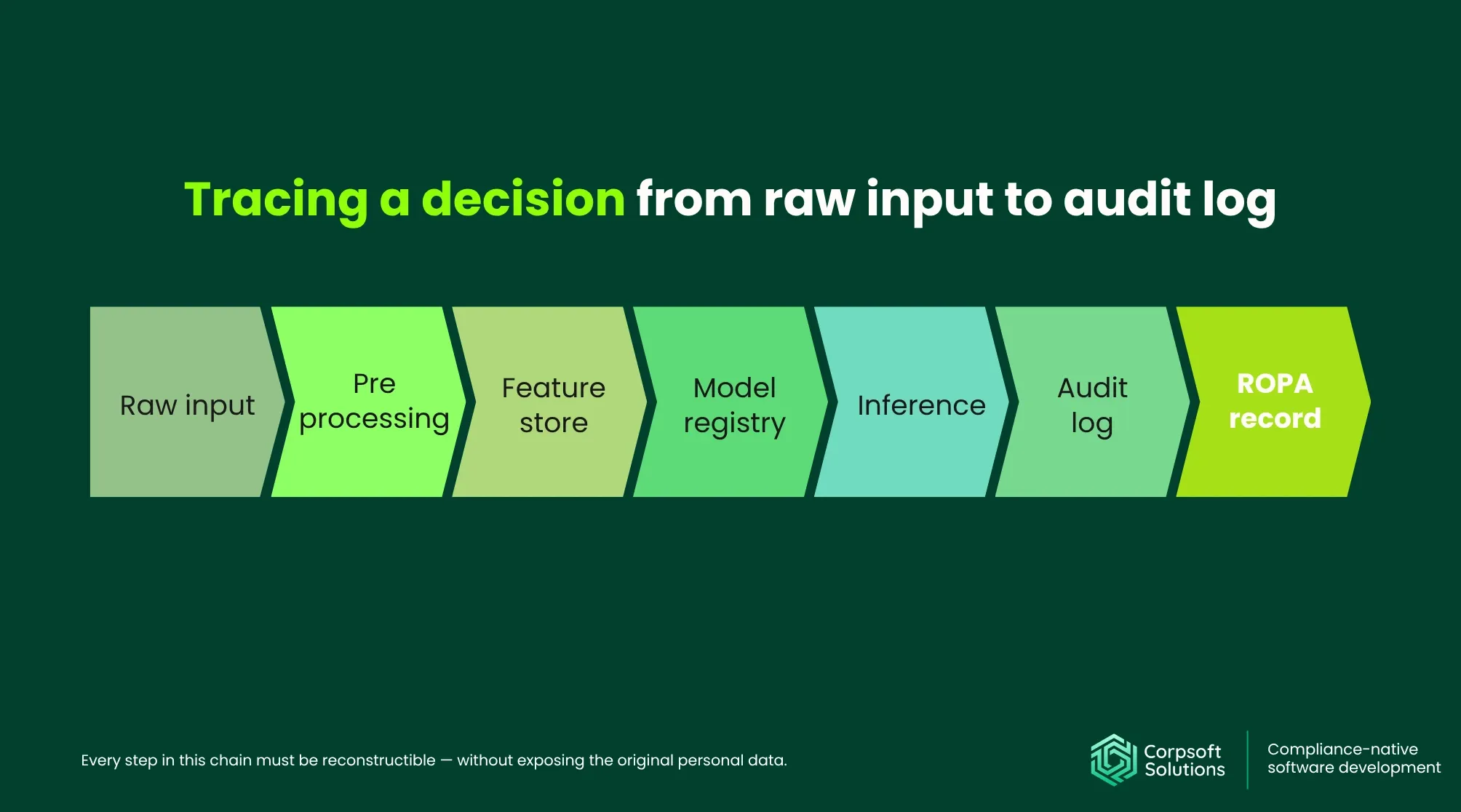
Where logging captures what was decided, AI traceability supports a different question: if something went wrong, or a data subject exercises their rights, can the full chain be reconstructed — from raw input to decision output — and can your organization demonstrate control over every step in it?
1. Model lineage
Model lineage is the first requirement. Every deployed model should be registered with an immutable deployment record: model ID, version, training data snapshot reference, deployment timestamp, approval record, and deprecation timestamp when applicable. Every audit log entry references a specific model registry entry.
This allows attribution of any historical decision to an exact model artifact and its training data provenance, which is the precondition for answering access and explanation requests accurately.
2. Data lineage
Data lineage covers the processing chain from raw input to inference output:
raw input → preprocessing transformations → feature extraction → inference.
The chain should be reconstructible without requiring access to the original personal data.
3. Erasure traceability (Art. 17)
Erasure traceability (Art. 17) is one of the most consistently underestimated engineering obligations in AI. When a data subject requests erasure, the obligation doesn’t stop at deleting their record from the main database. It extends to:
-
Training dataset records: Was this individual’s data in any training set?
-
Fine-tuning data: If the model were fine-tuned, were their data included?
-
Cached embeddings: Are vectors generated from their data stored in a vector database?
-
Derived features: Are any stored features derived from their personal data?
Erasure traceability means being able to identify and document each of these and demonstrate deletion or exclusion. Without training data provenance tracking implemented before the first training run, these questions can’t be answered when they arrive.
Embeddings are consistently the most underestimated part of Art. 17. We’ve seen this play out in a healthtech product built on a third-party fine-tuned model: no training data provenance tracking existed, so when an erasure request arrived, the engineering team genuinely couldn’t determine whether that individual’s data had been part of the fine-tuning set. The request sat unresolved for weeks while legal and engineering worked out whether the model itself — not just the source records — needed to be retrained or retired.
4. ROPA mapping
Every AI processing operation should be reflected in an Art. 30 record that references the current model version and is reviewed when the model changes. The ROPA entry isn’t a one-time documentation task — it’s a living reference that should stay synchronized with the model registry.
5. Third-party AI traceability
When a system calls an external inference API — OpenAI, Anthropic, AWS Bedrock, Cohere, or any other — personal data included in the prompt is a data transfer to a processor under GDPR.
The obligations:
-
A signed Data Processing Agreement (DPA) with the provider,
-
A ROPA entry for this processing operation,
-
Documentation of the lawful basis for the transfer.
The fact that processing happens via an API doesn’t alter the controller’s obligations.
Engineering takeaway: Training data provenance tracking isn’t a compliance afterthought — it’s the precondition for honoring Art. 17 in any system that uses fine-tuned or continuously trained models. It needs to be in place before the first training run.
What GDPR-compliant AI needs to explain
The GDPR right to explanation isn’t a single article. It emerges from three provisions read together: Articles 13(2)(f) and 14(2)(g) require disclosure of “meaningful information about the logic involved” when collecting data used in automated processing; Article 22(3) gives individuals the right to obtain human intervention, express their point of view, and contest the decision; Recital 71 makes the legislative intent explicit — individuals should be able to understand and challenge automated decisions that affect them.
Together, these provisions mean individuals must receive an explanation they can use. The obligation is user-facing — not a technical artifact for regulators. Understanding what explainable AI is starts with this distinction.
Three levels of explanation operate in parallel for any GDPR-compliant AI system:
- Regulatory level — what the DPIA and ROPA document about the system’s logic for the supervisory authority: the model category, the features used, the decision thresholds, and the safeguards in place. This is for regulators, not individuals.
- User level — what an individual is entitled to receive when they request an explanation of an automated decision affecting them. This must be in plain language, identify the factors that influenced the outcome, and explain how to contest the decision.
- Technical level — how the engineering team demonstrates interpretability to DPA investigators or in litigation: per-decision feature contributions, confidence scores, model version, and the explanation generation method.
AI model explainability approaches in practice. SHAP values and LIME provide feature importance for individual predictions. They satisfy the technical level and can generate inputs to user-level explanations — but SHAP output with 12 decimal-weighted feature contributions is not itself a user-facing explanation. The generation pipeline needs to translate technical outputs into a language the individual can understand and act on.
Inherently interpretable models — decision trees, linear models, rule-based systems — make the decision logic transparent by design. For applications where this accuracy trade-off is acceptable, they simplify both the explainability architecture and the regulatory documentation.
Black-box models, including large neural networks and LLMs, are not prohibited by GDPR. According to the EDPB’s guidance, post-hoc explanation generation is acceptable — provided the explanation is accurate and doesn’t misrepresent how the model actually reached the output.
Sample user-facing explanation structure:
“Your application was assessed automatically based on [processing purpose]. The factors that most influenced this outcome were: [factor 1 — direction and relative weight], [factor 2 — direction and relative weight], [factor 3 — direction and relative weight]. If you believe this assessment is incorrect or wish to have a human review your case, you can request this at [specific contact or link]. You can contest this decision by [process].”
This structure is a starting template. The ICO’s guidance on AI and data protection recommends testing user-facing explanations with people from the affected population — a technically accurate explanation that fails comprehension testing doesn’t satisfy the “meaningful information” requirement.
What GDPR does NOT require
Explainable AI GDPR obligations are frequently misread as requiring more than the regulation actually asks for.
- Does not require publishing model weights or architecture details.
- Does not require revealing training data or feature engineering methodology.
- Does not mandate a specific technique — SHAP, LIME, attention weights, or any other method.
- Does not require that the explanation reproduce the model’s internal computations.
- It requires that individuals receive meaningful information about the logic and significance of the automated decision affecting them.
- Does require that the explanation be accurate — it cannot misrepresent how the model reached its output.
A compliance review we ran on an AI recruitment screening tool found its entire user-facing “explanation” was one line: “Your profile did not match our current requirements.” The system had been live for 14 months. That sentence satisfies zero GDPR requirements — no information about the logic, no contributing factors, no way to contest the decision. Fixing it wasn’t a copywriting task: it required building the feature-explanation pipeline the team had skipped at launch, then retrofitting it against 14 months of decisions that had never generated one.
Engineering takeaway: The explainability endpoint is not a feature added at the end of the project. It needs to exist before the system goes live, and it needs to produce output that an affected individual can understand and use. The test is user comprehension, not technical correctness alone.
Your AI system may already have logging in place — but does it log the right things? Corpsoft Solutions reviews your AI architecture against GDPR and EU AI Act requirements in a 7-day technical assessment and delivers a prioritized gap report before you need it in a regulatory context.
GDPR and EU AI Act: key requirements compared
Both GDPR and the EU AI Act apply to most AI systems processing personal data in the EU. They address overlapping but distinct aspects of the same technical systems — and building for both from sprint one costs a fraction of satisfying them separately.
| Requirement | GDPR | EU AI Act | ISO 42001 |
| Audit logging | Art. 30 ROPA — every processing operation | Art. 12 — high-risk systems log automatically during operational lifetime | Cl. 7.5 — documented information about AI operation |
| Explainability | Art. 13/14/22 — meaningful explanation for individuals | Art. 13(3)(b)(iv) and Art. 86 — technical capacity to explain output and right to explanation of individual decisions | Cl. 8.4 — AI system impact assessment |
| Human oversight | Art. 22(3) — right to human intervention | Art. 14 — mandatory human oversight for high-risk AI | Annex A.8 — human oversight controls for AI system use |
| Impact/conformity assessment | Art. 35 DPIA before deployment | Annex VII conformity assessment for high-risk systems | Cl. 6.1 — AI risk management process |
| Data retention limits | Art. 5(1)(e) — storage limitation | Art. 12(1) — proportionate to intended purpose | Cl. 7.5.3 — control of documented information |
| Right to contest | Art. 22(3) | Art. 13(3)(e) — information on the right to contest | Not specified |
The practical implication: the logging layer, explainability endpoint, and human review workflow described in this guide substantially satisfy the EU AI Act’s Art. 12-14 technical requirements for high-risk systems. The technical documentation required by both overlaps significantly. What differs is the classification process — EU AI Act Annex III defines high-risk categories — and some documentation formats. For most teams, these aren’t two parallel compliance projects. They’re one set of engineering controls with two sets of documentation artifacts.
ISO 42001 adds a management system layer: governance, risk management processes, and defined accountability structures. For teams pursuing certification, the engineering controls above form the technical foundation that the management system governs.
→ See: EU AI Act Explained
Four misconceptions that create GDPR liability in AI systems
1. “We use the OpenAI API, so GDPR doesn’t apply to us”.
The data controller’s GDPR obligations don’t transfer to an API provider. When a system sends personal data to an external inference endpoint, that’s a data transfer to a processor under GDPR.
The controller obligations — lawful basis, transparency, subject rights, ROPA documentation — belong to the organization integrating the API. A DPA with the provider is required; it’s the minimum, not the solution.
2. “We train on anonymized data, so we’re outside GDPR scope”.
Anonymization under GDPR requires that re-identification is irreversible and that no reasonable means exist to link the data to an identifiable individual — whether directly or in combination with other available information. Pseudonymized data, which is common in healthcare AI and often described as “de-identified,” is explicitly defined by GDPR as personal data.
Embeddings generated from personal data may be personal data if they can be linked back to an identifiable individual. Whether training data qualifies as genuinely anonymous depends on a technical assessment, not on the label applied to the dataset.
3. “SHAP values satisfy our explainability obligation”.
GDPR doesn’t require SHAP, LIME, or any specific method. It requires “meaningful information about the logic involved” that enables the individual to understand the decision and contest it.
A SHAP output listing 12 features with decimal-weighted contributions satisfies the technical level of explainability — but it’s an input to the user-facing explanation process, not the output. The obligation is to produce something the affected individual can understand and act on.
4. “We just need a privacy policy and a DPA with our cloud provider”.
A privacy policy satisfies the Art. 13/14 transparency disclosure obligation for data collection. A DPA with a cloud provider covers storage infrastructure. Neither produces an audit trail, a model registry, an explainability endpoint, a human review workflow, or an erasure pipeline. GDPR obligations on AI systems are engineering deliverables. They can’t be satisfied with legal documents alone.
Reference architecture for GDPR-compliant AI
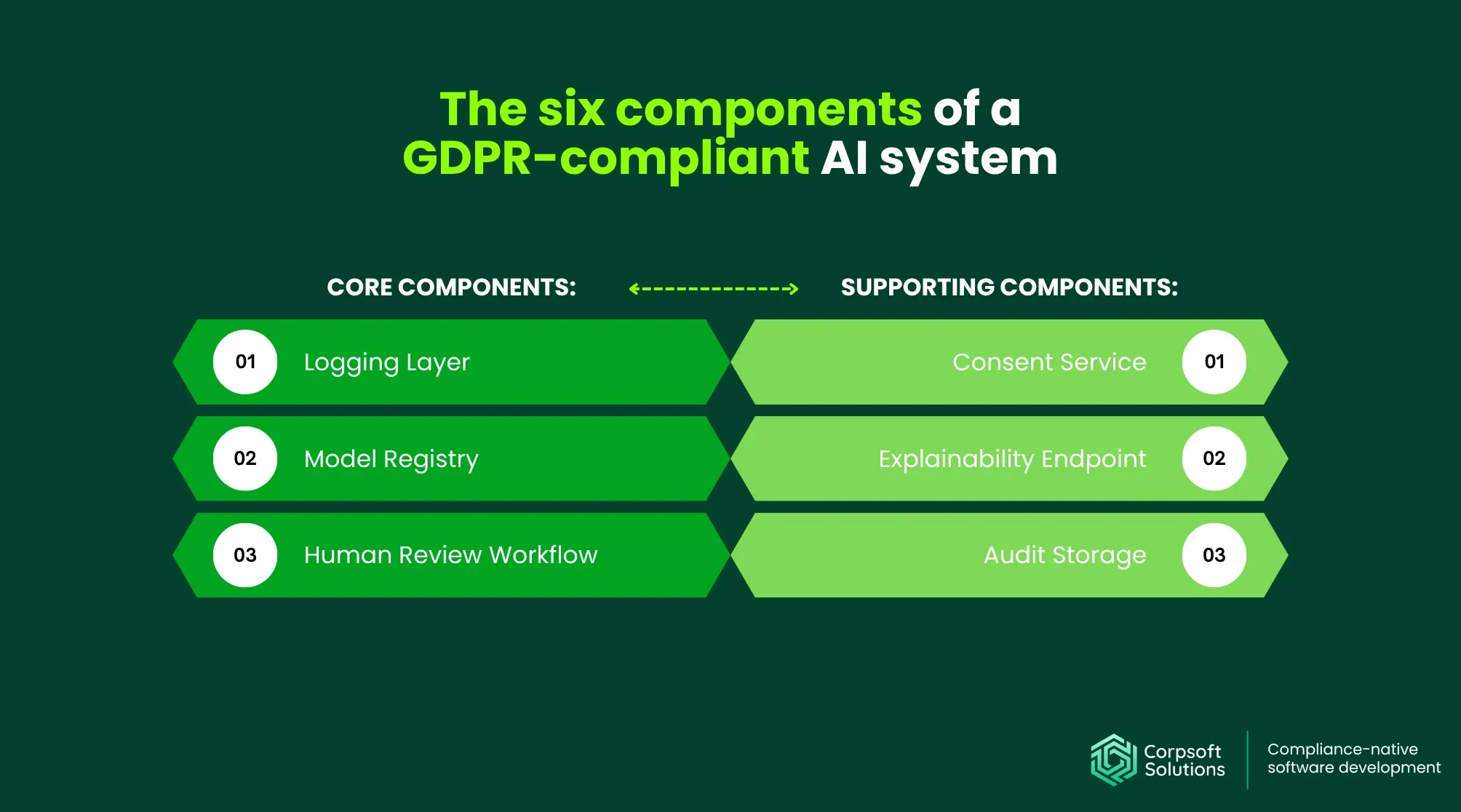
Building a GDPR-compliant AI system doesn’t require a specialized compliance platform — it requires introducing six components that satisfy the specific technical obligations above. At Corpsoft Solutions, we typically recommend introducing these before production deployment because they map directly to what supervisory authority investigators and enterprise compliance teams expect to find . Retrofitting them after the first audit costs significantly more than the initial implementation — especially the logging layer and model registry, which require migrating historical records.
Core components:
- Logging Layer: A structured, append-only event log capturing every inference request and output with the required fields. Separate from application logs — different retention period, access controls, and integrity requirements. The logging layer writes at inference time; no other process can modify the records.
- Model Registry: A version-controlled store of every model artifact deployed to production. Each deployment generates an immutable record: model ID, version, training data snapshot reference, deployment timestamp, and deprecation timestamp when applicable. Every audit log entry references a specific model registry entry. When the model changes, a new entry is created — the old one remains as the permanent reference for historical decisions.
- Human Review Workflow: For AI systems where meaningful human intervention is legally required: a workflow that routes flagged or contested decisions to a qualified reviewer with full access to the original input data, the model explanation, and functional authority to override the automated output. Tracks review triggered, reviewer assigned, review completed, and any override applied — all appended to the audit log.
Supporting components:
- Consent Service: Tracks lawful basis per processing operation per data subject. When consent is the basis, the consent record (what was consented to, when, under which terms) is linked per processing operation. When legitimate interests are the basis: the LIA reference. Every audit log entry references the active lawful basis record at the time of inference — not the general privacy policy.
- Explainability Endpoint: Accepts a decision ID and returns: the features that influenced the output, their relative contributions, and a structured rationale formatted for user-facing delivery. Called by the human review workflow and by the subject access request handler.
- Audit Storage: Immutable, access-controlled, retention-managed storage for the audit log. Separate read and write permissions: only the inference pipeline and human review workflow can write; compliance, legal, and authorized reviewers can read. Retention policy enforced at the storage infrastructure level. Integrity verification via a hash chain or equivalent.
→ See how this architecture was implemented in practice: Pediatric AI Platform case study
Building an AI system that will process personal data of EU residents — or already running one that predates your GDPR review? Corpsoft Solutions reviews your logging, traceability, and explainability architecture against GDPR and EU AI Act requirements and delivers a prioritized gap report in 7 days — before a supervisory authority does.
→ Book a scoping call — no commitment
Share this post: