

Enterprises are increasingly exploring autonomous AI agents to automate workflows and coordinate complex business processes. Yet most organizations face a practical constraint: their operations depend on a patchwork of existing software systems: ERPs, CRMs, and legacy platforms that were never designed to interact with AI-driven environments. Integrating agents into this environment can quickly expose architectural mismatches, fragmented data access, and costly integration work.
When done well, however, AI solutions, including AI agents, can free up to 60-70% of employees’ time. They can act as coordination layers across existing systems, executing multi-step tasks, retrieving information from multiple tools, and supporting human decision-making without requiring a full infrastructure overhaul.
This article explores how organizations are integrating autonomous AI agents with existing software systems, the role of the so-called legacy gap in shaping those efforts, and the architectural patterns that make enterprise adoption feasible.
The rise of autonomous AI agents in enterprise software
The growing interest in agentic AI integration reflects a shift in how organizations approach automation. Instead of focusing solely on isolated tasks, enterprises are beginning to deploy systems that coordinate entire workflows across multiple applications and data sources.
From automation to agency: the development of agentic AI in enterprise

Traditional enterprise automation tools typically rely on predefined rules and rigid process flows. These systems are designed to execute tasks according to a fixed set of instructions configured in advance by developers or system administrators.
While this approach works well for repetitive tasks with predictable inputs, it becomes difficult to maintain when processes involve ambiguous information or multiple possible outcomes. If the workflow encounters a scenario that was not anticipated when the rules were written, the automation may fail or require manual intervention.
These limitations are driving interest in agentic AI for enterprises, which can interpret context, adapt workflows dynamically, and coordinate actions across different systems without relying solely on rigid, preconfigured logic.
These AI agents combine large language models with software integrations, enabling them to interact with enterprise platforms.
Several capabilities distinguish the best AI agents for enterprises from traditional automation tools:
- Task planning: agents break complex requests into multiple steps
- Tool use: agents interact with APIs or enterprise software systems
- Context awareness: agents maintain state across tasks
- Adaptive decision-making: agents adjust workflows dynamically
These capabilities allow AI agents to function as software coordination layers, retrieving information from multiple systems and executing tasks that would otherwise require manual intervention.
Check out how these features were highlighted and implemented in Corpsoft Solutions’ custom product for a pediatric clinic! Read the success story
AI agents vs chatbots for enterprises
In enterprise environments, the distinction between these two technologies is important. Chatbots act as interfaces that help users access information or services, whereas AI agent workflow automation tools function more like operational assistants that can actively carry out tasks across enterprise systems.
| AI chatbots |
AI agents |
|
| What do they do? | Handle conversational interactions with users | Plan and execute multi-step tasks across multiple software systems |
| Where are they used? | Internal IT support, customer service, and employee self-service environments | Operations automation, finance and compliance workflows, supply chain management, IT operations, and enterprise data analysis |
| Processes they govern | Respond to questions Retrieve information from redefined knowledge bases Guide users through simple processes |
Coordinate workflows across systems Retrieve and update data through APIs Trigger actions in enterprise applications, monitor task completion |
Where autonomous AI agents for enterprises deliver the most business value
Organizations are already experimenting with building autonomous AI agents for enterprise workflows in several areas:
- Operations and internal workflows. AI agents can automate administrative tasks such as generating internal reports or coordinating information across systems used by different departments.
- Customer support. Agents can retrieve information from CRM platforms, ticketing systems, and knowledge bases to assist support teams or respond to routine inquiries.
- Data analysis. AI agents can collect and summarize information from multiple data sources, helping analysts conduct research and produce reports more efficiently.
- IT operations. In engineering environments, agents can monitor infrastructure logs, analyze operational data, and assist with incident management.
These applications align with the findings of the 2025 McKinsey report, which show that 23% of organizations are already scaling AI agent systems within their enterprises, while another 39% are actively experimenting with them. This suggests that agentic workflows are moving from pilot projects toward broader operational deployment.
Why enterprises want AI agents to work inside existing systems
Despite the growing capabilities of agentic AI systems integration, most enterprises cannot simply replace their existing software infrastructure.
Critical business data and workflows are deeply embedded in systems such as:
- ERP platforms
- CRM software
- data warehouses
- internal business applications
- compliance and reporting systems
These platforms often represent years of investment and contain highly customized functionality tailored to the organization’s operations.
Because of this, the development and adoption rates of agentic AI solutions for businesses depend heavily on AI agents’ ability to work with existing software environments rather than on entirely new systems.
Why existing systems shape every aspect of enterprise AI agent architecture
The most significant barrier to enterprise AI adoption is not always the models’ capabilities, but the complexity of integrating them with existing software infrastructure.
What counts as a legacy system in modern enterprises?

The term legacy system often refers to software that remains essential to business operations but is difficult to update or integrate with modern technologies. According to enterprise architecture research, organizations continue to rely on legacy systems because they support critical processes and contain valuable institutional data even when the underlying technologies are outdated.
Legacy systems often share several characteristics:
- monolithic architectures
- limited or nonexistent APIs
- tightly coupled internal components
- outdated development frameworks
- proprietary technologies
Despite these limitations, legacy systems frequently remain essential because they support core business operations. Examples include:
- financial transaction processing systems
- inventory management platforms
- manufacturing control software
- internal enterprise databases
In many cases, these systems continue to function reliably and contain critical institutional knowledge, making them difficult to replace even if they are technologically outdated.
The “Legacy Gap”: A hidden constraint in agentic AI data integration
When organizations begin implementing AI integration into existing systems, they often encounter a legacy gap: an architectural mismatch between modern AI technologies and older enterprise platforms.
Modern AI infrastructure is typically built around:
- API-driven services: software components communicate via standardized interfaces, enabling systems and applications to exchange data programmatically.
- Modular microservices architectures: applications are divided into smaller, independent services that can be updated or scaled without affecting the entire system.
- Cloud-native infrastructure: systems are designed to run in distributed cloud environments, enabling scalability, resilience, and easier integration with other services.
- Event-driven communication: systems react to events (such as database updates or user actions) and trigger automated workflows across multiple applications.
Legacy systems, however, may rely on closed architectures with limited integration capabilities.
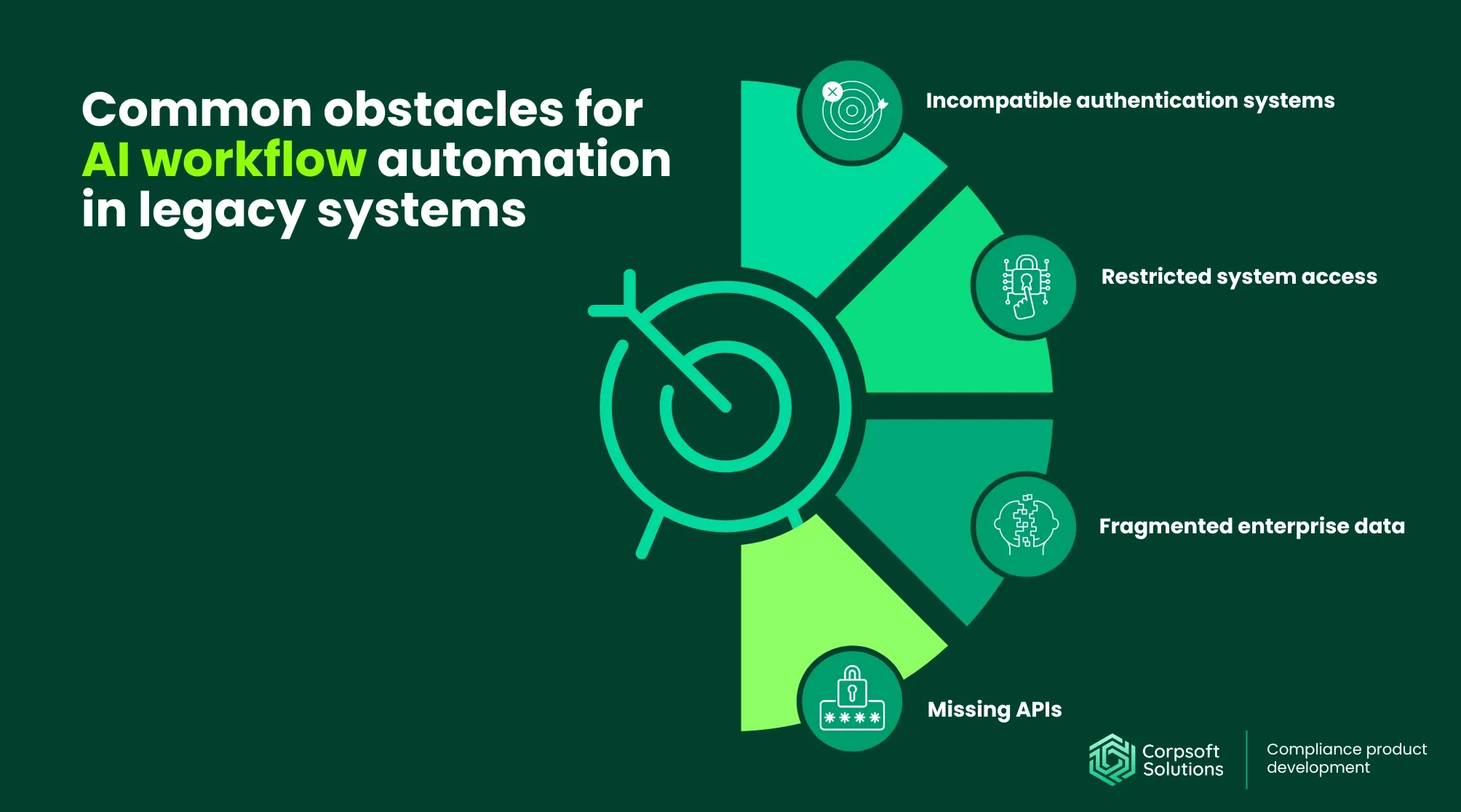
This mismatch can create several obstacles for agent-based AI systems for workflow automation, including:
- Missing APIs: legacy systems often lack modern application programming interfaces, making it difficult for AI agents to access data or trigger actions programmatically.
- Restricted system access: older platforms may limit external connections or integrations, preventing automated tools from interacting with core functionality.
- Fragmented enterprise data: critical information may be spread across multiple disconnected systems, requiring additional integration layers before AI agents can use it effectively.
- Incompatible authentication systems: legacy security mechanisms may rely on outdated authentication methods that do not align with modern identity and access management standards.
Research on agentic AI for enterprise frequently identifies integration with existing systems as one of the primary technical challenges organizations face when adopting AI technologies.
The real cost of the “Legacy Gap”

The legacy gap introduces both technical and operational costs when organizations attempt to deploy autonomous agents in AI
- Technical costs. Developers often need to build custom integration layers — APIs, middleware, or data connectors — to enable AI agents to interact with legacy systems. In many cases, older platforms were not designed for programmatic access, which means additional engineering effort is required to expose system functionality and ensure reliable communication between modern AI tools and existing infrastructure.
- Operational costs. Legacy systems typically require ongoing maintenance and specialized expertise. Organizations may rely on older programming languages, outdated frameworks, or internal knowledge held by only a small number of engineers. This can slow development cycles and make it harder to introduce new technologies, including AI-driven automation.
- Strategic costs. Integration complexity can delay the development of autonomous AI agents enterprise or limit their scope. When connecting AI systems to legacy platforms becomes too resource-intensive, organizations may postpone adoption or restrict AI deployment to isolated use cases rather than integrating it into core business processes.
For example, research from Deloitte indicates that 35% of AI leaders cite infrastructure integration as the biggest challenge in adopting AI, highlighting how connecting new AI systems with existing enterprise infrastructure remains a major barrier to scaling AI initiatives.
Integration architecture patterns for AI autonomous agents

To address the challenges we outlined earlier, organizations are adopting architectural patterns that allow AI agents to interact with complex enterprise systems.
#1 API Enablement: the most common integration layer
One of the most widely used approaches for autonomous AI agents development is exposing system functionality through application programming interfaces.
APIs allow AI agents to perform actions such as:
- retrieving customer information from CRM systems
- updating inventory records in ERP platforms
- retrieving financial data for analysis
- submitting service requests
Application modernization guidance from Google Cloud emphasizes that APIs are one of the most effective ways to enable communication between legacy systems and modern applications. Once APIs expose system functionality, AI agents can call them as tools during task execution.
#2 Middleware and integration layers
In more complex enterprise environments, organizations often introduce middleware platforms that sit between AI agents and existing software systems. These middleware layers act as integration hubs, enabling communication between multiple applications, databases, and services without requiring direct connections between every component in the system.
Middleware platforms typically handle several important functions:
- route requests between different systems
- manage authentication and permissions
- transforms data formats from legacy systems into structured files that AI-powered agents can process more easily.
Another important role of middleware is workflow coordination. When AI agents execute multi-step tasks involving multiple systems, middleware can orchestrate these interactions and ensure they occur in the correct order.
By introducing a middleware layer, companies can gradually expand enterprise agentic AI integration without modifying each legacy platform individually. This approach reduces the complexity of large-scale integrations and allows organizations to modernize their architecture incrementally.
#3 Agent platforms as an integration hub
Another emerging pattern in building AI solutions for businesses is the use of dedicated agent platforms that manage interactions between AI agents and enterprise systems. These platforms provide a centralized environment where agents can access tools, data sources, and software services across the organization.
Agent platforms typically include several core components:
- Tool registry. A catalog of available services and APIs that agents can call when executing tasks.
- Connector libraries. They simplify integration with common enterprise systems. Instead of building every integration from scratch, developers can use prebuilt connectors that allow agents to interact with widely used software platforms.
- Task orchestration. Agent platforms help manage how agents plan and execute multi-step workflows, ensuring that tasks are performed in the correct sequence and that errors or interruptions are handled appropriately.
By centralizing these capabilities, agent platforms simplify the integration of enterprise agentic AI into legacy environments. They help organizations manage integrations through a single platform that coordinates workflows across their existing software ecosystem.
Designing reliable multi-agent AI for workflow automation

Even with the right architecture in place, organizations must design workflows carefully to ensure that AI agents operate reliably and securely and are aligned with business objectives. For this reason, enterprises need to define clear operational boundaries for AI agents and ensure that automated workflows remain transparent and controllable.
Mapping AI agent capabilities to enterprise processes
Successful deployment begins with identifying tasks that autonomous agents AI can realistically perform within existing enterprise workflows. Organizations typically start by analyzing business operations and identifying discrete tasks that can be reliably executed by an agent.
In practice, this involves several steps:
- Breaking business processes into discrete steps. Complex workflows are divided into smaller actions such as retrieving data, generating reports, updating records, or triggering notifications.
- Identifying the systems involved in each step. Enterprises determine which platforms store the required information or execute the necessary operations, such as CRM systems, ERP platforms, internal databases, or analytics tools.
- Defining the APIs or tools that agents must access. Developers specify the interfaces that allow agents to retrieve data, trigger actions, or interact with enterprise software.
This structured approach ensures that autonomous AI agents operate within clearly defined boundaries and that their actions align with existing operational processes. It also makes workflows easier to test, monitor, and improve over time as organizations expand the scope of automation.
Handling data fragmentation
One of the most common challenges in enterprise environments is data fragmentation. Information relevant to a single workflow may be distributed across multiple platforms, including transactional databases, analytics systems, document repositories, and internal knowledge bases.
As a result, AI-powered agents often need to retrieve information from several sources before they can complete a task. For example, an agent handling a customer support request might need to access order history in an ERP system, retrieve previous interactions in a CRM platform, and consult internal documentation in a knowledge base.
Typical enterprise data sources include:
- Structured databases: operational systems that store transactional data such as customer records, financial information, or inventory data.
- Analytics platforms: systems used for reporting, dashboards, and business intelligence insights.
- Document repositories: collections of reports, contracts, manuals, and internal documents that may contain relevant information.
- Knowledge bases: internal documentation platforms that store procedural guidance, troubleshooting steps, and institutional knowledge.
To work effectively in such environments, AI agents are often combined with retrieval systems, data pipelines, and integration layers that consolidate information from multiple sources. These mechanisms allow agents to access the data they need while maintaining consistency and data integrity across the organization.
Defining security and compliance considerations
Unlike traditional automation scripts, a workflow automation AI agent can dynamically decide how to perform tasks, which makes governance and oversight particularly important.
The key requirement is action traceability: every action performed by an AI agent should be logged and traceable. Detailed logs allow organizations to track what the agent did, which systems it accessed, and why a particular action was executed.
Another important consideration is risk management. Enterprises must define clear boundaries on which actions agents are allowed to perform and under what conditions. Sensitive operations may require additional safeguards, including approval checkpoints or human-in-the-loop validation.
To mitigate these risks, organizations typically implement several governance mechanisms:
- Role-based access controls (RBAC) define which systems, data sets, and actions an AI agent is authorized to access based on predefined roles.
- Activity logging and monitoring records every action performed by an agent so administrators can review system behavior and maintain a complete audit trail.
- Model output verification validates AI-generated outputs before they trigger system actions, using rule-based checks, secondary models, or human review to prevent incorrect or unsafe decisions.
- Approval workflows require human validation before agents execute high-impact actions such as financial transactions or configuration changes.
- Compliance monitoring ensures automated workflows adhere to regulatory requirements, internal policies, and industry security standards.
Explore our evaluation criteria for building AI agents in one of the most regulated industries: finance! Read the article
Helping enterprises successfully deploy AI agents

Successfully deploying AI agent workflow automation tools in enterprise environments requires more than simply integrating a model into existing systems. Organizations must approach adoption strategically, balancing technological capability with operational constraints, governance requirements, and infrastructure limitations.
#1 Start with high-leverage integration points
One of the most effective ways to introduce AI agents is by focusing on workflows where automation can deliver immediate operational benefits. These are typically processes that involve repetitive tasks, interactions across multiple software systems, or large volumes of data processing, such as:
- internal reporting workflows
- customer support ticket management
- IT operations monitoring
- data aggregation tasks
In many organizations, employees spend significant time manually retrieving information from different systems, compiling reports, or updating records across platforms. AI agents can automate these activities by coordinating data retrieval, performing analysis, and generating outputs automatically.
The potential impact of such automation is substantial. Research from Gartner suggests that by 2027, 50% of business decisions will be augmented or automated by AI systems, reflecting a shift toward data-driven, automated operational workflows.
Read more: How and where using AI agents in healthcare will generate the most revenue? Explore the insights
#2 Build an incremental integration roadmap
Agentic solutions AI integration scale continues to grow each day as enterprise software environments become more interconnected. Attempting to integrate AI agents across all systems simultaneously can introduce unnecessary complexity. Instead, organizations typically develop a phased integration roadmap that gradually expands agents’ capabilities.
The process often begins with pilot projects that connect AI agents to a limited number of systems through APIs or middleware layers. These early deployments focus on validating integrations, testing model outputs, and identifying operational risks before broader adoption.
Analysts expect this trend to accelerate. Gartner predicts that 40% of enterprise applications will include task-specific AI agents by 2026, compared with less than 5% in 2025.
Developing a phased roadmap allows organizations to prepare for this shift while minimizing disruption to existing systems.
#3 Align teams, infrastructure, and data governance
AI agent workflow automation software development for environments requires coordination across multiple teams, including IT departments, engineering groups, security teams, and business stakeholders.
Governance frameworks are equally important. Organizations need clear policies defining how AI agents interact with sensitive data, which actions require human oversight, and how automated decisions are audited. These safeguards help maintain trust in automated systems while ensuring compliance with regulatory requirements.
Because autonomous decision-making will increasingly shape enterprise workflows, organizations must ensure that technical infrastructure, governance policies, and operational teams evolve together.
#4 Preparing existing systems for AI agent integration
Before AI agent workflow automation tools can operate reliably within enterprise environments, organizations must ensure that their existing systems are technically prepared to support automated interactions.
Preparing systems for AI agent integration typically involves evaluating several core aspects of enterprise infrastructure:
- API maturity. Enterprise systems should expose their functionality via stable, well-documented APIs. Mature APIs allow AI agents to retrieve data, trigger workflows, and update records programmatically without relying on fragile workarounds such as UI automation or manual scripting.
- Data accessibility. Agents must be able to access relevant data across operational systems, analytics platforms, and document repositories.
- Identity and access control. Autonomous AI agents interacting with enterprise systems must operate within established identity management frameworks. Role-based access controls, service accounts, and authentication protocols help ensure that agents access only authorized systems and perform only permitted actions.
- Monitoring and logging. Organizations need mechanisms to track AI-enabled interactions with enterprise systems. Comprehensive logging allows administrators to monitor agent activity, audit automated actions, and identify potential issues or unexpected behavior within workflows.
- System boundaries. Defining clear operational limits is essential for safe automation. Enterprises must determine which systems agents can access, which processes can be automated, and where human oversight is required to prevent unintended outcomes.
How can Corpsoft Solutions assist you in building reliable autonomous AI agents for enterprises?
Successful implementation and adoption of AI agents depends on integrating those agents with existing software systems, ensuring reliable access to enterprise data, and establishing governance frameworks that maintain security and operational control.
Here’s how Corpsoft Solutions can help organizations address these challenges by providing the technical expertise and integration capabilities needed to build and deploy AI agents that operate effectively within complex enterprise ecosystems.
- Bridging the gap between modern AI technologies and legacy software infrastructure. Many operational systems were not originally designed to support automated interactions through APIs or data pipelines. Corpsoft Solutions works with organizations to evaluate their existing architecture and design integration layers that allow autonomous AI agents to interact safely and efficiently with enterprise platforms.
- Preparing enterprise systems for AI-driven workflows. This includes improving API maturity, ensuring data accessibility across operational platforms, and establishing secure identity and access management frameworks for AI agents.
- Establishing governance and observability frameworks. Even the best autonomous AI agents must operate within clearly defined boundaries, with mechanisms in place to monitor actions, verify outputs, and maintain auditability. Our expert team supports the implementation of monitoring and logging systems that track agent behavior across workflows, allowing organizations to maintain visibility into automated processes and ensure compliance with internal policies and regulatory requirements.
- Designing scalable agent architectures. Rather than focusing on isolated AI solutions, the goal is to build multi-agent AI for workflow automation where agents coordinate workflows across multiple systems and departments.
With Corpsoft Solutions as your technological partner, you can move from experimental AI deployments to reliable, production-ready agent systems that deliver measurable operational value.
Conclusion
AI agents are rapidly becoming an important component of modern enterprise software environments due to their capability to interpret goals, retrieve information from multiple systems, and execute multi-step workflows with minimal human intervention. This makes agentic AI particularly valuable for organizations looking to streamline operations, reduce manual work, and improve decision-making across complex digital ecosystems.
However, the success of AI agent adoption depends largely on how well these systems integrate with existing enterprise infrastructure. Many organizations still rely on legacy platforms and fragmented data environments, which means deploying AI agents requires careful planning, integration layers, and strong governance mechanisms.
By focusing on API accessibility, data integration, security controls, and workflow monitoring, enterprises can gradually introduce agent-driven automation without disrupting critical systems. With the right technical foundation and implementation strategy, AI agents can evolve from experimental tools into reliable operational assistants that help organizations automate processes, improve efficiency, and unlock new value from their existing technology environments.
Share this post: