



Best Practices for Implementing Mental Health Accounting Software with HIPAA and PCI DSS Compliance
Accounting is a crucial part of running a mental health facility, since clinics work with sensitive patient medical data. It adds a whole new layer of specific challenges, putting even more responsibility on your shoulders.
Medical and financial information are the most sensitive data since cybercriminals can use it to blackmail people and steal their money. While a compromised credit card number can be replaced, a leaked diagnosis (especially a mental one) can be used for blackmail.
That’s why you need to protect both financial and medical data with the same precision. But how to ensure that you do your best? Follow the latest HIPAA and PCI DSS standards.
These frameworks govern data privacy, security, and the protection of payment transactions. Ignoring them can result in data leakage, hefty fines, reputational damage, or even the closure of your practice. And nobody wants that, right?
So let’s explore how these compliance frameworks work together to protect your practice and your patients.
Why do you need to integrate HIPAA and PCI DSS?
Since you are handling two of the most sensitive data types, your accounting system should be 100% secure. If you slip up even once, you risk losing clients’ trust and facing heavy penalties.
Thus, most mental facilities leverage HIPAA and PCI DSS frameworks to form a unified security framework. Ignoring them can lead to millions of dollars, reputational loss, and even lawsuits.
So, let’s break down what these two frameworks actually are and how to ensure that you follow their guidelines.
HIPAA: The foundation of medical data protection
HIPAA (Health Insurance Portability and Accountability Act) is a U.S. federal law that sets the standards for storing, processing, and transmitting medical information. Its focus is the protection of PHI (Protected Health Information), which is basically any data that can potentially identify a patient.
To ensure that you are adhering to HIPAA principles, follow these guidelines:
- Ensure full encryption and secure transmission by encrypting PHI at rest and in transit to avert unauthorized access.
- Remote-based access, so only authorized staff have access to sensitive information.
- Activity logging and audit trails, where you document every access attempt and edit. In case of a leak, it will be easy to find a responsible person.
- Continuous risk assessment with regular security evaluations helps you detect vulnerabilities early.
HIPAA compliance also involves staff training, defining internal policies, and ensuring that every vendor or subcontractor handling patient data follows the same standards.
PCI DSS: Safeguarding Payment Transactions
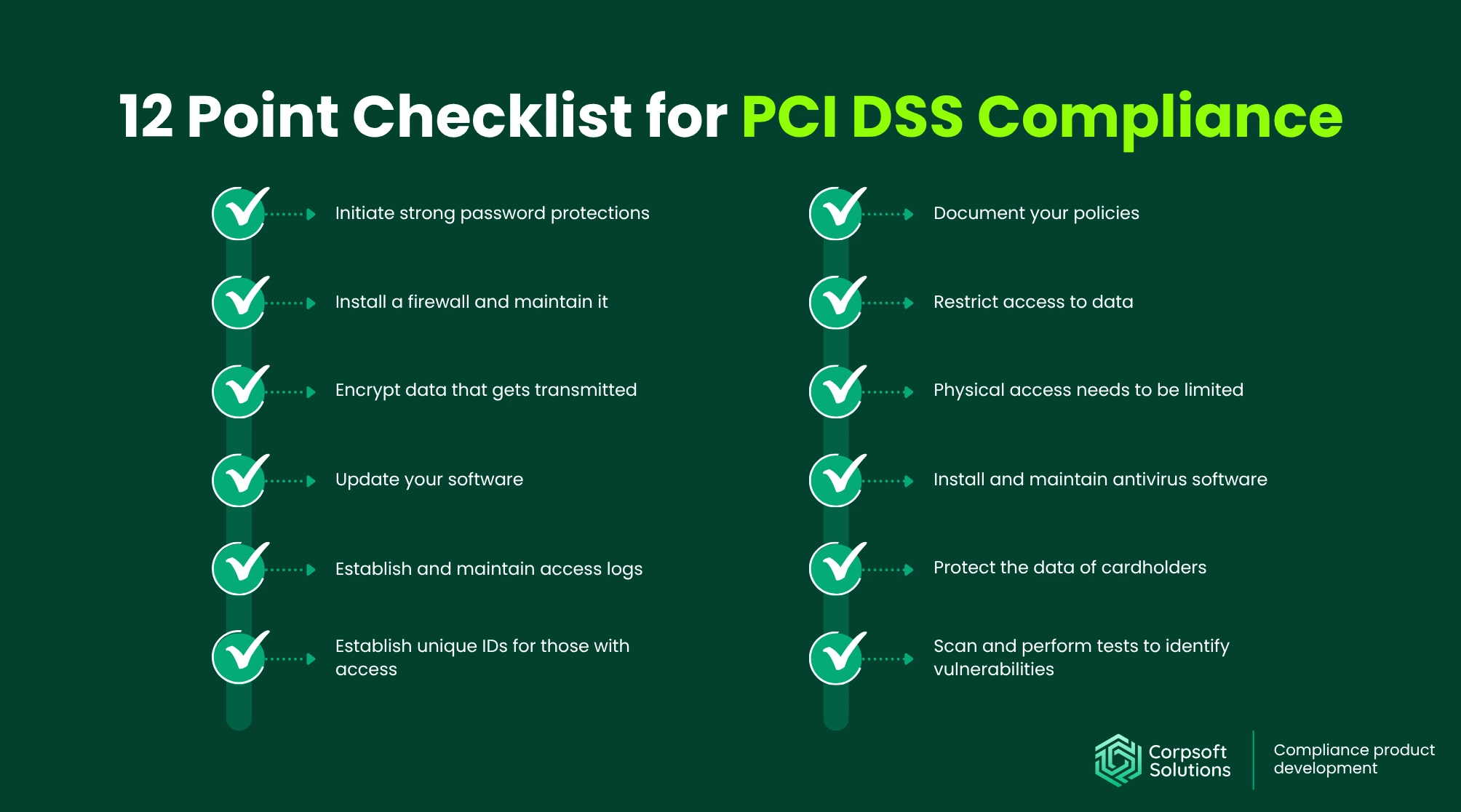
PCI DSS (Payment Card Industry Data Security Standard) is an international framework developed by major credit card companies to ensure the secure handling of card information.
In your context, PCI DSS compliance ensures that payments for consultations, therapy sessions, or subscriptions are processed safely. It protects both clients and businesses from fraud or data theft.
As a mental health facility, you need to stick to these PCI DSS requirements:
- Protect data by using tokenization or encryption by replacing any potentially sensitive details with tokens. Also, you can encrypt them before storage to minimize the risk of exposure.
- Use segregation of systems to prevent cross-contamination during a breach.
- Develop multi-layered access control where only designated employees or systems can handle payment data.
- Implement regular testing to ensure resilience against evolving threats.
Together, HIPAA and PCI DSS frameworks can help you to create a system that covers every layer of a mental health practice. When integrated properly, they not only prevent breaches but also reinforce a clinic’s reputation as a safe, responsible, and professional institution.
5 Best Practices for Implementing Accounting Software in Mental Health
To make accounting secure, ensure that all your staff follow best security practices. That way, you can minimize even the potential of a data breach, ensure compliance with HIPAA and PCI DSS, and create a reliable environment for daily operations. Let’s explore five best practices in detail.
Choose Software Built for Compliance
It’s the most critical step since a poor choice can cost you reputation or even freedom. Serious PHI breaches can lead to criminal charges, with jail time possible for willful violations. So it’s safer to choose compliant software.
| Point to consider | Why it so important |
| HIPAA and PCI DSS certifications | It’s proof that the system meets the latest protection standards. |
| Integration with medical systems (EHR/EMR) | Secure data exchange with minimal risks. |
| Logging and monitoring features | It improves transparency and accountability. |
| Regular updates and patches | Continuous vendor support ensures that they provide you with an up-to-date version with the latest security patches. |
It would be perfect if your software provider offered detailed documentation outlining all security mechanisms and compliance measures of your tools. It also simplifies internal audits and strengthens your due diligence processes.
Use Encryption and Multi-Layered Security

Secure software is always encrypted. The type and complexity of encryption may vary, but reliable software nonetheless protects all data within it.
So, you need to ensure that the chosen tool safeguards the data both “at rest” (in databases, backups, and local storage) and “in transit” (when data is being transmitted over networks or shared with integrated systems).
However, it’s not enough just to encrypt data. A resilient system employs multi-layered protection to mitigate risks associated with human error and unauthorized access.
So, to ensure extra cybersecurity of your mental health facility, implement:
- Multi-factor authentication (MFA) adds an extra layer of verification to prevent account hijacking.
- VPN for remote access, so your therapists can work even when they are physically far from the office.
- Automatic session timeouts. Once the tool sees that the user isn’t active for a predetermined amount of time (e.g., 10 minutes), it automatically ends the session to reduce the chances of unauthorized use.
- Regular password rotation policies help you ensure that no one can reuse compromised credentials.
Combining precise encryption with layered defense creates a robust barrier against both internal and external threats.
Access Control: Roles and Permissions
In mental health, organizations deal with multiple types of highly sensitive data. It means that you need to stick to the golden rule of data security: limit access as much as possible.
We highly recommend that you implement role-based access control (RBAC), where each employee is granted only a fraction of permissions. For example:
- Accountants can access financial transactions and reporting only.
- Therapists see the medical records of assigned clients.
- Administrative staff view only the minimal data needed for scheduling and operations.
This approach minimizes the risk of data exposure while strengthening traceability and accountability.
Conduct Regular Security Audits
Attackers are becoming even trickier, so they can breach your system through minor vulnerabilities. That’s why you need to conduct regular audits, testing, and security updates.
| What you should implement | Why do you need it |
| Internal reviews of activity logs | That way, you can monitor and analyze data access patterns |
| Penetration testing | Simulation of real attacks helps you determine vulnerabilities early |
| Regular examination by independent auditors | They’ll give you an outside perspective, since they can identify subtle issues that internal teams may simply overlook |
Train Your Staff, as They Are Your First Line of Defense
The human factor is one of the weakest links in any security chain. Even the most advanced software can’t protect data if employees mishandle sensitive information. Thus, you must conduct regular staff tracking and training.
Here are 4 key topics for data security training for health facility staff:
- Password and authentication hygiene, where they’ll learn how to create, store, and rotate passwords.
- Social engineering and phishing training, so your team will learn how to identify and report suspicious emails or links.
- Sensitive data storage sessions should teach your team how to work with such information.
- Incident response training, so your staff won’t get lost in case of a real incident.
A well-trained team acts as the first layer of protection for both your business and your clients. When security awareness becomes the core of your company, you’ll see how the reliability and compliance posture of your organization skyrockets to unprecedented heights.
The Benefits of HIPAA and PCI DSS Compliance Implementation
Implementing accounting software with HIPAA and PCI DSS compliance gives you tangible business, security, and operational advantages. A properly chosen system can streamline all the workflows, yet ensure that your doctors provide ethical and efficient care to the patients.
Building and Maintaining Patient Trust
Patients in the mental health field are particularly sensitive about their privacy. Nobody wants information about their diagnosis or therapy sessions to end up outside the facility. In some cases, data leakage could cost your patients their careers. That’s why you need to show your clients that their financial and personal data will be safe with you.
This reassurance builds confidence, enhances credibility, and sets the clinic apart from competitors. Patients are more likely to return, refer others, and leave positive reviews when they know that you securely handle their data.
Seamless Financial Operations and Payment Security
Becoming PCI DSS compliant ensures that all transactions in your facility are processed safely and efficiently. It eliminates payment disruptions, card blocks, or lost transactions, which can harm both patients and providers.
For clinics, this means a steady cash flow, reduced risk of fraud, and accurate control over income and expenses. For patients, it means peace of mind since they know that their card data is safe.
Avoiding Legal and Regulatory Risks

Non-compliance with HIPAA or PCI DSS can lead to serious penalties, lawsuits, and even suspension of your business. You can reduce risk exposure by simply using a compliant accounting solution. Once you document security policies, audit trails, and compliance logs, you simplify your future audits.
In other words, compliance doesn’t just protect you from fines. Being compliant shows your clients that you are a professional who is taking care of your patients in all aspects.
Operational Efficiency Through Automation
Modern accounting has already become a powerful automation tool. It can manage payment tracking, generate financial reports, oversee billing cycles, and even integrate directly with medical records (EHR/EMR).
Such automation saves the time of your team, minimizes human error, and boosts the clinic’s efficiency. Instead of spending hours manually entering data, staff can focus on what truly matters: delivering care and supporting patients.
Conclusion
Those healthcare facilities that want to stay successful in the ever-changing landscape should leverage the latest safety measures, such as HIPAA and PCI DSS compliance. They are the foundation of clients’ trust, business stability, and patient safety.
A truly compliant system protects sensitive data, prevents costly penalties, ensures smooth financial operations, and enhances the overall efficiency of your clinic. If you want to see a constantly growing stream of clients, you need to both hire top-notch therapists and secure patient data. That way, your clients will know that they are totally safe with you, which helps you gain trust and become a leader in your area or niche.
Plan to implement accounting software for your mental health practice? Save yourself time and effort by collaborating with compliance experts, such as the Corpsoft Solutions team. We can help you navigate regulations, reduce risks, and create a secure, efficient system tailored to your clinic’s needs.
Share this post: