



4 Incredible Ways to Use OCR in Healthcare: Automation That Saves Hours
In a clinic, doctors, nurses, and admins deal with piles of paper, from patient records to lab results and insurance forms. This flow of documents never ceases, so your team must continually enter new data into the system.
Manual processing typically requires 2-5 minutes per document, accumulating significant time costs. This repetitive work increases fatigue, which can lead to errors ranging from minor data duplicates to potentially serious mistakes in patient information.
Smart clinics already save time and prevent potential entry mistakes by implementing optical character recognition (OCR) software. It “reads” paper files and automatically turns them into digital records that you can process, store, and analyze immediately. Let’s examine how this technology can help you in 2025!
What is OCR?
Optical Character Recognition is a technology that allows a computer to “read” text from paper documents or PDFs and convert it into a digital format. In other words, it acts like a scanner that automatically analyzes the context on the paper and fills the corresponding fields within the digital document/database.

If you are old enough to remember Adobe Acrobat, this software is acting like “Acrobat on steroids”. While Adobe’s app simply decodes the text, and you still need to manually transfer it to the electronic system, OCR does it for you. It speeds up the creation of treatment plans, automatically saving and checking data to provide suitable insurance forms and invoices, and much more.
The technology easily integrates with EHR (Electronic Health Records) and EMR (Electronic Medical Records). So, data from any document goes straight into the patient’s digital chart, ready for analytics, reporting, and clinical decision-making.
4 Key benefits of OCR for healthcare
Even the smallest private practice generates an enormous amount of paperwork, from patient intake forms and medical histories to insurance claims and lab results. Managing this manually consumes hours, causes delays, and increases the risk of errors.
That’s why more clinics are adopting Optical Character Recognition (OCR) tools, aimed to help everyone involved. Let’s examine how these tools can help patients, doctors, clinics, and even insurance companies.
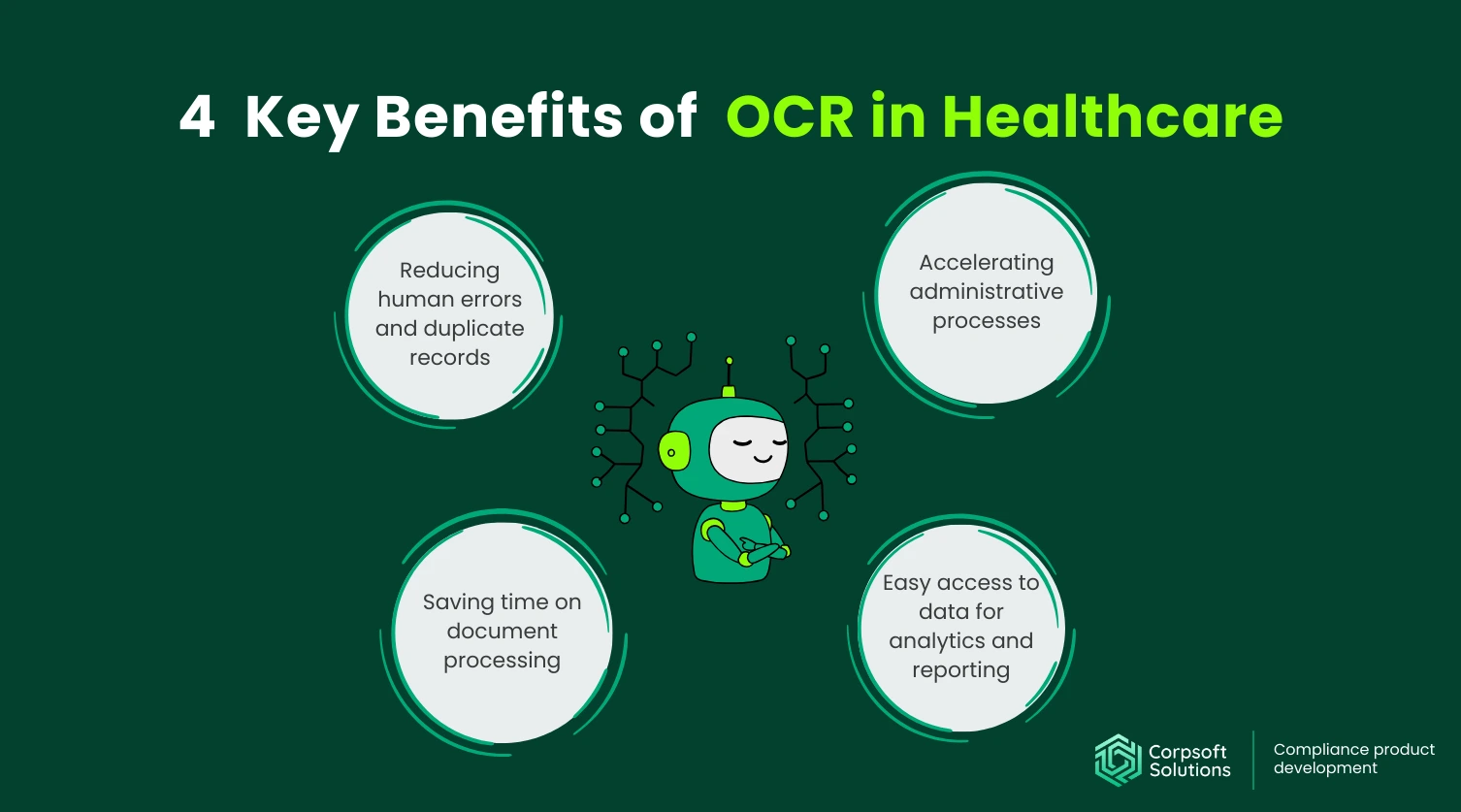
Saving time on document processing
Picture this: your admin sits down with a stack of insurance forms or patient histories. To enter them into the system, they have to open each file, read it, and manually type the data into the right fields. Depending on the patient’s history, your staff will spend at least 2-5 minutes with each paper.
Now imagine that your staff need to deal with dozens of such documents every day. It is no wonder that they make minor errors since they simply get tired. Meanwhile, OCR automates everything. Simply ask your staff to scan the stack, and the digital tool will do everything else automatically: from “reading” the data to adding it into the EHR or EMR system.
OCR tools can reduce administrative time, allowing healthcare professionals to allocate more time to direct patient care. Meanwhile, admins can handle even more clients per shift without lowering their quality of work.
Reducing human errors and duplicate records
Manual data entry is always risky. Any person can easily mix up numbers (typing 10 mg instead of 100 mg), misspell a last name, enter the same record twice, or simply lose a document in the pile. However, even those minor mistakes can have unprecedented consequences. Keep in mind that each wrong result can actually put someone’s health at risk. In severe cases, it may lead to claims or criminal charges. OCR minimizes these risks since:
- A system instantly recognizes characters and numbers. It saves HOURS of manual entering.
- Data goes straight into the right fields in the system. There is no manual entry, lowering the risks of error.
- Built-in algorithms detect duplicates. If the same document is uploaded twice, the system flags it.
If you still use old-school manual methods and put the wrong insurance policy number, the company will instantly reject the claim. So, you’ll spend extra hours to find out where you made a mistake, and then wait for weeks until insurance approves the resubmitted form. It will likely irritate your patients, so they may switch to another practice next time.
Once you implement OCR, the tool scans everything within seconds and submits a correct claim. As a result, you’ll have more opportunities for insurance approval, ultimately leading to satisfied clients.
Many healthcare facilities in North America and the EU are increasingly adopting OCR software to meet growing compliance and efficiency standards. Want to save yourself from legal trouble? Contact Corpsoft Solution, and we’ll create a digital solution tailored to your specific needs, integrating seamlessly with your CRM, EHR, and EMR.
Accelerating administrative processes
Healthcare admins are drowning in paperwork. They need to verify every single piece of data to ensure that everything is accurately entered into the system.
Meanwhile, there is no room for error in the healthcare industry. So if you want to ensure that your staff work with data fast and responsibly, implement OCR tools. You can still ask your admins and doctor to double-check the info just to be safe. But even in this case, manual paperwork will take far less time due to lower bureaucracy.
Easy access to data for analytics and reporting
Let’s say that you need a report from your clinics: how many appointments happened last month, which diagnoses were the most common, or how much patients spent on lab tests. If you don’t have a digital database, it would be a nightmare. Your doctors and admins will spend weeks digging through archives, copying numbers into spreadsheets, and analyzing data to give you insights.
With OCR, every document becomes a digital, structured record. That means all data is searchable and ready to use. Want to find every case of a certain diagnosis in a year? A couple of clicks. Need stats on lab results or costs? The system generates them automatically.
You can feed this data to your other tools to get crucial insights. It not only speeds up analytics and reporting but also makes audits and insurance checks stress-free.
Preparing for integration with other digital systems
Many healthcare institutions are already moving toward digitalization: electronic health records, telemedicine, analytics, mobile apps for patients, etc. But none of that works if your data is stuck in paper charts or PDFs.
OCR acts as the bridge between your team and AI digitalization. Optical Character Recognition technology transforms messy paperwork into structured digital data, instantly ready to load into EHR/EMR systems, connect with BI tools, link to patient CRMs, or even feed into mobile apps.
If you have a collaboration with a third-party lab, you can ask your patient to use it. Once they receive their blood or undergo the MRI, you’ll see updates in their patient card. So, even if the client forgets their lab conclusion, you can still examine it from your computer.
Increasing transparency and process control
Paper bureaucracy has always been a blind spot for healthcare workers. Documents sit in folders, someone forgets to enter data, lab results get mixed up, or a page goes missing. In the end, it’s challenging to determine who worked with the data, whether all information was accurately entered into the system, or if any data was lost during the process.
OCR changes that. You can see who uploaded the file, when, and from where. Meanwhile, you have access to the access levels. It means that only authorised users can access the data, which lowers the chances of insider data breaches.
Management can track which documents have been processed and which are still pending. Audits become easier because every step is logged automatically. And most importantly, patients gain more trust, knowing their data isn’t lost or casually edited on the fly.
TOP-4 Ways to Use OCR in Healthcare
Healthcare facilities generate substantial amounts of paperwork daily, including patient records, insurance forms, prescriptions, test results, and more. If your staff manually enters all this information into digital systems, it will take hours of their time, increase costs, and introduce a high risk of human error.
Optical Character Recognition (OCR) can change it for good. Your staff will no longer need to spend hours manually entering data. Now all they need to do is make a few clicks. Let’s examine 4 real-life situations in which these tools can help your business.

Automatic Reading and Processing of Patient Medical Records
A patient’s medical record contains a massive amount of data: diagnoses, treatment history, prescriptions, test results, etc. Even 5-10 years ago, administrators or nurses manually entered all data, reviewed every page, and sometimes even deciphered a doctor’s handwriting. All this manual labor is time-consuming and introduces a high risk of errors.
Meanwhile, OCR can scan the entire record in just a few seconds, automatically filling EHR/EMR databases. Imagine a clinic receiving 500 old paper patient records. Previously, entering all that data manually would have taken administrators a whole week. With OCR, the process is completed in under two days, with near-perfect accuracy.
Scanning and Storing Insurance Forms and Bills
Insurance documents and billing are integral to the daily routine of any clinic. Each form contains the patient’s name, policy number, dates, amounts, and procedure codes. Previously, administrators had to verify and enter every detail into the system manually. It’s a long process that is prone to errors.
With OCR, the workflow becomes effortless, as the system scans the form and immediately recognizes key fields such as patient name, policy number, dates, etc. Later, it automatically checks and verifies data for precise accuracy. If the same form is uploaded twice, the system flags it immediately.
Imagine a clinic that processes 150 insurance forms every day. Without OCR, each form would take 5–10 minutes to enter manually. It will add up to nearly 15 hours of administrative work daily. Meanwhile, with OCR, this process will take less than an hour.
Automating Prescriptions and Medical Orders
Prescriptions and treatment orders are part of the everyday workflow in any clinic. Doctors write down medications, dosages, frequency, and sometimes even specific notes for patients. Traditionally, nurses or administrators had to manually transfer this information into the system, double-checking every drug name and dosage. And if the doctor’s handwriting looked like a “cryptogram,” the process became even more complicated.
OCR makes this task effortless. It scans prescriptions or orders, recognizes drug names, dosages, intake frequency, and treatment duration, and automatically uploads the data into the system. This eliminates the need to manually check every line, dramatically reducing the risk of errors.
Imagine a clinic issuing 200–300 prescriptions daily. Without OCR, entering them manually could take several hours, with occasional mistakes such as swapped medications or incorrect dosages. OCR scans and uploads the entire batch within minutes, with near-perfect accuracy. Patients receive precise, accurate prescriptions with no risk of confusion at the pharmacy, while doctors save valuable time and administrators focus less on routine and more on oversight.
Integrating OCR with Analytics Systems for Instant Data Search
As a manager, you may want to examine the specifics of your latest procedures to better understand your target audience. You may want to see the most common diagnoses, how many patients underwent specific procedures, or how much was spent on lab tests. If this information is locked away in paper charts, PDFs, and forms, the process turns into a time-consuming quest.
OCR solves this by converting every scanned document into a structured digital database. The data instantly downloads into BI tools, EHR/EMR analytics, or CRM systems. That way, you can get access to data-driven insights within seconds.
Real-life cases of OCR in healthcare
Optical character recognition has already transformed the healthcare industry by automating one of the most mundane data entry tasks. It facilitates processes across all departments, from reception to intensive care units, by speeding up insurance claims and making patient records instantly searchable. OCR is proving its value every day.
A study published in PMC showed how OCR-based data entry systems help businesses efficiently facilitate data entry, making it a promising tool for clinical data management. The reviewed systems achieved an impressive 96.9% accuracy and saved a significant amount of time compared to manual data entry.
In another case, one large US clinic implemented an Azure-based OCR to handle more than 4 million medical claims annually. The system automatically converts scanned medical documents into standardized 837 formats, drastically speeding up processing while reducing errors.
Wrapping Up
OCR is slowly becoming a necessity for healthcare institutions. By automating data entry, streamlining administrative workflows, and providing instant access to structured information, this technology is transforming your internal workflow. It helps clinics move away from piles of paperwork, ensures critical data is never lost, and provides management with full visibility over operations.
Clinics that implement OCR can handle higher volumes of data, improve accuracy, and free staff to focus on what truly matters: patient care. Doctors can spend more time with patients instead of double-checking forms, nurses can manage treatments without worrying about manual errors, and administrators can process documents in minutes rather than hours.
Share this post: