
FDA Compliant Software Development
Validated software, ready for FDA review.
Your product gets 21 CFR Part 11 audit trails and e-signatures, IEC 62304 development documentation and premarket cybersecurity controls built in, so validation evidence grows with the code.
What Is FDA Compliance?
FDA compliance means meeting U.S. Food and Drug Administration rules for regulated products. For software, that covers 21 CFR Part 11 records and e-signatures and, for medical devices, IEC 62304 and premarket cybersecurity requirements.
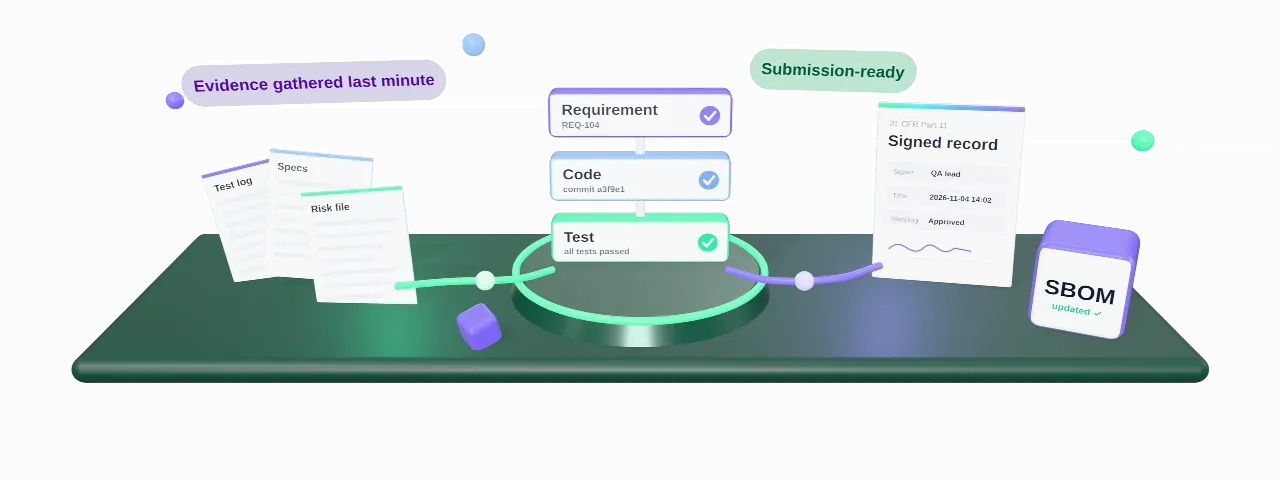
Most teams collect validation evidence right before submission, when every gap delays launch. Built-in compliance closes that gap in four ways:
Audit trails by default
Every record change is logged with who made it and when, as Part 11 requires.
Compliant e-signatures
Each signature shows the signer, the time and its meaning, linked to the record it signs.
Requirement-to-test traceability
Every requirement links to its code and test results, ready for IEC 62304 review.
Submission-ready documentation
SBOM and cybersecurity documentation update with every release.
Benefits of Choosing FDA Compliance-First Development
Avoid product recalls, shipment holds, and penalties
Use real-time FDA compliance monitoring tools
Meet all FDA labeling requirements and audit standards
Align software with FDA software regulation
Leverage medical device regulatory compliance software to automate and scale
Strengthen credibility with regulators, partners, and end-users
Ready to Build FDA-Compliant Products?
Assess Your FDA Compliance ReadinessOur Process for FDA Compliance Implementation
- 01
FDA Compliance Assessment & Gap Analysis
We evaluate your current product, system, and documentation against FDA regulatory compliance standards.
- 02
Regulatory Strategy Development
We build a product-specific roadmap that addresses FDA certification requirements, labeling, risk controls, and submission timelines.
- 03
System Integration & Validation
We implement or enhance medical device compliance software and help you meet key expectations like validation, tracking, and reporting.
- 04
Documentation & Submission Support
Our team prepares technical files, labeling content, and clinical data required for FDA regulatory certification — from 510(k) to PMA submissions.
- 05
Risk Management & Post-Market Monitoring
We guide you through FDA compliance risk management protocols and implement tools for long-term FDA compliance monitoring.
FDA Compliant Software from Day One
Bring your product or prototype. In one call, we’ll review it against Part 11, IEC 62304 and FDA cybersecurity requirements. You’ll leave with: ✓ Map of records and signatures that fall under Part 11 ✓ Gaps in traceability and validation evidence ✓ Architecture recommendations for audit trails and cybersecurity controls
Talk to AndriiFDA Compliant Software from Day One
Bring your product or prototype. In one call, we’ll review it against Part 11, IEC 62304 and FDA cybersecurity requirements. You’ll leave with: ✓ Map of records and signatures that fall under Part 11 ✓ Gaps in traceability and validation evidence ✓ Architecture recommendations for audit trails and cybersecurity controls
Talk to Andrii
Andrii Svyrydov
Founder & CEO of Corpsoft Solutions · ex-Head of Tech at a software company with 1,500+ delivered projects
Questions clients ask before we start
FAQ
“FDA cleared” refers to devices that have gone through the 510(k) premarket notification process and demonstrated that they are substantially equivalent to an already legally marketed device.
FDA compliant means a product or process meets all applicable FDA rules and FDA certification requirements for its category, including manufacturing, labeling, and safety standards.
Start by conducting a compliance gap analysis, defining your regulatory pathway, implementing FDA regulatory compliance software, validating your processes, and building the required documentation for submissions.
No. “FDA approved” typically refers to higher-risk products (like Class III medical devices or pharmaceuticals) that have undergone a full premarket approval (PMA) process. “Cleared” means it passed the 510(k) equivalency review.
FDA oversight spans a wide range of industries including food, drugs, biologics, cosmetics, tobacco, veterinary products, and FDA medical devices.
Depending on your product, required documentation may include design history files, risk assessments, testing reports, labeling content, clinical evidence, and validation records — all supported by tools like FDA compliance software or medical device compliance software.
Ready to discuss your project with us?Not sure where to start?
Drop us a line about your project or challenge — we'll take it from there.
 Typical response time1 hour on business days