
OSHA Compliant Software Development
Workplace safety records, ready for every inspection.
Your platform gets incident reporting, OSHA 300, 300A and 301 recordkeeping and electronic submission to OSHA’s Injury Tracking Application, with training records and audit logs in one place.
What Is OSHA Compliance?
OSHA compliance means meeting the workplace safety rules of the U.S. Occupational Safety and Health Administration. That includes injury and illness logs on Forms 300, 300A and 301, severe incident reports within 8 or 24 hours and annual electronic submission.
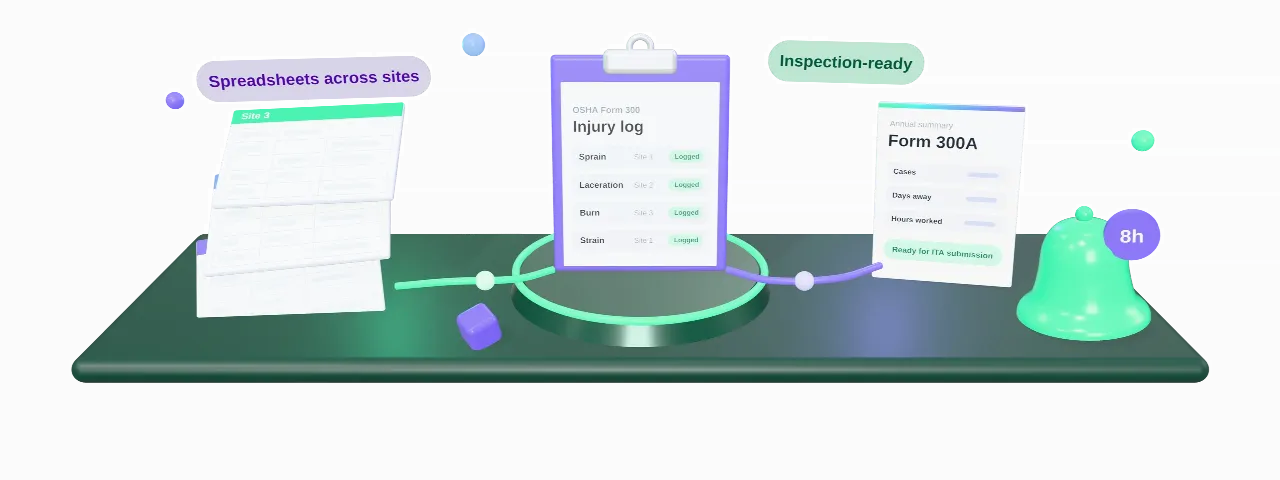
When this data sits in spreadsheets across sites, every inspection turns into a search. Built-in compliance closes that gap in four ways:
Incidents logged at the source
Every report from any site goes straight into the OSHA 300 log.
Deadline alerts
Severe incidents trigger reminders for the 8-hour and 24-hour reporting windows.
Annual submission prepared
Form 300A data is formatted for OSHA’s Injury Tracking Application.
Five years of searchable records
Logs, training records and audit history stay retrievable for as long as OSHA requires.
Benefits of Choosing OSHA Compliance-First Systems
Prevent workplace injuries and liability
Automate compliance with digital OSHA software
Pass audits using structured, documented processes
Simplify reporting with OSHA recordkeeping software
Empower your team with integrated OSHA compliance software
Align with industry-specific OSHA healthcare compliance or general safety requirements
Ready to Build a Safer, Compliant Workplace?
Assess Your OSHA Compliance LevelOur Process for OSHA Compliance Implementation
- 01
OSHA Compliance Audit & Gap Analysis
We assess your current policies, procedures, and practices using a thorough OSHA audit checklist and identify compliance gaps.
- 02
Custom Safety Strategy
Our team creates a safety action plan tailored to your operations, including OSHA small business checklist considerations.
- 03
Digital Safety Infrastructure
We implement or recommend OSHA safety software, OSHA tracking software, and OSHA record-keeping software to support automated documentation and hazard tracking.
- 04
Training & Internal Controls
We provide guidance on safety programs and integrate OSHA training software to ensure all staff are informed and compliant.
- 05
Ongoing Monitoring & Support
Stay ahead of changes with continuous access to OSHA compliance consulting, periodic reviews, and up-to-date reporting tools.
OSHA Compliant Software from Day One
Bring your EHS or HR platform. In one call, we’ll review how it captures incidents and prepares OSHA records. You’ll leave with: ✓ Map of incident data against Forms 300, 300A and 301 ✓ Gaps in reporting deadlines and electronic submission ✓ Architecture recommendations for multi-site recordkeeping
Talk to AndriiOSHA Compliant Software from Day One
Bring your EHS or HR platform. In one call, we’ll review how it captures incidents and prepares OSHA records. You’ll leave with: ✓ Map of incident data against Forms 300, 300A and 301 ✓ Gaps in reporting deadlines and electronic submission ✓ Architecture recommendations for multi-site recordkeeping
Talk to Andrii
Andrii Svyrydov
Founder & CEO of Corpsoft Solutions · ex-Head of Tech at a software company with 1,500+ delivered projects
Questions clients ask before we start
FAQ
OSHA compliance entails adhering to the Occupational Safety and Health Administration’s regulations to ensure a safe and healthy working environment, encompassing hazard control, training, record-keeping, and reporting.
Being OSHA-compliant or certified protects your workforce, prevents legal trouble, boosts morale, and strengthens your public image.
Penalties can range from thousands to hundreds of thousands of dollars, depending on the severity of the violation, and may include operational shutdowns.
Conduct a safety audit using an OSHA inspection checklist, identify risks, implement required safety protocols, provide employee training, and maintain accurate records using OSHA recordkeeping software or OSHA tracking software.
Construction, manufacturing, healthcare, warehousing, and logistics are among the most heavily regulated under OSHA regulatory compliance.
Businesses with fewer than 10 employees or in low-risk industries may qualify for OSHA exemptions for small businesses, but certain types of incidents must still be reported. Always verify based on your NAICS code.
Ready to discuss your project with us?Not sure where to start?
Drop us a line about your project or challenge — we'll take it from there.
 Typical response time1 hour on business days