
DevSecOps Services
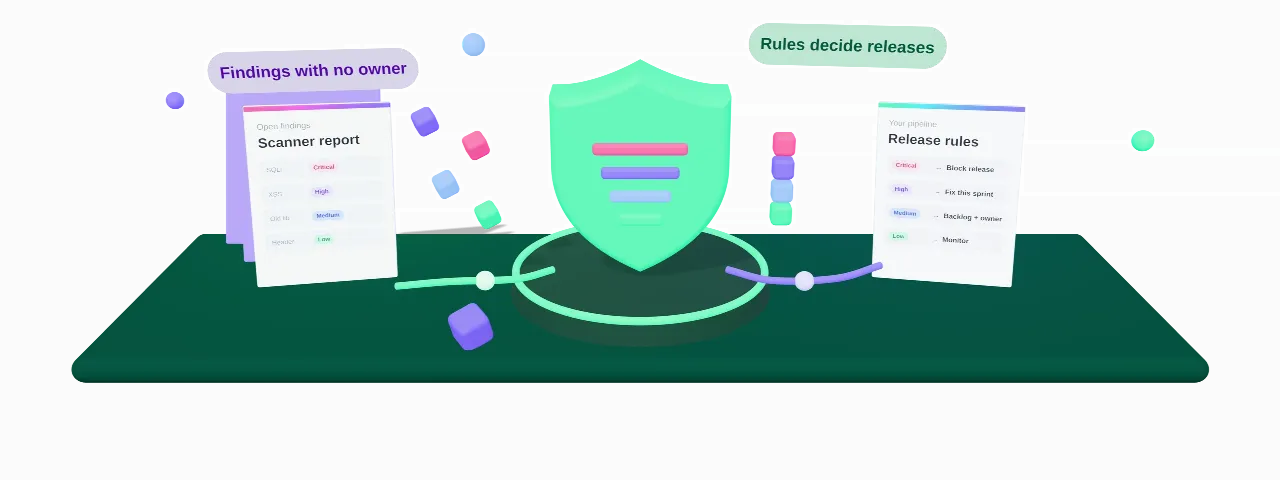
Your pipeline runs security scans. Who decides what actually blocks a release?
Most teams bolt a scanner onto CI/CD and call it DevSecOps. Findings pile up, and nobody owns the call on what’s critical enough to stop a deploy. Your pipeline gets security gates, root-cause fixes and clear release rules, so every blocked deploy has a reason your team can defend.
 Security gates in CI/CDAWS Partner, Select TierCompliance mapped into every gateFixes at the root cause
Three signs your DevSecOps stops at the scanner
Most CI/CD pipelines run a scan. Fewer act on it, and a pull request with a critical flaw merges like any other. Here’s how that sounds from inside the team:
A scanner that never blocks
We run a scanner. Nobody's ever actually blocked a merge because of it.
A backlog nobody owns
We have hundreds of open findings, and nobody’s sure which ones matter.
Same issue, next sprint
We patch the symptom the scanner flags. The same root cause shows up again next sprint.
What DevSecOps as a service actually means here
Security decisions happen inside your pipeline: at commit, at build and at deploy. Where your risk tolerance calls for it, a high or critical finding blocks the pull request until it’s fixed.
Commit & Build Gates
Secret scanning and linting on every commit, SAST and container image scanning on every build, with tools like SonarQube, Semgrep and Trivy matched to your stack.
Deploy-Time Policy Enforcement
Policy checks and infrastructure validation run before anything reaches production, and a failed check stops the release.
AWS Security Stack
GuardDuty, Inspector and Security Hub configured and tuned for your environment. It’s the standard stack we run for clients under HIPAA, GDPR, PIPEDA and SOC 2.
Root Cause Remediation
The engineers who find a gap also close it at the source, with fixes prioritized by real risk.
What working with Corpsoft Solutions looks like in numbers
~80→10+
Open findings after review
On a HIPAA-compliant telehealth platform, after an AWS Security Hub, GuardDuty and Inspector review. The remaining 10 are accepted-by-design exceptions, such as a bastion host open on a management port.
100%
Audit readiness
Across our compliance engagements. If a finding tied to our work contributes to a failed audit, we fix it as part of the engagement.
6
Core regulations and standards
One pipeline covers overlapping controls across HIPAA, SOC 2 Type II, ISO 27001, GDPR, EU AI Act and NIS2, so you don’t build security twice.
7 days
To a risk assessment
From kickoff to a prioritized remediation roadmap for your pipeline.
Know exactly which findings actually block your next release.
A short scoping call maps your current pipeline, what a security gate would catch and what it takes to turn your scanner into one your team acts on.
Book a 30-Min Scoping CallThree services people mix up — what each one actually owns
These three live on the same parent page and cover related ground, but they answer different questions.
DevSecOps Services
Security decisions built into the pipeline itself — gates, automation, and the judgment calls about what blocks a release.
Vulnerability Management
Continuous scanning of your already-deployed cloud, containers, and applications, with risk-based prioritization and remediation.
Not pipeline-stage gates — this runs against what's live, not what's about to ship.
Software Security Testing
Dedicated SAST, DAST, and manual security review, mapped to OWASP Top 10 and your target compliance framework.
Not an ongoing pipeline or infrastructure service — this is a focused testing engagement.
DevSecOps Services
Security decisions built into the pipeline itself — gates, automation, and the judgment calls about what blocks a release.
Vulnerability Management
Continuous scanning of your already-deployed cloud, containers, and applications, with risk-based prioritization and remediation.
Not pipeline-stage gates — this runs against what's live, not what's about to ship.
Software Security Testing
Dedicated SAST, DAST, and manual security review, mapped to OWASP Top 10 and your target compliance framework.
Not an ongoing pipeline or infrastructure service — this is a focused testing engagement.
Most tools patch the symptom. We close the gap.
A scanner can quiet almost any finding with a rule on top: a WAF rule, a suppressed dependency, a config flag. The finding leaves the report, and the flaw stays in the system. That space is the Audit-to-Fix Gap.
Mapped, then fixed in code
We map where your pipeline stands, from no automation to fully gated, then close each finding at the source.
When a temporary block is right
If no fix exists yet, such as a zero-day with no patch, we block it in code until one ships. That’s the rare case. Everything else gets a real fix.

The human side of the gap
Pipeline gates can’t stop credentials pasted into Slack or a notebook. Most breaches involve a person somewhere in the chain, so closing the gap includes training your team on the habits that prevent the next incident.
How security moves through your pipeline
- 01
Maturity Baseline
We map where your pipeline stands today, from no automation to fully gated, against the Audit-to-Fix Gap framework — before deciding what to build first.
- 02
Commit & Build
Secret scanning and linting run on commit; SAST and container image scanning run on build, catching issues before they're merged.
- 03
Deploy Gates
Policy checks and infrastructure validation run before deploy. Where risk tolerance calls for it, high or critical findings block the merge outright.
- 04
Continuous Monitoring
Post-deploy, DAST and continuous compliance monitoring keep watching what's already live — coordinated with our Vulnerability Management service.
- 05
Root Cause Fixes
Findings get closed at the source by the engineers who found them, prioritized by real risk, not by how loud the alert was.
What you have once DevSecOps is running
Every deliverable is something your team can open, check and show an auditor.
Gated CI/CD Pipeline
High and critical findings block the merge before they reach production.
Exception Register
Every finding closed at the source, plus a documented record for the rare one that needs a temporary block.
AWS Audit Trail
CloudTrail logging and least-privilege IAM, mapped to the specific HIPAA, GDPR and SOC 2 controls they cover.
Encryption Where Data Lives
Data encrypted in transit and at rest, with workloads in private subnets.
A Documented Maturity Baseline
A record of where your pipeline stands today, re-measured as it matures.
Tuned Alerts and a Trained Team
Alerts set to what matters for your system now, and engineers who know the habits that prevent the next incident.
Trusted by growing companies, past the MVP stage
 |20+ reviews
5★/21
Check out what they have to say about working with us.
“They’ve understood the project much better than anyone else and been able to implement quick solutions.”
Corpsoft.io has excelled at quickly delivering, testing features, and finding bugs, making them a great MVP development partner. The team is budget-conscious and offers top-notch project management. Additionally, they’re very agile, available, understanding, and highly communicative.
“We could mention their technical expertise and wonderful work, but communication is their most impressive trait.”
The client has saved $200,000 and gained an incalculable amount of new business thanks to the platform’s efficiency and professional look. Corpsoft.io has delivered outstanding work, but they’ve excelled overall in project management. They use SCRUM sprints and Jira and are responsive partners.
 |20+ reviews
5★/21
Check out what they have to say about working with us.
“They’ve understood the project much better than anyone else and been able to implement quick solutions.”
Corpsoft.io has excelled at quickly delivering, testing features, and finding bugs, making them a great MVP development partner. The team is budget-conscious and offers top-notch project management. Additionally, they’re very agile, available, understanding, and highly communicative.
“We could mention their technical expertise and wonderful work, but communication is their most impressive trait.”
The client has saved $200,000 and gained an incalculable amount of new business thanks to the platform’s efficiency and professional look. Corpsoft.io has delivered outstanding work, but they’ve excelled overall in project management. They use SCRUM sprints and Jira and are responsive partners.
Turn your scanner output into a pipeline that stops bad code.
Tell us what’s in your pipeline today and what’s driving the need: an audit, a security review or a compliance deadline. We’ll map what’s missing.
Book a call with AndriiTurn your scanner output into a pipeline that stops bad code.
Tell us what’s in your pipeline today and what’s driving the need: an audit, a security review or a compliance deadline. We’ll map what’s missing.
Book a call with Andrii
Andrii Svyrydov
Founder & CEO of Corpsoft Solutions · ex-Head of Tech at a software company with 1,500+ delivered projects
Further reading on this topic
 June 23, 202626 min read
Exposed API Keys in Frontend Code: A Cybersecurity Risk Assessment Guide for CTOs
Most API key leaks start with a credential nobody knew was there. Here's what a proper cybersecurity risk assessment of your API key infrastructure actually looks like.
View more
 September 4, 202613 min read
Enterprise AI Security: What Buyers Actually Ask Before They Sign
Your SOC 2 report covers most of the vendor questionnaire, but not its AI section. What enterprise buyers ask about your model, data path and retention, and which artifacts close the review.
View more October 10, 20259 min read
How To Build Trust with Secure Accounting Software for Mental Health Practices
Learn how to ensure HIPAA- and PCI DSS compliance to confidently manage an ever-growing stream of clients.
View more


Questions clients ask before we start
DevOps focuses on shipping software reliably and fast — build, test, deploy, repeat. DevSecOps adds security as a first-class step in that same cycle, not a review that happens after the fact. In practice, that means scans and policy checks run inside the pipeline itself, with real gates on what's allowed to ship, instead of a separate security audit that happens weeks after code is already live.
A little, and that's by design, not an accident. A gate that blocks a critical finding does add a step. The honest trade-off is between shipping speed and the confidence that what ships is actually safe — and where exactly that line sits is something we scope with your team, not something we apply blindly. Most teams find the slowdown is measured in minutes on a blocked PR, not days on a delayed release.
Fix the root cause instead of suppressing the alert. Keep gates scoped to what actually matters for your risk profile, not every possible check at once — an alert system nobody can keep up with gets ignored within days. And train the team, not just the pipeline: the weakest point in most real incidents is a person reusing a password, not a line of vulnerable code.
They describe the same underlying idea — security integrated into the development lifecycle rather than bolted on afterward. The difference is emphasis: "DevSecOps" is the far more common term and usually implies security checks built into an existing DevOps pipeline, which is the model we build to.
Security gates built into your CI/CD pipeline — commit, build, and deploy — plus the AWS security stack (GuardDuty, Inspector, Security Hub) for teams running on AWS, and root-cause remediation when a gate finds something real. It starts with a maturity baseline against the Audit-to-Fix Gap framework, so the first thing we build is whatever closes the biggest gap first, not every control at once.
Yes — Corpsoft Solutions is an AWS Partner, Select Tier Services, with AWS Certified Solutions Architects on the team. GuardDuty, Inspector, and Security Hub are the standard stack we configure for clients under HIPAA, GDPR, PIPEDA, and SOC 2, tuned to your actual environment rather than deployed as a generic default.
We map where your pipeline actually stands against the Audit-to-Fix Gap framework — from no automation at all to fully gated and enforced — before recommending what to build. That baseline gets re-measured as the engagement progresses, so you can see the trend, not just a single starting score.
Directly, if it's built right. Least-privilege IAM and audit logging satisfy access-control and accountability requirements. Encryption in transit and at rest covers technical safeguards most frameworks require outright. A gated pipeline with documented exceptions gives an auditor exactly the evidence trail they're going to ask for anyway — DevSecOps done well produces compliance evidence as a byproduct, not a separate project.
Ready to discuss your project with us?Not sure where to start?
Drop us a line about your project or challenge — we'll take it from there.
 Typical response time1 hour on business days